
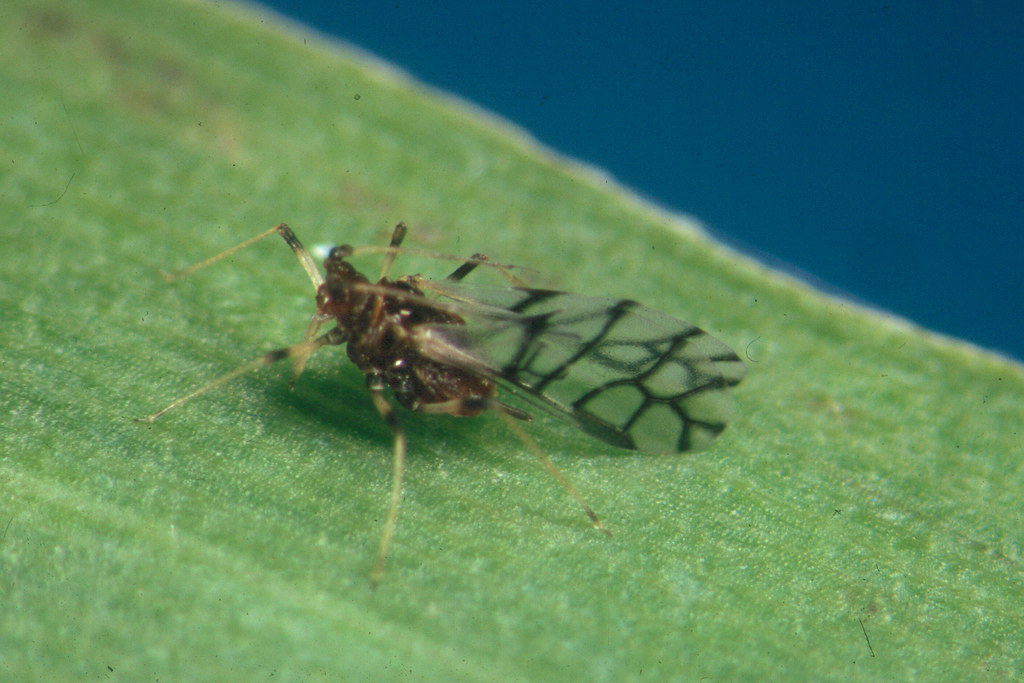
People usually talk about aphids like they are already explained. Tiny green bugs. Bad for the roses. Spray them, squish them, move on. That is not wrong. It is just a very small version of the story.
Aphidini is a tribe of aphids within the subfamily Aphidinae, containing approximately 30 genera divided into two subtribes: Aphidina and Rhopalosiphina. The tribe includes economically significant genera such as Aphis (containing the black bean aphid and cotton aphid) and Rhopalosiphum (containing the bird cherry-oat aphid and green peach aphid). Members are small, soft-bodied sap-feeding insects with complex life cycles often involving host alternation between primary woody hosts and secondary herbaceous hosts.
Atheroides is a genus of aphids in the family Aphididae, subfamily Chaitophorinae, tribe Siphini. The genus contains at least two described species: Atheroides brevicornis and Atheroides doncasteri. These aphids are found in Europe and North America.
Calaphidinae is the second-largest subfamily in the family Aphididae, comprising more than 60 genera and over 360 described species. The subfamily includes aphids primarily associated with woody host plants, particularly birches (Betula), oaks (Quercus), and related tree species in the families Fagaceae and Betulaceae. Recent molecular phylogenetic studies have substantially revised the classification of Calaphidinae, establishing eight tribal divisions and revealing that the group is paraphyletic with respect to the former 'Saltusaphidinae'. The subfamily shows complex evolutionary patterns involving host plant shifts and geographic expansion from an Eastern Palaearctic origin.
Cerataphidini is a tribe of aphids in Hormaphidinae. Its members are known for complex relationships with host plants, including gall formation on Styrax trees in East and Southeast Asia. The tribe includes host-alternating and non-host-alternating life cycles, and some species produce sterile soldier forms. Details such as body form, host use, and geography vary among its genera and species.
giant conifer aphids, conifer aphids
Cinara is a genus of aphids comprising approximately 200-243 species, commonly known as giant conifer aphids. These insects are specialized feeders on conifers in the families Pinaceae and Cupressaceae, including pines, firs, spruces, cedars, and cypresses. Molecular studies indicate their tribe Eulachnini represents the basal group for other aphids. Several species are significant pests of cultivated Christmas trees, particularly Fraser fir production in the southeastern United States.
Coccinellini is a tribe of ladybird beetles in the family Coccinellidae and subfamily Coccinellinae. It includes many genera, so the tribe does not have one uniform appearance or ecology. Research on selected species from southern Brazil documents predatory adults and immature stages and has practical value for identification and biological-control studies. The evidence summarized here applies to the tribe-level grouping and to the studied species, not automatically to every member.
Cretamyzidae is an extinct family of aphids in the hemipteran superfamily Aphidoidea. The family is known from Upper Cretaceous fossils in Canada and contains the genus Cretamyzus. Its type species, Cretamyzus pikei, was described from Upper Campanian amber in Alberta. A later fossil find placed an aphid assigned to Cretamyzidae in amber attached to a Prosaurolophus jaw, providing an unusual link between an insect inclusion, resin, and a dinosaur fossil.
Deraeocoris nebulosus is a predatory plant bug in the family Miridae. It is native to North America and has been documented from the northeastern United States through the mid-Atlantic and into the South. The species is a significant biological control agent in agricultural and ornamental systems, feeding on mites, aphids, and other small arthropod pests. It has been studied extensively for its role in managing European red mite in Virginia apple orchards.
Drepanosiphidae is a family-level name applied to a group of aphids in Hemiptera. GBIF currently lists it as an accepted family, while another modern treatment places the corresponding living group in the subfamily Drepanosiphinae within Aphididae. This difference reflects changing classification, so the name alone does not identify one body form or ecological strategy. Traits documented for a particular genus or species should not automatically be assigned to the whole group.
Greenideinae is a subfamily of aphids (Aphididae) comprising approximately 179 extant species across 18 genera in three tribes: Cervaphidini, Greenideini, and Schoutedeniini. Species are primarily distributed in eastern and southern Asia, with many exhibiting specialized associations with woody host plants, particularly in Fagaceae. The subfamily has been extensively studied for its complex symbiotic relationships with microbial associates, including the primary endosymbiont *Buchnera aphidicola* and diverse secondary symbionts.
Lachnidae is a family-level name used for a lineage of aphids in the order Hemiptera. Current references do not use the name uniformly: the Aphid Species File and several modern summaries treat Lachninae as a subfamily of Aphididae, while other classifications have ranked the group as a family. These aphids are plant-associated sap feeders, and the group includes some relatively large aphids. Because the limits and rank of the group have changed among treatments, a family-level record should be read alongside its cited taxonomic sources.
Mindaridae is a family-level name for aphids in the order Hemiptera and suborder Sternorrhyncha. GBIF accepts the family in its current backbone classification and records the name with the authorship Tullgren, 1909 in the underlying source record. The family is represented in specialist literature by genera such as Mindarus, but traits documented for one genus or species should not automatically be assigned to every member. Family-level identification therefore works best as a taxonomic placement followed by a specialist key.
Myzocallidini is a tribe of aphids in Aphididae and Calaphidinae. The detailed evidence available here focuses on Myzocallis, a Holarctic member, so its traits are not generalized to every myzocallidine. The study combines morphology, ecology, and DNA barcodes.
Ovatus is a genus of aphids in the family Aphididae, currently treated as a synonym of Ovatomyzus. The genus was historically recognized for species associated with various host plants, though modern taxonomic revisions have consolidated many of these into Ovatomyzus. Records indicate distribution in parts of Europe including Denmark, Norway, and Sweden.
Panaphidini is a tribe of aphids within the subfamily Calaphidinae, established by Oestlund in 1923. The tribe comprises approximately 50 genera divided into two subtribes: Myzocallidina and Panaphidina. Many genera are associated with woody host plants, particularly in the families Fagaceae, Betulaceae, and Salicaceae. The tribe includes economically significant pests such as species of Tinocallis and Monellia.
Pemphiginae is a subfamily-level name in the aphid classification used for a group of plant-feeding hemipterans. The group is associated with aphidoid aphids, and published treatments place the former family name Pemphigidae within Aphididae rather than treating it as a separate current family. Members are not interchangeable with one species: their appearance, host use, and life history vary among lineages. Some related woolly-aphid lineages produce waxy coverings, alternate between host plants, or form plant galls, but those traits should not be assigned to every member of Pemphiginae.
Sinaphididae is an extinct family of aphid-like insects known from the fossil record. It is placed in Aphidoidea, the aphid superfamily, within Hemiptera and Sternorrhyncha. The family was established by Zhang, Zhang, Hou and Ma in 1989. Available taxonomic records associate its original description with Late Jurassic aphids from Shandong Province, China, while one database lists a Cretaceous stratigraphic range; those records should not be treated as a modern distribution.