
Panaphidini
Oestlund, 1923
Tribe Guides
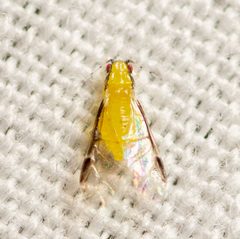
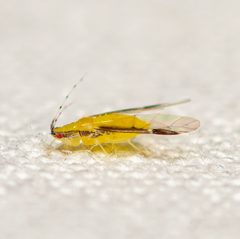
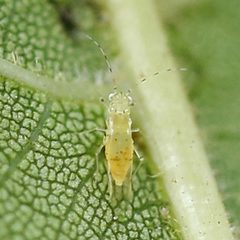
2Panaphidini is a tribe of aphids within the Calaphidinae, established by Oestlund in 1923. The tribe comprises approximately 50 divided into two subtribes: Myzocallidina and Panaphidina. Many genera are associated with woody plants, particularly in the Fagaceae, Betulaceae, and Salicaceae. The tribe includes economically significant pests such as of Tinocallis and Monellia.
Pronunciation
How to pronounce Panaphidini: /pænəˈfɪdɪni/
These audio files are automatically generated. While they are not always 100% accurate, they are a good starting point.
Identification
Panaphidini can be distinguished from other tribes by features of the Calaphidinae, including paired spinal on the and prothorax, and a characteristic wing venation pattern with the media of the forewing once-branched. Within the tribe, subtribe Myzocallidina generally includes with more pronounced tubercles and often longer setae, while Panaphidina typically shows reduced or absent spinal tubercles and more streamlined body forms. such as Tinocallis and Takecallis possess distinctive leaf-curling or marginal leaf-rolling that aid in field recognition.
Images
Habitat
of Panaphidini inhabit temperate and subtropical regions, primarily associated with deciduous broadleaf trees and shrubs. associations include oaks (Quercus), birches (Betula), maples (Acer), walnuts (Juglans), and elms (Ulmus). They occupy foliage, with many species preferring young leaves and shoot tips.
Distribution
The tribe has a broad distribution across the Northern Hemisphere, with highest diversity in the Palearctic and Nearctic regions. Several (e.g., Tinocallis, Shivaphis) have expanded ranges through human-mediated transport, establishing in regions outside their native distributions.
Diet
All are phloem-feeding on woody angiosperms. plant associations are often - or -specific; for example, Tinocallis species feed on Ulmaceae, while most Myzocallis species are restricted to Fagaceae.
Host Associations
- Quercus - primary Fagaceae; for Myzocallidina
- Betula - primary Betulaceae; for several Panaphidina
- Acer - primary Sapindaceae; for Dasyaphis and related
- Ulmus - primary Ulmaceae; primary for Tinocallis and related
- Juglans - primary Juglandaceae; for Monellia and Monelliopsis
Life Cycle
vary between holocyclic (alternating between primary woody and secondary herbaceous or woody hosts, with ) and anholocyclic (parthenogenetic year-round on a single host). Many temperate produce oviparae and males in autumn, with on bud axils of the primary host. Some species, particularly in introduced ranges, have lost the sexual phase and persist through continuous .
Behavior
Several exhibit characteristic leaf-modification : Tinocallis and related roll or curl leaf margins to form pseudogalls; Monellia and Monelliopsis feed in dense colonies on leaf undersides and produce copious honeydew. production (E-β-farnesene) has been documented in multiple species. Many species are attended by ants, though the strength of associations varies.
Ecological Role
As primary consumers, Panaphidini transfer nutrients from phloem to higher through honeydew production and as prey for and . Their feeding can induce leaf , gall formation, or shoot distortion, indirectly affecting plant growth and competitive dynamics. Some species serve as for plant viruses, though this role is less prominent than in other groups.
Human Relevance
Several are significant ornamental and forestry pests. Tinocallis platani and related species damage sycamore and plane trees in urban settings. Monellia caryella (pecan ) and Monelliopsis pecanis are major pests of pecan (Carya illinoinensis) in North American orchards, causing direct feeding damage and honeydew accumulation. Shivaphis celti is an pest of hackberry in North America.
Similar Taxa
- CalaphidiniAlso in Calaphidinae; distinguished by different arrangement of and often more reduced siphunculi
- EuceraphidiniWithin Calaphidinae; typically associated with coniferous rather than broadleaf trees, with distinct wax gland patterns
- MacrosiphiniDifferent (Aphidinae); generally lacks paired spinal on and prothorax, and often has longer siphunculi
More Details
Taxonomic stability
The tribal classification of Calaphidinae has undergone revision; some authors have questioned the monophyly of Panaphidini as currently circumscribed. Molecular phylogenetic studies suggest that subtribes Myzocallidina and Panaphidina may not form sister groups, with implications for future reclassification.
Invasive species
The tribe includes multiple introduced with expanding ranges. Tinocallis platani (sycamore aphid), native to Europe, is now established in North America, Australia, and New Zealand. Shivaphis celti (Asian woolly hackberry aphid), native to East Asia, has spread throughout North America since its detection in 2002.