
Monelliopsis pecanis
Bissell, 1983
Yellow Pecan Aphid
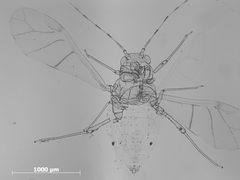
Monelliopsis pecanis, commonly known as the yellow pecan aphid, is a sap-feeding insect in the Aphididae that specializes on pecan (Carya illinoinensis). It is one of two primary 'yellow' or 'honeydew' affecting pecan production, distinguished from the blackmargined aphid (Monellia caryella) by its roof-like wing posture and lack of a black marginal stripe on the wings. typically occur later in the growing season than those of M. caryella and can cause significant defoliation, reduced nut yield, and quality degradation. The species reproduces parthenogenetically during spring and summer, with sexual forms appearing in autumn to produce .

Pronunciation
How to pronounce Monelliopsis pecanis: /mɔˌnɛliˈɒpsɪs pɛˈkænɪs/
These audio files are automatically generated. While they are not always 100% accurate, they are a good starting point.
Identification
Distinguished from the closely related blackmargined aphid (Monellia caryella) by wing posture: M. pecanis holds wings roof-like over the body and lacks the black stripe along the wing margin present in M. caryella. stages are difficult to identify to . Molecular or expert morphological examination may be required for definitive identification of nymphs. When present in mixed , the two yellow species can be separated by wing characteristics.
Images
Appearance
Small, soft-bodied insect with . Winged hold wings roof-like over the body and lack the black stripe along the wing margin that characterizes Monellia caryella. Body coloration is yellowish. Nymphs are wingless and difficult to distinguish from other yellow . Adults may be winged or wingless.
Habitat
Pecan orchards and native pecan groves. Found exclusively on pecan (Carya illinoinensis) trees, feeding on foliage. Occurs throughout the without directional or height preferences noted.
Distribution
Native to North America; recorded from Mexico and the United States (Alabama, Arizona, California, Florida, Georgia, New Mexico, Oklahoma, South Carolina, Texas). Introduced to Europe (Italy, Sicily, Portugal, including Madeira), Africa (Egypt, South Africa), and Sicily.
Seasonality
hatch in spring; nymphs feed on newly expanded leaves. typically increase later in the season compared to Monellia caryella, with commonly occurring from late summer through autumn. Sexual forms develop in late September and October, followed by oviposition of overwintering eggs in bark crevices.
Diet
Phloem sap from pecan (Carya illinoinensis) leaves, obtained through . Feeds on leaf and leaf tissue.
Host Associations
- Carya illinoinensis - obligate Exclusive plant; all life stages complete development on pecan
Life Cycle
in bark crevices on twigs and tree trunks hatch in spring. Nymphs mature in approximately one week and reproduce parthenogenetically (viviparously) throughout spring and summer, with all individuals female. Multiple occur annually. In late September and October, sexual forms (males and females) develop; females deposit overwintering eggs that persist through winter.
Behavior
Forms dense colonies on pecan foliage. Excretes honeydew—excess sugars from phloem feeding—that accumulates on leaves and serves as substrate for growth. can increase rapidly under favorable conditions due to short time and high reproductive capacity. Winged forms disperse to establish new colonies.
Ecological Role
Herbivore that can significantly impact pecan tree physiology through direct sap removal and indirect effects of honeydew production. Serves as for diverse natural enemy including (lacewings, lady beetles, predatory , hover flies) and (Aphelinus perpallidus, Alloxysta schlingeri). Honeydew production supports growth, potentially reducing photosynthetic .
Human Relevance
Significant economic pest of commercial pecan production. Late-season can cause defoliation, reduced nut fill, and decreased yield and quality. Management relies on monitoring, conservation of natural enemies, and selective applications when densities exceed thresholds (approximately 25 per compound leaf on susceptible cultivars). 'Pawnee' cultivar shows least susceptibility; 'Cheyenne' is particularly vulnerable. Insecticide applications risk disrupting natural enemy and may trigger secondary pest outbreaks.
Similar Taxa
- Monellia caryellaAlso a yellow/honeydew on pecan; distinguished by flat wing posture with black marginal stripe, and typically earlier seasonal abundance peak
- Melanocallis caryaefoliaeBlack pecan aphid; more destructive than M. pecanis, causing characteristic yellow spotting between leaf ; pear-shaped body with black or dark olive-green coloration
More Details
Cultivar Susceptibility
Susceptibility varies among pecan cultivars. 'Pawnee' demonstrates least susceptibility to yellow damage, while 'Cheyenne' is most vulnerable. Most cultivars experience crashes without intervention due to natural enemy activity or environmental factors.
Natural Enemy Associations
Associated with approximately 33 aphidophagous . Most abundant include Chrysopa rufilabris, C. quadripunctata, Micromus posticus, Coniopteryx simplicior, Olla abdominalis, Coleomegilla maculata, Hippodamia convergens, and Allograpta oblique. Primary include Aphelinus perpallidus and Alloxysta schlingeri.
Sources and further reading
- BugGuide
- GBIF taxonomy match
- iNaturalist taxon
- NCBI Taxonomy
- Catalogue of Life
- Insects and mites that feed on leaves - AgriLife Extension Entomology
- Managing Insect and Mite Pests of Commercial Pecans in Texas - AgriLife Extension Entomology
- Publications | Entomology Research Museum
- Monelliopsis pecanis . [Distribution map].
- Probing Behavior and Density of Monelliopsis pecanis, Monellia caryella, and Melanocallis caryaefoliae (Homoptera: Aphididae) on Pecan Cultivars
- SEASONAL ABUNDANCE AND DISTRIBUTION OF PREDATORS AND PARASITES ASSOCIATED WITH MONELLIOPSIS PECANIS BISSELL AND MONELLIA CARYELLA (FITCH) (HOMOPTERA: APHIDAE)1