
Chrysopa
Leach, 1815
Green lacewings, Stink lacewings
Species Guides
9- Chrysopa chi(X-marked Green Lacewing)
- Chrysopa coloradensis(Colorado green lacewing)
- Chrysopa excepta
- Chrysopa incompleta(green lacewing)
- Chrysopa nigricornis(Black-horned Green Lacewing)
- Chrysopa oculata(golden-eyed lacewing)
- Chrysopa pleuralis(green lacewing)
- Chrysopa quadripunctata(Four-spotted Green Lacewing)
- Chrysopa slossonae(Slosson's Green Lacewing)
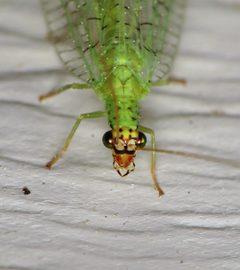
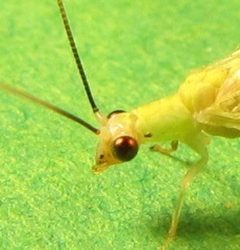
Chrysopa is a of green lacewings in the Chrysopidae, first described by William Elford Leach in 1815. Members are common across North America, Europe, and Asia. The genus is closely related to Chrysoperla, with which it shares similar characteristics and has undergone taxonomic revisions. Both genera are important in biological pest control due to their predatory larvae.
Pronunciation
How to pronounce Chrysopa: /krɪˈsoʊpə/
These audio files are automatically generated. While they are not always 100% accurate, they are a good starting point.
Identification
Chrysopa is distinguished from the closely related Chrysoperla by subtle morphological differences, though have been moved between these genera repeatedly. can be recognized by their green coloration, long filamentous , large transparent wings with dense net-like venation, and often metallic golden . Precise species identification requires examination of wing venation patterns and genitalia.
Images
Habitat
Found in a variety of vegetated including gardens, agricultural fields, and natural vegetation. are often observed on flowering plants.
Distribution
Widespread across North America, Europe, and Asia. Introduced to New Zealand in the 1890s for , but no established successfully.
Diet
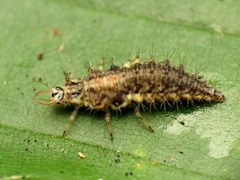
Larvae are predatory, feeding on aphids, mites, , soft scales, and other soft-bodied insects. feed on pollen, honeydew, and possibly small prey.
Life Cycle
Development time and survival of stages are influenced by environmental humidity, with higher humidity generally improving survival and reducing development time. is affected by humidity conditions during development. are laid on plant stems.
Behavior
Larvae are voracious , earning the 'aphid lions.' They have been observed engaging in . are active fliers often found on vegetation.
Ecological Role
Important agents. Larvae function as of agricultural pests, particularly aphids. The has been used in deliberate biological control programs.
Human Relevance
Used in biological pest control, with deliberate introductions attempted in New Zealand in the 1890s. Methods have been developed for field distribution of in agricultural settings. Gardeners value them for control.
Similar Taxa
- ChrysoperlaExtremely similar ; have been repeatedly transferred between these . Distinguished by subtle differences in wing venation and genitalia.
More Details
Taxonomic history
The was first described by William Elford Leach in 1815 in Brewster's Edinburgh Encyclopædia. Taxonomic boundaries between Chrysopa and Chrysoperla remain fluid.
Failed introduction
Albert Koebele introduced to New Zealand in the 1890s to combat aphids, but no Chrysopa species established successfully.
Sources and further reading
- BugGuide
- Wikipedia
- GBIF taxonomy match
- iNaturalist taxon
- NCBI Taxonomy
- Catalogue of Life
- Encyrtid Holdings | Entomology Research Museum
- Looking for Lygus | Bug Squad
- The Beauty and the Beast | Bug Squad
- Life History Traits of Chrysopa cornea and Chrysopa rufilabris (Neuroptera: Chrysopidae): Influence of Humidity
- Development of methods for field distribution of eggs of the insect predator Chrysopa carnea Stephens
- Effects of Prey-Mediated Sublethal Exposure to Imidacloprid and Nitenpyram on the Fitness and Predation Capacity in Chrysopa pallens.