
Chrysoperla
Steinmann, 1964
Common Green Lacewings
Species Guides
6- Chrysoperla comanche(Comanche Green Lacewing)
- Chrysoperla downesi
- Chrysoperla externa(green lacewing)
- Chrysoperla harrisii(Harris's Green Lacewing)
- Chrysoperla plorabunda(Weeping Green Lacewing)
- Chrysoperla rufilabris(Red-lipped Green Lacewing)
Chrysoperla is a of green lacewings in the Chrysopidae, tribe Chrysopini, containing approximately 67 described with a distribution. are characterized by a pale yellowish stripe down the middle of the body and delicate, transparent wings. The genus is notable for its use in biological pest control, as larvae are predatory and feed on aphids, mites, and other soft-bodied insects. Species identification is complicated by morphological similarity; many species are distinguished primarily by male genitalia features and species-specific vibrational courtship songs rather than external appearance.
Pronunciation
How to pronounce Chrysoperla: //ˌkrɪsoʊˈpɜːrlə//
These audio files are automatically generated. While they are not always 100% accurate, they are a good starting point.
Identification
Separation from similar green lacewing requires examination of male genitalia, specifically the combination of arcuate tignum, lack of gonapsis, and presence of spinellae on the gonosaccus. Wing venation provides additional characters: the short intramedian that does not overlap the first crossvein from the radial sector. -level identification within Chrysoperla is particularly challenging as many species are morphologically identical; reliable separation often requires analysis of species-specific vibrational courtship songs produced by abdominal vibration against substrates, or examination of male genitalia details. and mitochondrial haplotype analysis are increasingly used to distinguish cryptic species, particularly within the C. carnea which contains at least 20 species and multiple undescribed 'song species'.
Images
Appearance
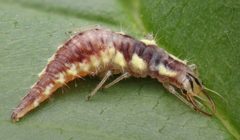
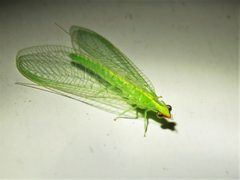
have delicate bodies with large, transparent, highly-veined wings held roof-like over the body. A pale yellowish stripe runs down the middle of the body. The short intramedian (im) in the wing does not overlap the first crossvein from the radial sector. Coloration varies seasonally; adults may appear brown, pink, or reddish in autumn and spring rather than bright green. Male genitalia contain diagnostic features: an arcuate tignum, absence of gonapsis, and presence of spinellae on the gonosaccus. Larvae are alligator-like with prominent sickle-shaped and lack the debris-carrying seen in some other chrysopid .
Habitat
Found in diverse terrestrial including agricultural landscapes, gardens, forests, and arid regions. overwinter in sheltered locations. Specific habitat associations vary by ; for example, Chrysoperla zastrowi is adapted to hot, arid environments while other species occupy more mesic conditions. Agricultural fields and greenhouse environments are common habitats due to abundant prey.
Distribution
distribution with particular abundance in Europe and North America. The occurs across temperate and tropical regions globally. Chrysoperla zastrowi, originally Afro-Eurasian, has naturalized in the southwestern United States, Mexico, and Guatemala within the last 10-15 years. The C. carnea has a holarctic distribution.
Seasonality
are active during warmer months with activity patterns varying by latitude and . Many species overwinter as adults, becoming active in early spring when temperatures permit. In temperate regions, adults may be found from March through autumn, with peak activity in summer. Some species show or multivoltine with multiple per year.
Diet
Life Cycle
Holometabolous development with , larva, pupa, and stages. Eggs are laid on stalks, typically attached to vegetation. Larvae pass through three instars before pupating in silken cocoons. Duration of developmental stages varies with temperature and . Some species overwinter as adults; others may have diapausing egg stages. among larvae can occur under crowded conditions.
Behavior
produce -specific vibrational courtship songs by vibrating their against leaves or twigs, creating substrate-borne signals. Males and females engage in duetting , with either sex initiating and the other responding; successful matching of songs leads to copulation. These songs are inaudible to humans without specialized equipment. Adults are attracted to light and may be collected at blacklights. They are active hunters, seeking colonies to oviposit near.
Ecological Role
Human Relevance
Widely used in biological pest control in greenhouses and field crops. Commercial insectaries rear multiple for sale as biocontrol agents, particularly for management. The historical conflation of multiple cryptic species under the name 'Chrysoperla carnea' has complicated biocontrol efficacy, as species vary in climatic suitability and prey preferences. Recent recognition of species-specific climatic adaptations, such as C. zastrowi's suitability for hot, arid regions, offers potential for improved matching of biocontrol agents to target environments. Some species harbor specialized gut yeasts (Metschnikowia chrysoperlae, Candida picachoensis, Candida pimensis) that may be transmitted vertically.
Similar Taxa
- ChrysopaHistorically confused with Chrysoperla; distinguished by presence of gonapsis in male genitalia and different wing venation patterns
- AtlantochrysaFormerly included Chrysoperla as a subgenus; separated by genitalic and larval characteristics
- Other Chrysopini generaShare green lacewing general but differ in male genitalia structure, particularly the combination of arcuate tignum, absence of gonapsis, and presence of spinellae on gonosaccus that define Chrysoperla
Misconceptions
The name 'Chrysoperla carnea' was historically applied to a supposedly single holarctic , but research since the 1990s has revealed this to be a complex of at least 20 cryptic species distinguishable primarily by vibrational songs and subtle morphological or genetic differences. Commercial biocontrol products labeled as C. carnea may contain multiple species with different ecological requirements, potentially reducing efficacy in target environments.
More Details
Taxonomic instability
The has undergone repeated taxonomic revision since its original description as a subgenus of Chrysopa in 1964, with placement in Atlantochrysa before elevation to full genus status in 1977 based on genitalic and characteristics. have been moved between genera multiple times during these revisions.
Vibrational communication research
Charles Henry and colleagues have conducted extensive research on -specific vibrational songs in the C. carnea complex, demonstrating that these signals function as pre-mating isolation mechanisms and providing a practical tool for species identification where fails.
Yeast associations
and harbor specialized yeasts (Metschnikowia chrysoperlae, Candida picachoensis, Candida pimensis) not found in larvae, suggesting possible and a specialized -microbe relationship of unknown ecological significance.
Sources and further reading
- BugGuide
- Wikipedia
- GBIF taxonomy match
- iNaturalist taxon
- NCBI Taxonomy
- Catalogue of Life
- Primary Type List | Entomology Research Museum
- Drought-Tolerant, Aphid-Hungry Lacewing Species Arrives in Americas
- Bug Eric: Last Night to Blacklight?
- Sulfoxaflor Found to Be Less Harmful to Beneficial Predators of Soybean Aphids
- Stories about small insects and making a big difference - Buglife Blog - Buglife
- Bug Eric: Blacklighting Already?
- Rearing of the common green lacewing, Chrysoperla carnea Stephens, in the laboratory Gojenje navadne tenčičarice (Chrysoperla carnea Stephens) v laboratorijskih razmerah
- Life History Comparison of Two Green Lacewing SpeciesChrysoperla johnsoniandChrysoperla carnea(Neuroptera: Chrysopidae)
- Metschnikowia chrysoperlae sp. nov., Candida picachoensis sp. nov. and Candida pimensis sp. nov., isolated from the green lacewings Chrysoperla comanche and Chrysoperla carnea (Neuroptera: Chrysopidae)
- A Thermo-Sensitive Molecular Switch: Pyrexia-1 Dynamically Regulates Low-Temperature Adaptation in Chrysoperla nipponensis.