
Chrysoperla comanche
(Banks, 1938)
Comanche Green Lacewing
Chrysoperla comanche is a green lacewing native to northern Mexico and the southern United States, with records extending to Canada, Chile, and Hawaii. It has been evaluated for commercial insectary production due to its non-diapausing in California's San Joaquin Valley, where remain green and continue deposition through winter months. The species is a of soft-bodied arthropods, with documented prey including aphids, leafhoppers, psyllids, whiteflies, , and cochineal insects. It has shown particular promise for in vineyard , where it was the most commonly encountered species in post-release surveys. Development occurs optimally around 29.7°C, with lower temperature threshold near 10°C.
Pronunciation
How to pronounce Chrysoperla comanche: //ˌkɹaɪsoʊˈpɜːlə kəˈmænʧi//
These audio files are automatically generated. While they are not always 100% accurate, they are a good starting point.
Identification
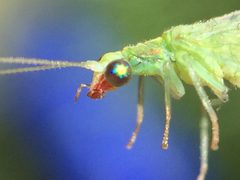
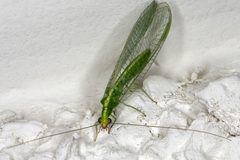
Identification to within the Chrysoperla carnea-group requires specialized techniques, as morphological differences are minimal. Historically, species in this group were considered a single holarctic species. Accurate identification of C. comanche relies on vibrational song analysis (duetting between sexes), specific morphological features, and analysis. are green lacewings with golden , typical of the . Differentiation from C. carnea and C. rufilabris in field settings may require expert examination or behavioral cues such as winter activity and preference.
Images
Habitat
California San Joaquin Valley vineyards; agricultural including grape vines, prune trees, and ground covers. Natural habitats in northern Mexico and southern USA include nopal (prickly-pear cactus, Opuntia ficus-indica) and white poplar (Populus alba) trees. Also recorded in shortgrass prairie and arid regions. have been observed in outdoor winter conditions at ambient temperatures without entering .
Distribution
Native to northern Mexico and southern USA. Recorded from Canada, USA, Mexico, Chile, and Hawaii. Specific localities include Fresno County, California; State of Mexico; and Kearney Agricultural Research and Extension Center (KREC) vineyards. GBIF records indicate presence in North America and Oceania.
Seasonality
active year-round in California's San Joaquin Valley, with continuous deposition observed from October through January. Eggs deposited in November hatched after 49–53 days at average 7.8°C. Development from egg to adult occurs from 16.7 days at 32.2°C to 56.1 days at 15.6°C; no development at 12.7°C or 36.7°C.
Diet
of soft-bodied arthropods. Larvae consume late instar leafhoppers (Erasmoneura variabilis), with approximately 250 individuals consumed during development at 26.7°C. Documented prey includes aphids (Melanaphis sorghi, M. sacchari, Chaitophorus populialbae), psyllids (Diaphorina citri), whiteflies (Bemisia tabaci), (Frankliniella occidentalis), and cochineal insects (Dactylopius opuntiae). Laboratory rearing successful on Mediterranean flour moth (Ephestia kuehniella) . fed artificial diet of whey yeast, enzymatic protein hydrolysate of Brewer's yeast, honey, and water.
Host Associations
- Erasmoneura variabilis - preyleafhopper, primary prey in vineyard studies
- Ephestia kuehniella - laboratory food sourceMediterranean flour moth used for rearing
- Opuntia ficus-indica - /associated plantnopal cactus, of cochineal insect prey
- Populus alba - /associated plantwhite poplar, of prey
- Vitis spp. - grape vines, primary agricultural
- Metschnikowia chrysoperlae - yeast isolated from digestive tract and , possible
- Candida picachoensis - yeast isolated from digestive tract
- Candida pimensis - yeast isolated from digestive tract
Life Cycle
stage: threshold temperature 10.6°C, 73.5 degree days. First instar: threshold 12.9°C, 38.5 DD. Second instar: threshold 11.5°C, 37.4 DD. Third instar: threshold 10.3°C, 44.3 DD. Pupal stage: threshold 11.0°C, 140.4 DD. Complete development (egg to ) viable at 15.6–35°C. Larval period approximately 9.6 days at 26.7°C. Adults do not appear to enter in California conditions; remain green and continue through winter. Average adult longevity 53.6 days. Mean lifetime 1087–1108 eggs, with 77.3–80.9% produced in first 30 days of reproduction. Peak egg production at approximately 10 days post-.
Behavior
exhibit non-diapausing in California's San Joaquin Valley, remaining green and continuing deposition through winter months (October–January) when other become brown and enter . Preference for grape vine over ground covers compared to other species. Larval heavily weighted toward third instar consumption. Females likely search for oviposition sites at base of plants. Duetting vibrational songs used for species recognition and mate location, with both sexes participating. in field settings often small.
Ecological Role
in agricultural and natural , particularly effective in vineyard pest management. Candidate for programs due to preference for grape vines and non-diapausing extending predatory activity into winter. More suitable than C. carnea and C. rufilabris for certain regions based on climatic and habitat specificity. Potential for commercial insectary production targeting specialty natural enemy market.
Human Relevance
Evaluated for commercial insectary production and release. Most commonly encountered in post-release surveys in California vineyards, suggesting establishment success. Laboratory rearing protocols developed for potential mass production. Used in programs in Chile and other regions. Potential value in hot, arid agricultural regions where non-diapausing provide year-round pest suppression.
Similar Taxa
- Chrysoperla carneaHistorically confused due to morphological similarity within the C. carnea-group; distinguished by song, preference, and non-diapausing winter
- Chrysoperla rufilabrisSimilar and prey associations; C. comanche distinguished by preference for grape vines over ground covers and lack of winter in California conditions
Misconceptions
The was historically lumped with other members of the Chrysoperla carnea-group as a single holarctic species. Early programs may have used misidentified specimens. Color-based identification alone is insufficient for species-level determination within this group.
More Details
Development thresholds
Lower temperature thresholds vary by instar: 10.6°C, first instar 12.9°C, second instar 11.5°C, third instar 10.3°C, pupa 11.0°C. Upper lethal limit near 36.7°C. Optimal development near 29.7°C.
Yeast associations
Consistently three novel yeast in digestive tract: Metschnikowia chrysoperlae (teleomorph with needle-shaped ascospores), Candida picachoensis, and Candida pimensis. M. chrysoperlae isolated from both and suggests possible , though no yeasts were recovered from larvae. This specialized relationship may indicate .
Laboratory rearing challenges
Successful development on single prey possible but with variable rates: 7 of 32 adults emerged from Dactylopius opuntiae rearing; 5 of 9 larvae reached adulthood on Chaitophorus populialbae. Cocoon weight decreases as temperatures approach lethal thresholds.
Sources and further reading
- BugGuide
- GBIF taxonomy match
- iNaturalist taxon
- NCBI Taxonomy
- Catalogue of Life
- Megacyllene comanchei revisited | Beetles In The Bush
- Drought-Tolerant, Aphid-Hungry Lacewing Species Arrives in Americas
- The lacewing Chrysoperla comanche (Banks) (Neuroptera: Chrysopidae): two new host records
- Biology of Chrysoperla comanche (Neuroptera: Chrysopidae)—Should This Predator Be Considered for Insectary Production?
- Metschnikowia chrysoperlae sp. nov., Candida picachoensis sp. nov. and Candida pimensis sp. nov., isolated from the green lacewings Chrysoperla comanche and Chrysoperla carnea (Neuroptera: Chrysopidae)