
Chrysoperla rufilabris
(Burmeister, 1839)
Red-lipped Green Lacewing
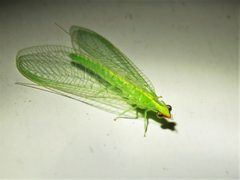
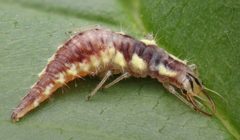
Chrysoperla rufilabris, the red-lipped green lacewing, is a predatory insect in the Chrysopidae native to eastern North America. Larvae are voracious of soft-bodied insects, particularly aphids, and are widely used as agents in agricultural and ornamental systems. are primarily and are commonly attracted to artificial lights. The has been extensively studied for its potential in , with research demonstrating its effectiveness against diverse prey including aphids, scale insects, and lepidopteran .
Pronunciation
How to pronounce Chrysoperla rufilabris: //ˌkɹaɪ.soʊˈpɜːr.lə ˌɹuː.fɪˈlæb.rɪs//
These audio files are automatically generated. While they are not always 100% accurate, they are a good starting point.
Identification
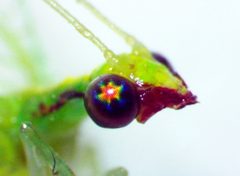
Distinguished from other North American Chrysoperla by four key characters: broadly red genae (cheeks), pointed apex of the forewing, black gradate crossveins in the wing venation, and presence of spinellae on male genitalia. exhibit the typical delicate green lacewing form with large, transparent, net-veined wings and golden . Coloration varies seasonally; adults may appear brown, pink, or reddish in autumn and spring rather than bright green.
Images
Habitat
Found in diverse terrestrial including agricultural fields, gardens, orchards, and natural vegetation. Commonly occurs in agroecological systems where are present. overwinter in sheltered locations and become active in early spring.
Distribution
Native to eastern North America. Documented from the Caribbean, Central America, and North America including the United States and Canada. GBIF records confirm presence in Vermont and broader North American distribution.
Seasonality
overwinter and become active in early spring, with activity continuing through the growing season. Attracted to blacklights and porch lights during periods. Multiple per year in temperate regions.
Diet
Larvae prey upon soft-bodied insects including aphids, , whiteflies, scale insects, and lepidopteran . Laboratory studies confirm on at least 16 ; complete larval development achieved on seven species including Aphis glycines (soybean aphid) and Myzocallis asclepiadis. Prey preference studies show larvae prefer Heliothis virescens larvae over cotton aphids, and cotton aphids over H. virescens eggs.
Life Cycle
Holometabolous development with , larva, pupa, and stages. Larvae pass through three instars. Developmental success varies significantly with prey ; survival, larval development time, pupal mass, and adult egg load are influenced by prey identity. Females produce eggs on stalks, typically laid near aphid colonies.
Behavior
Larvae exhibit success-motivated searching when feeding on certain prey types, particularly lepidopteran . Foraging performance studies demonstrate larvae can target prey under dark conditions, suggesting olfactory cues mediate prey location. are and strongly attracted to artificial light sources. Larvae do not discriminate between healthy and -infected Spodoptera frugiperda prey, though search time is approximately twice as long for infected larvae.
Ecological Role
Significant of agricultural and horticultural pests, particularly aphids. Functions as a natural agent and is commercially reared for augmentative release. Contributes to suppression of pest in agroecosystems. Subject to intraguild ; are vulnerable to predation by coccinellids such as Coleomegilla maculata lengi.
Human Relevance
Widely used in programs for management in greenhouse and field crops. Commercially available from insectaries. Research demonstrates compatibility with selective such as sulfoxaflor, which is rated harmless to slightly harmful to this while controlling target pests. Potential biocontrol agent for pests including crapemyrtle bark scale (Acanthococcus lagerstroemiae).
Similar Taxa
- Chrysoperla carnea-groupMorphologically similar historically confused with C. rufilabris; requires examination of genitalic structures and wing venation for separation. The carnea-group contains 20+ cryptic distinguished primarily by male vibrational songs rather than visual characters.
- Other Chrysoperla species in North AmericaC. rufilabris uniquely identified by combination of red genae, pointed forewing apex, black gradate crossveins, and male genitalic spinellae; other lack this full character set.
Sources and further reading
- BugGuide
- Wikipedia
- GBIF taxonomy match
- iNaturalist taxon
- NCBI Taxonomy
- Catalogue of Life
- Primary Type List | Entomology Research Museum
- Sulfoxaflor Found to Be Less Harmful to Beneficial Predators of Soybean Aphids
- Drought-Tolerant, Aphid-Hungry Lacewing Species Arrives in Americas
- Bug Eric: Last Night to Blacklight?
- Stories about small insects and making a big difference - Buglife Blog - Buglife
- Bug Eric: Blacklighting Already?
- Diet breadth of the aphid predatorChrysoperla rufilabrisBurmeister (Neuroptera: Chrysopidae)
- Handling time, prey preference, and functional response for Chrysoperla rufilabris in the laboratory
- Microorganisms associated with field-collected Chrysoperla rufilabris (Neuroptera: Chrysopidae) adults with emphasis on yeast symbionts
- Green Lacewing Chrysoperla rufilabris (Neuroptera: Chrysopidae) is a potential biological agent for controlling crapemyrtle bark scale (Hemiptera: Eriococcidae)
- HOW DO LADYBIRDS [COLEOMEGILLA MACULATA LENGI (COLEOPTERA: COCCINELLIDAE)] FEED ON GREEN LACEWING EGGS [CHRYSOPERLA RUFILABRIS (NEUROPTERA: CHRYSOPIDAE)]?
- The potential of Chrysoperla rufilabris and Doru taeniatum as agents for dispersal of Spodoptera frugiperda nucleopolyhedrovirus in maize
- The chromosome complement of male Chrysoperla rufilabris (Burmeister, 1839), with evidence of distance segregation in meiosis I.
- Combined use of Chrysoperla rufilabris (Neuroptera: Chrysopidae) and Cry3Aa for improved control of Leptinotarsa decemlineata (Coleoptera: Chrysomelidae).