
Acanthococcus lagerstroemiae
(Kuwana, 1907)
crapemyrtle bark scale, CMBS
Acanthococcus lagerstroemiae, commonly called crapemyrtle bark or CMBS, is an felt scale insect native to East Asia. First detected in the United States near Dallas, Texas in 2004, it has since spread to at least 17 states across the Southeast and Middle Atlantic regions. This phloem-feeding pest primarily infests crapemyrtles (Lagerstroemia spp.), forming distinctive white, felt-like coverings on trunks and branches. Heavy cause branch dieback, reduce flowering, and promote black growth through honeydew . The scale has also been confirmed on alternative including American beautyberry, pomegranate, apple, and spirea.
Pronunciation
How to pronounce Acanthococcus lagerstroemiae: //əˌkænθəˈkɒkəs ˌlæɡəˌstroʊˈmiːiː//
These audio files are automatically generated. While they are not always 100% accurate, they are a good starting point.
Identification
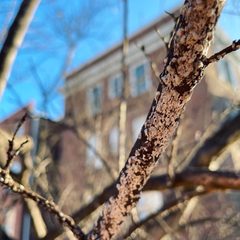
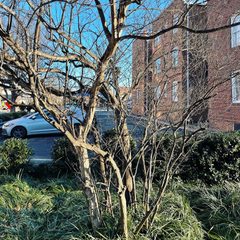
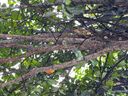
females produce conspicuous white, felt-like ovisacs approximately 2 mm long and 1 mm wide that cling tightly to bark surfaces, giving infested branches a snowy appearance. When crushed, the pink and inside exude a distinctive pink or reddish residue. Males develop in smaller, elongated white sacs about 1 mm long and 0.5 mm wide. The is not considered an or soft scale, but rather a felt scale (bark scale) in the Eriococcidae. are often first detected by the presence of black on bark, stems, and surrounding surfaces below infested trees.
Images
Habitat
Urban and suburban landscapes, ornamental nurseries, and greenhouses. Infests bark surfaces of plants, particularly trunks and branches of crapemyrtles. Thrives in warm climates with multiple per year; in greenhouse conditions at 25°C and 50% relative humidity, development proceeds rapidly.
Distribution
Native to East Asia (Japan, Korea, China, India). In the United States, confirmed in Alabama, Arkansas, Georgia, Kansas, Louisiana, Maryland, Mississippi, New Mexico, North Carolina, Oklahoma, Tennessee, Texas, Virginia, and Washington. First U.S. detection in Richardson, Texas in 2004; spread northward to North Carolina by 2016, Virginia by 2017, and Maryland by 2020.
Diet
Phloem-feeding hemipteran that imbibes nutrient-rich plant sap. To obtain sufficient nutrients, vast quantities of phloem are processed, with excess liquid excreted as sugary honeydew.
Host Associations
- Lagerstroemia spp. - primary crapemyrtle; no resistance reported among and cultivars
- Callicarpa americana - confirmed American beautyberry, native U.S.
- Spiraea spp. - confirmed spirea; raises concern for other Amygdaloideae crops
- Punica granatum - confirmed pomegranate; 12 of 35 cultivars tested showed
- Malus domestica - confirmed apple
- Malus angustifolia - confirmed southern crabapple
- Chaenomeles speciosa - confirmed flowering quince
- Diospyros rhombifolia - confirmed diamond-leaf persimmon
- Heimia salicifolia - confirmed false heather
- Hypericum kalmianum - confirmed St. Johnswort
Life Cycle
with of 56 to 83 days depending on temperature and . Two to four per year; up to four generations observed in Dallas, Texas. Under greenhouse conditions, males develop through five nymphal instars, females through three. Size ranges from 0.3 mm to 3 mm depending on developmental stage. Gravid females lay 100 to more than 300 bright pink within white ovisacs. Eggs hatch into pink that disperse to settle new bark areas.
Behavior
(first-instar nymphs) are the only mobile stage and the most vulnerable to contact . occurs through multiple mechanisms: wind dislodgement at speeds as low as ~7 m/s, phoretic transport on bird feathers and mammal fur, and potentially human-mediated spread via infested nursery stock. Crawlers exhibit "takeoff" to become airborne. Active crawlers willingly crawl onto proxies including birds and mammals. Netting to inhibit dispersal and has negligible effects on establishment. A single female with sac can establish a new population approximately 92% of the time.
Ecological Role
pest causing aesthetic and economic damage to horticultural crops. Acts as an ecological catalyst in urban environments: infested trees serve as resource hubs that attract and concentrate natural enemies (Coccinellidae, Vespidae) and scavengers (Dolichopodidae, Muscidae), resulting in uneven insect dominated by a few highly responsive . Many responding natural enemy are non-native, suggesting potential for facilitating invasion cascades in anthropogenic . Honeydew production supports black growth and attracts stinging insects.
Human Relevance
Significant economic pest of crapemyrtle, an ornamental tree with U.S. wholesale value exceeding $65 million. Heavy reduce plant market value by more than 50 percent. Infestations create nuisance conditions through sticky honeydew deposition on vehicles, furniture, and sidewalks, and subsequent black growth. Management relies on including cultivar selection, conservation, proper pruning and , and targeted or contact applications timed to .
Similar Taxa
- Acanthococcus azaleaeNative azalea bark scale; initially confused with CMBS when first detected in Texas, but later distinguished as separate introduced
- Sarucallis kahawaluokalaniCrapemyrtle aphid; also infests crapemyrtle and produces honeydow leading to , but colonizes leaf undersides rather than bark and lacks felt-like coverings
- Parthenolecanium quercifexOak lecanium scale; similar soft and honeydew production, but distinct preference and lacks white felt-like ovisacs
More Details
Insecticide susceptibility
Neonicotinoid , which are structurally similar to nicotine, act as agonists at nicotinic receptors. Research using electrical penetration graph techniques revealed that nicotine selectively inhibits phloem sap ingestion (waveform E2) while not affecting salivation (waveform E1), suggesting nAChRs specifically regulate sap ingestion in CMBS. This insight may inform insecticide application in programs.
Host suitability variation
Biological parameters differ significantly among crapemyrtle . Lagerstroemia limii supported the highest female numbers (576 ± 25 at 17 weeks after inoculation), while L. speciosa supported the lowest (57 ± 15 at 19 weeks). L. speciosa showed significantly reduced male numbers, suggesting potential for breeding low-suitability cultivars. Plant nutrient conditions also affect performance: CMBS shows higher , finite rate of increase, and net reproductive rate under nutrient-deficient conditions compared to healthier growing conditions.
Taxonomic note
The placement remains debated between Eriococcidae and Acanthococcidae. The was originally described as Eriococcus lagerstroemiae by Kuwana in 1907, with Acanthococcus lagerstroemiae (Borchsenius, 1960) now widely used but considered a synonym in some classifications.
Sources and further reading
- BugGuide
- GBIF taxonomy match
- iNaturalist taxon
- NCBI Taxonomy
- Catalogue of Life
- Publications - AgriLife Extension Entomology
- crapemyrtle bark scale (Acanthococcus lagerstroemiae) infestation - Entomology Today
- Pests and Diseases Threaten Crapemyrtle in U.S. Landscapes and Nurseries
- Acanthococcus lagerstroemiae Archives - Entomology Today
- Archive — Bug of the Week
- Crapemyrtles are not dreaming of a white Christmas: Crapemyrtle bark scale, Acanthococcus (=Eriococcus) lagerstroemiae — Bug of the Week
- Crapemyrtle Bark Scale Acanthococcus (=Eriococcus) lagerstroemiae (Kuwana) (Insecta: Hemiptera: Eriococcidae)
- Feeding Preference of Crapemyrtle Bark Scale (Acanthococcus lagerstroemiae) on Different Species
- Plant-level establishment can result from a single female Acanthococcus lagerstroemiae propagule
- Biology and Ecology of Crapemyrtle Bark Scale, Acanthococcus Lagerstroemiae (Kuwana) (Hemiptera: Eriococcidae)
- Physiology of crapemyrtle bark scale, Acanthococcus lagerstroemiae (Kuwana), associated with seasonally altered cold tolerance
- Host Suitability for Crapemyrtle Bark Scale (Acanthococcus lagerstroemiae) Differed Significantly among Crapemyrtle Species
- Biological Parameters of Crapemyrtle Bark Scale (Acanthococcus lagerstroemiae) Differ When Reared on Different Crapemyrtle Hosts
- Temperature-Dependent Development and Host Range of Crapemyrtle Bark Scale, Acanthococcus lagerstroemiae (Kuwana) (Hemiptera: Eriococcidae)
- Life Table Construction for Crapemyrtle Bark Scale (Acanthococcus lagerstroemiae): The Effect of Different Plant Nutrient Conditions on Insect Performance
- Crape myrtle bark scale Acanthococcus lagerstroemiae (Coccidae: Eriococcidae) infestation seasonally alters the insect biodiversity on crape myrtle trees
- Feeding Behavior Analyses Reveal Nicotine Selectively Inhibits Sap Ingestion in Crapemyrtle Bark Scale (Acanthococcus lagerstroemiae), an Invasive Insect in the U.S.1
- Confirmation of New Crapemyrtle Bark Scale (Acanthococcus lagerstroemiae) Hosts (Spiraea and Callicarpa) through DNA Barcoding
- Life table construction for crapemyrtle bark scale (Acanthococcus lagerstroemiae): the effect of different plant nutrient conditions on insect performance
- Quantifying the potential for wind and phoresy to drive off‐plant movement of crapemyrtle bark scale, Acanthococcus lagerstroemiae ( Kuwana ) ( Hemiptera: Eriococcidae ): Implications for spread in urban landscapes