
Parthenolecanium quercifex
(Fitch, 1859)
oak lecanium scale
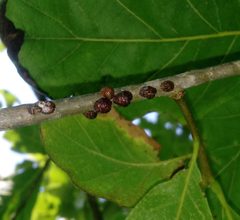
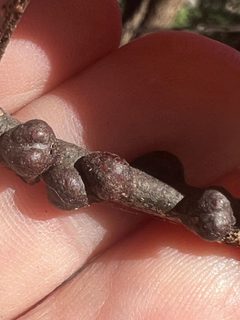
Parthenolecanium quercifex, commonly known as the oak lecanium , is a native soft scale insect in the Coccidae. females are hemispherical, 4–7 mm long, and light to dark brown or gray with lateral humps. The is prevalent in the eastern United States, primarily infesting oak trees but occasionally found on hickory and birch. It has one , with laid in late May to June and hatching in June to early July. Heavy can cause stunted foliage, , twig death, and dieback, while moderate may support beneficial natural enemies.
Pronunciation
How to pronounce Parthenolecanium quercifex: /pɑːrˌθiːnoʊlɪˈkeɪniəm kwɜːrˈsɪfɛks/
These audio files are automatically generated. While they are not always 100% accurate, they are a good starting point.
Identification
females distinguished by hemispherical shape with lateral humps and brown to gray coloration. First instars can be separated from P. corni by absence of large (>5 μm) pores. Often confused with P. corni and other soft scales; accurate identification may require microscopic examination of first instar .
Images
Habitat
Primarily associated with oak trees in urban and suburban environments. Thrives in cities due to urban heat island effects and reduced / . Found on plant leaves, twigs, and branches.
Distribution
Eastern United States. Present in North America (Canada, United States, Mexico) and Middle America.
Seasonality
One . laying: late May to June. Hatching: June to early July. feed on leaf undersides through summer. Second instars return to woody tissues in late summer/fall to overwinter. Females mature and grow in spring.
Diet
Feeds on phloem sap of plants using . Extracts nutrient-rich fluids from vascular tissue.
Host Associations
- Quercus - primary Primary ; commonly Quercus phellos (willow oak) and Quercus palustris (pin oak) in urban settings
- Carya - secondary Observed on hickory
- Betula - secondary Observed on birch
Life Cycle
Hemimetabolous with three life stages: , nymph, . Eggs laid in late May–June beneath female body. (first instars) disperse to leaf undersides in June–July, feeding along main . to second instars in late summer/fall, migrate back to twigs for . Spring growth produces mature hemispherical females.
Behavior
actively move to leaf undersides after hatching. Second instars migrate to woody tissues for . Females remain on branches after maturing. Excretes honeydew during feeding.
Ecological Role
Herbivore and phloem feeder. Heavy damage trees through nutrient extraction. Moderate support natural enemy including lady beetles, larvae, spiders, and such as Encyrtus fuscus. Honeydew production serves as supplemental food for natural enemies and substrate for growth. Acts as prey/host base that may enhance in surrounding vegetation.
Human Relevance
Pest of urban oak trees causing aesthetic and economic damage through defoliation, dieback, and fouling. Honeydew attracts stinging insects (honeybees, yellowjackets, paper wasps), creating nuisance and safety concerns. Management complicated by linkages between tree and shrub natural enemy ; treatments may disrupt in nearby plants.
Similar Taxa
- Parthenolecanium corni females frequently confused; distinguished by first instar pore size (>5 μm present in P. corni, absent in P. quercifex)
- Melanaspis tenebricosaBoth are dome-shaped urban pests on trees; gloomy scale on maple versus oak lecanium scale on oak
More Details
Urban heat island effect
Studies at North Carolina State University found P. quercifex 8–12 times more abundant on hotter urban trees compared to cooler locations, with sac abundance five times greater in thermal hotspots. Warmer temperatures increase nymph survival by 20%.
Natural enemy support
Research demonstrates that -infested oaks more spiders, , and lady beetles than uninfested oaks. Natural enemies accumulate in shrubs beneath scale-infested trees within 6–9 days, potentially providing services to surrounding vegetation.
Sources and further reading
- BugGuide
- Wikipedia
- GBIF taxonomy match
- iNaturalist taxon
- Catalogue of Life
- Why a Little Bit of This Tree Pest is a Good Thing in Urban Landscapes
- Archive — Bug of the Week
- scale insects on trees - Entomology Today
- Encyrtus fuscus - Entomology Today
- Bumpy, sticky times for oaks in cities: Oak lecanium scale, Parthenolecanium quercifex — Bug of the Week
- Parthenolecanium quercifex Archives - Entomology Today
- Descriptions and Illustrations of the First Instars of Parthenolecanium corni (Bouché) and Parthenolecanium quercifex (Fitch) (Hemiptera: Coccidae)