
Eriococcidae
Felt Scales, Eriococcids, Bark Scales
Genus Guides
5- Acanthococcus(felt scales)
- Cryptococcus
- Eriococcus(felt scales)
- Gossyparia
- Ovaticoccus
is a of scale insects in the order Hemiptera, commonly known as felt scales or eriococcids. As of 2023, the family comprises 109 and 681 . Members are phloem-feeding herbivores typically associated with specific plant . The family is not monophyletic; recent ribosomal research indicates it represents an of several distinct evolutionary lineages, with morphologically similar species sometimes being distantly related. Many species produce distinctive waxy ovisacs or induce galls on host plants.
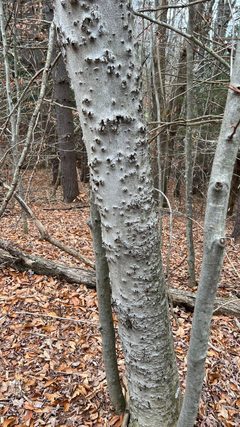
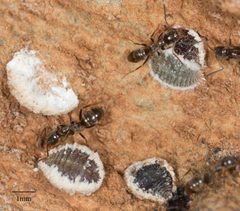
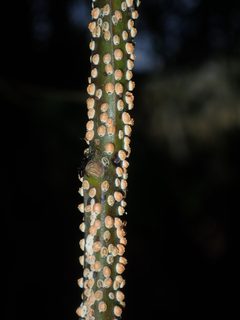
Pronunciation
How to pronounce Eriococcidae: /ˌɛri.oʊˈkɒksəˌdiː/
These audio files are automatically generated. While they are not always 100% accurate, they are a good starting point.
Identification
Distinguished from armored scales (Diaspididae) by lacking a separable test (hard protective cover) and from soft scales (Coccidae) by the felt-like or membranous ovisac structure rather than the waxy coatings typical of soft scales. Ovisac-producing are readily identified by the distinctive waxy capsule enclosing the female. Bark-dwelling species with reduced ovisacs require microscopic examination. Male second-instar nymphs construct narrow felt sacs for pupal development, a trait not seen in other .
Images
Habitat
Occurs on diverse plants including trees, shrubs, and grasses. Many inhabit bark crevices, leaf surfaces, or induce galls on leaves, buds, stems, or trunks. Some species occupy subalpine to penalpine wetlands, montane forests, and mossy wood in specialized . Gall-inducing species are restricted to specific host plant tissues.
Distribution
distribution with strong representation in Australia, New Zealand, South America, and North America. Notable radiations in Australia on Myrtaceae (Eucalyptus, Corymbia) and in New Zealand in alpine . Some are pests, including European elm scale and crapemyrtle bark scale in North America.
Seasonality
Activity patterns vary by and climate. In temperate regions, many species overwinter as nymphs and resume development in spring. Some species exhibit seasonal cold hardening, with nymphs increasing cold from November through February via dehydration and biochemical changes. Multiple per year occur in warmer climates.
Diet
Phloem-feeding herbivores. Each is typically specific to a particular plant or closely related group of hosts. Documented hosts include Myrtaceae (Eucalyptus, Corymbia, Psidium, Luma), Lythraceae (Lagerstroemia), Sapindaceae (Matayba), Dipterocarpaceae (Shorea, Dipterocarpus), Fagaceae (Fagus), and various other trees, shrubs, and grasses.
Host Associations
- Eucalyptus - primary Australian gall-inducing
- Corymbia - primary Australian gall-inducing
- Lagerstroemia - primary crapemyrtle bark scale
- Fagus - primary beech bark
- Psidium guajava - primary guava pest in Venezuela and Colombia
- Luma apiculata - primary Argentine
- Matayba guianensis - primary gall-inducing in Brazil
- Shorea robusta - primary Indian in bark crevices
- Dipterocarpus tuberculatus - primary Myanmar gall
- Schoenus pauciflorus - primary New Zealand alpine wetlands
- Chionochloa - primary New Zealand subalpine grassland
- Nothofagus menziesii - primary New Zealand montane forest
Life Cycle
Females typically lay 50-100 within the ovisac. First-instar nymphs () emerge from the ovisac opening. Development diverges by sex: females progress through second-instar nymph to (three post-egg stages); males feed briefly as second-instar nymphs, then construct a narrow felt sac and develop through and pupa to adulthood (five post-egg stages). Adult females are initially mobile, then settle permanently to feed. Adult males are winged and seek females for mating. Some are parthenogenetic. Gall-inducing species show specialized : females often remain in galls after maturity, while males may vacate galls to complete development elsewhere.
Behavior
females are generally after locating feeding sites. Adult males are winged and actively seek mates. First-instar nymphs () are the stage, capable of wind dispersal or phoretic transport on birds. Some exhibit intersexual , with wingless female nymphs clinging to winged adult brothers to exit maternal galls. Gall-inducing species manipulate plant tissue to form protective structures. Some species during dry seasons within galls.
Ecological Role
Phloem-feeding herbivores that can significantly impact plant health. Some are keystone pests causing tree mortality or complexes (e.g., beech bark facilitating Neonectria fungal ). Gall-inducing species create heterogeneity on tree . Serve as hosts for (Encyrtidae) and prey for predatory insects including lady beetles and larvae.
Human Relevance
Several are economically important pests: beech bark (Cryptococcus fagisuga) causes beech bark in North American forests; crapemyrtle bark scale (Acanthococcus lagerstroemiae) damages ornamental plantings; European elm scale, azalea bark scale, oak eriococcin, and others affect managed landscapes. Some Australian gall-inducing species are studied for their complex . have spread through human-assisted transport and wind .
Similar Taxa
- Diaspididae (armored scales)Both are scale insects with waxy coverings, but Diaspididae produce a hard, separable test (cover) that is shed during , while produce a felt-like or membranous ovisac that is not separable from the body
- Coccidae (soft scales)Both lack the hard test of armored scales, but Coccidae typically produce smooth waxy coatings or honeydew without the distinctive felt-like ovisac structure of ; soft scales often have marginal projections not seen in eriococcids
- BeesoniidaeSome eriococcid (e.g., Bystracoccus) show morphological convergence with beesoniids in forming sclerotized plug-like structures filling gall orifices; historically difficult to distinguish, but is now recognized as a separate
Misconceptions
The has long been treated as a natural group, but molecular has revealed it is not monophyletic. The type Eriococcus is polyphyletic, and some sources use Acanthococcidae as an alternative family name, though this remains debated. Morphological similarity does not reliably indicate evolutionary relationships within this group.
More Details
Taxonomic Instability
The is currently recognized as an artificial of multiple evolutionary lineages. Ribosomal studies show that morphologically similar may be distantly related, while dissimilar species are sometimes closely related. The appropriate family-level classification remains under active investigation.
Gall Induction Diversity
Gall induction has evolved multiple times within . Australian on Myrtaceae produce open-top pit galls; Brazilian species produce two-chambered leaf galls and pit galls on twigs; some species exhibit unique such as intersexual for .
Invasive Potential
Several eriococcid have established outside native ranges through a combination of wind-dispersed , phoretic transport on birds, and human-assisted movement. Once established, their parthenogenetic and protective waxy coverings make difficult.
Sources and further reading
- BugGuide
- Wikipedia
- GBIF taxonomy match
- iNaturalist taxon
- NCBI Taxonomy
- Catalogue of Life
- Publications - AgriLife Extension Entomology
- Eriococcidae Archives - Entomology Today
- Nasty scale insects spell trouble for American beech trees: Beech bark scale, Cryptococcus fagisuga — Bug of the Week
- New Species of Gall-Inducing Insect Found in Australia
- A revision of Lachnodius Maskell (Hemiptera, Coccomorpha, Eriococcidae)
- Crapemyrtle Bark Scale Acanthococcus (=Eriococcus) lagerstroemiae (Kuwana) (Insecta: Hemiptera: Eriococcidae)
- Biology and Ecology of Crapemyrtle Bark Scale, Acanthococcus Lagerstroemiae (Kuwana) (Hemiptera: Eriococcidae)
- Temperature-Dependent Development and Host Range of Crapemyrtle Bark Scale, Acanthococcus lagerstroemiae (Kuwana) (Hemiptera: Eriococcidae)
- Green Lacewing Chrysoperla rufilabris (Neuroptera: Chrysopidae) is a potential biological agent for controlling crapemyrtle bark scale (Hemiptera: Eriococcidae)
- A review of the genus Capulinia Signoret (Hemiptera: Coccoidea: Eriococcidae) with description of two new species
- Three new genera and six new species of felt scales (Hemiptera: Coccoidea: Eriococcidae) from mountain habitats in New Zealand
- A redescription of the monotypic felt scale insect genus Pedroniopsis Green (Hemiptera: Coccomorpha: Eriococcidae) from India and Burma
- Life cycle, biological behavior, host plants and biological control agents of Oregmopyga peruviana(Granara de Willink & Díaz) (Hemiptera: Coccoidea: Eriococcidae) in Vitis vinifera
- A new gall-inducing genus and species of Eriococcidae <br />(Hemiptera: Sternorrhyncha: Coccoidea) on Sapindaceae from Brazil
- Crape myrtle bark scale Acanthococcus lagerstroemiae (Coccidae: Eriococcidae) infestation seasonally alters the insect biodiversity on crape myrtle trees.