
Cryptococcus fagisuga
Lindinger, 1936
beech scale, woolly beech scale
Cryptococcus fagisuga is a felted insect and the initiating agent of beech bark , a complex disease affecting beech trees (Fagus spp.). Native to Europe, it was introduced to North America around 1890 and has since spread throughout the range of American beech. The insect feeds on phloem sap by inserting stylets into bark tissue, creating wounds that enable secondary by pathogenic Neonectria fungi. The combined damage from scale feeding and fungal cankers can girdle and kill trees over several years.
Pronunciation
How to pronounce Cryptococcus fagisuga: /ˌkrɪptoʊˈkɒkəs ˌfægɪˈsuːɡə/
These audio files are automatically generated. While they are not always 100% accurate, they are a good starting point.
Identification
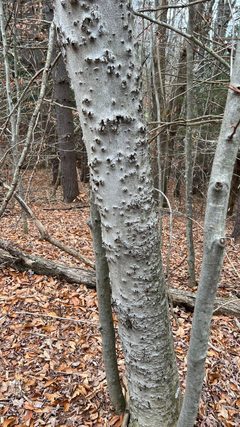
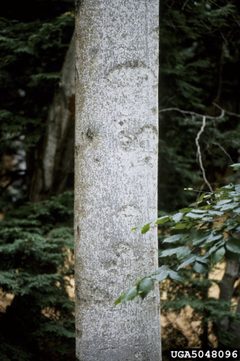
Distinguished by dense white flocculent wax masses on beech bark, particularly visible on smooth-barked trees. The woolly appearance separates it from other bark-infesting insects. Under magnification, the elliptical body form and long stylet are characteristic. Distinguishable from beech blight aphid (Grylloprociphilus imbricator) by body form versus pear-shaped body and cornicles.
Images
Habitat
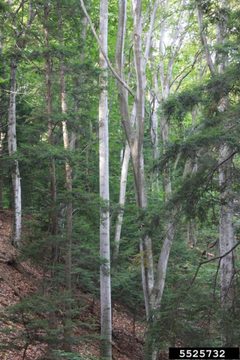
Strictly associated with bark of beech trees (Fagus spp.). Colonizes trunks and branches, preferring trees with cracked or rough bark that provides shelter. Found in forest, recreation, and residential settings where beech occurs. Trees older than 30 years are more susceptible; younger trees produce defensive chemicals that deter .
Distribution
Native to Europe (widespread including Britain, France, Germany, Scandinavia, extending to Iran, Turkey, Caucasus region). Introduced to North America: first detected in Nova Scotia around 1890, now established in eastern Canada (Quebec, Ontario, Maritime Provinces) and eastern United States (New England, New York, New Jersey, Pennsylvania, West Virginia, Michigan). Spreads at rates of 3.3–14.3 km per year. Colonized islands more than 20 km from mainland , suggesting bird or human-assisted .
Seasonality
deposited midsummer through fall. First-instar emerge approximately 20 days later (late summer to fall). Overwinter as nymphs beneath wax coating. Resume development in spring; mature present June–July. One per year.
Diet
Phloem sap extracted from parenchyma tissue of beech bark using .
Host Associations
- Fagus grandifolia - American beech, primary in North America
- Fagus sylvatica - European beech, native
- Fagus sylvatica orientalis - Oriental beech, suspected origin of North American
- Neonectria coccinea var. faginata - associated Primary fungal causing beech bark ; enters through feeding wounds
- Neonectria ditissima - associated Formerly identified as causal agent; now recognized as Neonectria coccinea var. faginata or related
- Neonectria galligena - associated Secondary fungal occasionally involved in complex
- Chilocorus stigma - Twice-stabbed lady beetle, feeds on but insufficient for
Life Cycle
Parthenogenetic; no males known. Females reproduce by . (4–8 per female) deposited in strings attached to bark midsummer to fall. First-instar hatch after ~20 days, disperse by wind or bird transport, locate feeding sites on bark, insert stylets, and to second-stage legless nymph. Second molt in spring produces mature female. One-year with overlapping possible.
Behavior
Sedentary as and second-instar nymphs; permanently attached to bark once feeding begins. First-instar are the stage, wind-borne and capable of long-distance travel. Forms dense colonies on bark with overlapping . Wax secretion provides protection from desiccation and .
Ecological Role
Forest pest initiating beech bark complex. Feeding wounds create entry points for pathogenic fungi, leading to canker formation, tissue death, and eventual tree girdling. Causes significant mortality in American beech , altering forest composition and structure. Reduces beech mast production, affecting wildlife food sources. Creates standing dead wood but overall negative impact on beech-dominated .
Human Relevance
Significant economic and ecological impact on forestry and natural areas. Reduces timber value of beech, alters forest composition, affects wildlife . Management options limited for natural stands; effective for specimen trees in managed landscapes. Subject to research seeking natural enemies from native range (northeast Greece, northern Iran, Caucasus region).
Similar Taxa
- Grylloprociphilus imbricatorWoolly beech aphid also produces white wax on beech, but has pear-shaped body, cornicles, and different feeding on leaves and twigs rather than bark.
- Acanthococcus lagerstroemiaeCrapemyrtle bark scale produces similar white woolly wax on bark but restricted to Lagerstroemia (crapemyrtle) and related , not beech.
More Details
Dispersal mechanisms
Primary long-range by wind-borne first-instar joining aerial plankton. Secondary dispersal via bird feet during . Human-assisted transport likely contributes to jump dispersal to islands and distant locations.
Cold tolerance
Air temperatures of -37°C lethal to exposed ; snow cover provides insulation. Climate warming may reduce winter mortality in northern portions of range.
Resistance breeding
Variation in tree susceptibility exists; some individuals show partial or complete resistance. Smooth bark provides fewer refugia, reducing establishment. Resistance breeding programs underway.
Sources and further reading
- BugGuide
- Wikipedia
- GBIF taxonomy match
- iNaturalist taxon
- NCBI Taxonomy
- Catalogue of Life
- Archive — Bug of the Week
- Nasty scale insects spell trouble for American beech trees: Beech bark scale, Cryptococcus fagisuga — Bug of the Week
- Cryptococcus fagisuga . [Distribution map].
- Nectria infection of beech bark in relation to infestation by Cryptococcus fagisuga Lindiger
- Beech bark disease: patterns of spread and development of the initiating agent Cryptococcusfagisuga
- Distribution of American Beech (Fagus grandifolia) and Beech Scale (Cryptococcus fagisuga Lind.) in Michigan from 2005 to 2009
- Etude de la dispersion des larves de premier stade de Cryptococcus fagisuga Lind. (Hom., Coccoidea) dans une hêtraie
- Impact of external factors on the population dynamics of beech scale (Cryptococcus fagisuga) (Hom., Pseudococcidae) in beech (Fagus sylvatica) stands during the latency stage1