
Grylloprociphilus
Smith & Pepper, 1968
woolly beech aphid, boogie-woogie aphid, beech blight aphid
Species Guides
1- Grylloprociphilus imbricator(Beech Blight Aphid)
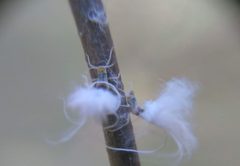
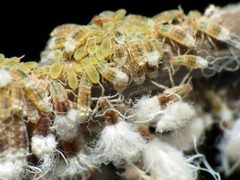
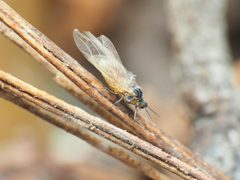
Grylloprociphilus is a of woolly aphids in the Aphididae, established by Smith & Pepper in 1968. The genus contains at least one described , G. imbricator, commonly known as the woolly beech aphid or boogie-woogie . These aphids are notable for producing dense white waxy secretions that cloak tree branches, and for their distinctive defensive of synchronized swaying when disturbed. The genus exhibits heteroecious with host alternation between primary and secondary hosts.
Pronunciation
How to pronounce Grylloprociphilus: //ˌɡrɪloʊproʊˈsɪfɪləs//
These audio files are automatically generated. While they are not always 100% accurate, they are a good starting point.
Images
Habitat
Forest and woodland environments; colonies form on branches and twigs of trees. Specific requirements correspond to distribution of primary host plants (Celtis ) and secondary hosts including American beech.
Distribution
North America; records from Vermont and broader United States. Distribution corresponds with range of primary plants (hackberry ) and secondary hosts.
Seasonality
as on bark; fundatrices hatch in spring; multiple parthenogenetic through summer; alatae produced for host in summer; return migration and in autumn; colony size peaks by late autumn.
Diet
Phloem sap of plants.
Host Associations
- Celtis occidentalis - primary common hackberry
- Celtis laevigata - primary sugar hackberry
- Celtis tenuifolia - primary dwarf hackberry
- Fagus grandifolia - secondary American beech
- Taxodium distichum - secondary swamp cypress; root-feeding stage
- Ptelea trifoliata - secondary hop-tree
Life Cycle
Heteroecious holocyclic with alternation. Overwinters as on primary host bark. Fundatrices hatch in spring and produce multiple parthenogenetic . Winged alatae migrate to secondary hosts in summer; some remain on beech while others move to swamp cypress roots. Return to primary host in autumn produces sexual morphs (oviparae and males); mating and oviposition on primary host complete the cycle.
Behavior
Colonies produce dense white waxy secretions from specialized abdominal glands. When disturbed, aphids perform synchronized swaying with wax-covered raised—termed 'boogie-woogie' —thought to confuse or distract . Defensive squads of female soldiers attack intruders including caterpillars, using to stab and dislodge threats.
Ecological Role
Phloem-feeding herbivore on native trees; colonies produce copious honeydew that supports growth of fungus Scorias spongiosa. Dense sooty mold may reduce in cloaked leaves and suppress survival of beech seedlings below infested trees. Serves as prey for and in forest .
Human Relevance
Potential pest of hackberry and beech trees in ornamental and forest settings. Dense waxy colonies and attendant create aesthetic damage. Defensive stinging sensation reported upon contact with colonies.
Sources and further reading
- BugGuide
- Wikipedia
- GBIF taxonomy match
- iNaturalist taxon
- NCBI Taxonomy
- Catalogue of Life
- Waxy ladies dance like someone’s watching: Woolly beech aphid, a.k.a. boogie-woogie aphid, Grylloprociphilus imbricator — Bug of the Week
- Life History and Synonymy of Grylloprociphilus imbricator (Fitch) (Homoptera: Aphididae)