
Spodoptera frugiperda
Smith, J.E., 1797
Fall Armyworm, Fall Armyworm Moth
, commonly known as the , is a migratory native to the Americas that has become a devastating pest across Africa and Asia. The larvae are , feeding on more than 80 plant species including maize, sorghum, cotton, and soybean. Economic damage from this species has been severe, with estimated losses of $2.5–6.3 billion annually in affected African countries. The species cannot overwinter in temperate regions, reinvading northern areas annually through long-distance .
Pronunciation
How to pronounce Spodoptera frugiperda: //spɔˈdɑptɛɹə ˌfɹuːdʒɪˈpɜːrdə//
These audio files are automatically generated. While they are not always 100% accurate, they are a good starting point.
Identification
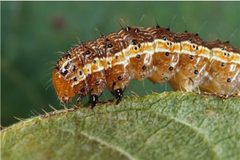
Among Spodoptera , S. frugiperda is distinguished by the square arrangement of pinaculae on the eighth abdominal segment and the inverted Y-shaped marking. It differs from S. exigua () by the presence of four pinaculae per abdominal segment rather than two. It can be separated from S. eridania and S. cosmioides by the absence of prominent black markings on the first abdominal segment and . Conclusive identification of young larvae is often not possible due to intraspecific color variability and similarity to .
Images
Appearance
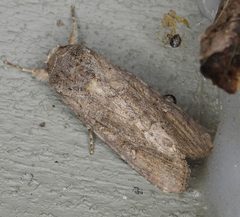
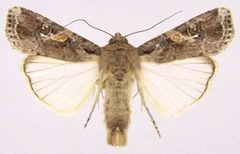
Larvae exhibit variable coloration but possess distinctive morphological features: four sclerotized pinaculae () on each abdominal segment, each bearing a single stout seta; the pinaculae on the eighth abdominal segment form a square arrangement. The capsule displays a pronounced inverted white Y-shaped mark. Late-instar larvae typically have a prominent white dorsolateral stripe. are medium-sized with mottled gray-brown forewings and lighter hindwings.
Habitat
Found in agricultural fields, particularly those containing grasses including corn, sorghum, and turfgrasses. In soybean systems, problems typically arise when larvae move from grassy weeds to small plants in late-planted or double-crop fields. Thrives in warm climates and cannot establish permanent in regions with cold winters.
Distribution
Native to tropical and subtropical regions of the Americas. Established throughout the southern United States, Mexico, Central America, the Caribbean, and South America (Brazil, Argentina). detected in Africa (first recorded 2016) and Asia (first recorded 2018), including Nepal and other South and Southeast Asian countries. Reinvades temperate North America annually through long-distance .
Seasonality
In temperate regions, occurs in late summer and fall, giving rise to the . Cannot overwinter north of Florida and Louisiana in North America. In tropical and subtropical regions, breeding occurs year-round with multiple annually.
Diet
; larvae feed on more than 80 plant across multiple . Preferred are grasses (Poaceae), including maize, sorghum, rice, wheat, and turfgrasses. Will feed on soybean foliage, blossoms, and pods; cotton; and various vegetable crops. Young larvae feed gregariously; older larvae are solitary and cannibalistic.
Host Associations
- Zea mays - primary Major crop pest; causes severe economic damage
- Sorghum bicolor - secondary Second preferred after maize; yield losses of 55–85% reported in Africa
- Gossypium hirsutum - Significant pest of cotton, especially late-season
- Glycine max - occasional Damage usually results from from grassy weeds to seedling soybeans
- Stenotaphrum secundatum - Common turfgrass in southeastern United States
Life Cycle
Complete with , larva, pupa, and stages. Eggs laid in masses on leaves and other surfaces. Larvae pass through 6 instars; early instars feed gregariously, later instars disperse and become cannibalistic. occurs in soil. Multiple per year in favorable climates; generation time approximately 30 days under optimal conditions.
Behavior
Larvae exhibit -dependent behavioral changes: young larvae feed in groups and skeletonize leaves, while older larvae become solitary and hide in soil or leaf during daylight, feeding nocturnally. are strong fliers capable of long-distance , reinvading temperate regions annually. Adults are and attracted to light.
Ecological Role
Major herbivore in agricultural ; significant pest of staple crops. Serves as for various including Telenomus remus and Trichogramma , which have been identified as potential agents in Africa and Asia. Larvae are prey for including birds, rodents, and predatory insects.
Human Relevance
One of the most economically damaging agricultural pests globally. losses in Africa estimated at $2.5–6.3 billion in 2017. Management relies heavily on , with significant environmental and human health costs. Bt corn provides partial control, though resistance to Cry1F protein has been documented in Puerto Rico and detected in migratory . programs using mass-reared (Telenomus remus, Trichogramma ) are being implemented in Africa and Asia. Cultivar diversity in turfgrass plantings has shown potential to reduce levels through associational resistance.
Similar Taxa
- Spodoptera exigua larvae similar in general form but possess only two pinaculae per abdominal segment versus four in S. frugiperda; typically green above and pinkish or yellowish below with white lateral stripe
- Spodoptera eridaniaSouthern exhibits prominent black markings on first and eighth abdominal segments and often a subspiracular light-colored line interrupted by the first abdominal segment marking; lacks the inverted Y-shaped marking of S. frugiperda
- Spodoptera cosmioidesBlack (South America) resembles S. eridania but almost always has a dark spot on the and uninterrupted subspiracular line; S. frugiperda lacks these dark thoracic markings
- Spodoptera ornithogalliYellow-striped armyworm has paired black triangular spots along the back with prominent yellow stripes running lengthwise, giving a velvety black appearance with bright yellow stripes; lacks Y-shaped marking
More Details
Invasive Spread
First detected in Africa in 2016 and Asia in 2018; rapid spread across continents represents one of the most significant lepidopteran invasions in recent history. The ' to harsh conditions and chemical has complicated management efforts in developing regions.
Bt Resistance
Field resistance to Cry1F protein documented in Puerto Rico; detected in North Carolina, likely originating from Caribbean . Resistance does not extend to pyramided Bt varieties containing multiple proteins such as Cry2Ab2 or Vip3A.
Biological Control
Telenomus remus and Trichogramma (including T. mwanzai and T. chilonis) identified in Africa and Asia with rates up to 70%. Mass-rearing programs established in Kenya, Niger, and Nepal for augmentative biocontrol release.
Sources and further reading
- BugGuide
- GBIF taxonomy match
- iNaturalist taxon
- NCBI Taxonomy
- Catalogue of Life
- New Study Reveals Natural Enemies of Fall Armyworm in Both Asia and Africa
- Quick Guide to Armyworms on Soybean | Beetles In The Bush
- How Artificial Intelligence Could Make It Easier to ID Common Corn Pests
- Bt-resistant Insects not Likely to Be a Problem for Maize Farmers
- Not Just Maize: Africa's Fall Armyworm Crisis Threatens Sorghum, Other Crops, Too
- Mixing Lawn Grass Varieties Could Trim Fall Armyworm Infestations