
Spodoptera
Guenée, 1852
Armyworm Moths
Species Guides
11- Spodoptera albula(Gray-streaked Armyworm Moth)
- Spodoptera androgea(androgea armyworm moth)
- Spodoptera dolichos(Sweet Potato Armyworm Moth)
- Spodoptera eridania(Southern Armyworm Moth)
- Spodoptera exigua(Beet Armyworm)
- Spodoptera frugiperda(Fall Armyworm)
- Spodoptera hipparis
- Spodoptera latifascia(velvet armyworm)
- Spodoptera ornithogalli(Yellow-striped Armyworm)
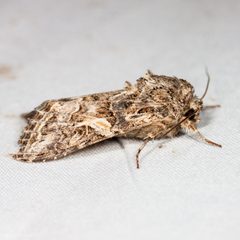
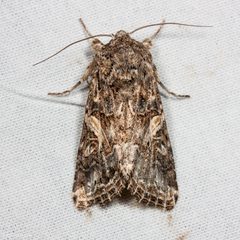
Spodoptera is a of noctuid comprising approximately 30 distributed across six continents. The larvae are commonly known as armyworms and include some of the most destructive agricultural pests worldwide. Several species, including the (S. frugiperda), (S. exigua), and cotton leafworm (S. littoralis), cause significant economic damage to crops. The genus is characterized by specific morphological traits that distinguish it from related noctuid genera.
Pronunciation
How to pronounce Spodoptera: /spɒdəʊˈtɛrə/
These audio files are automatically generated. While they are not always 100% accurate, they are a good starting point.
Identification
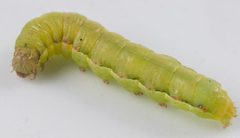
Distinguished from the related Euplexia by the absence of collar tufts and presence of metathoracic tufts. Smoother and slight abdominal tufts separate it from similar noctuids. Larval identification requires examination of capsule patterns: S. frugiperda shows the inverted "Y" marking; S. exigua and S. praefica lack this marking. Larvae may be confused with bollworms (Helicoverpa zea) and tobacco budworms (Chloridea virescens), but Spodoptera larvae typically have more prominent striping and specific head markings.
Images
Habitat
Agricultural fields, particularly corn, cotton, sorghum, rice, and vegetable crops. Also found in weedy areas, pastures, and wild vegetation. Larvae feed on terminal growth, leaves, squares, blooms, and fruiting structures of host plants. Some migrate from wild hosts to cultivated crops as wild hosts decline.
Distribution
distribution across six continents. Native to tropical and subtropical regions; established in multiple regions. Specific distributions vary: S. frugiperda native to tropical Americas, invasive in Africa and Asia (first detected in China December 2018); S. littoralis distributed across Africa, Mediterranean Europe, and Middle East; S. exigua widespread in North America, Central America, and Caribbean; S. litura occurs across Asia and Australia.
Seasonality
Activity patterns vary by and climate. In temperate regions, multiple occur during warmer months. In tropical areas, continuous breeding is possible. activity peaks during crop growing seasons. in corn show preference for vegetative growth stages over reproductive phases.
Diet
Highly . Larvae feed on more than 350 plant (S. frugiperda) to approximately 390 species (S. litura). Primary include gramineous crops: maize (Zea mays), rice (Oryza sativa), sorghum (Sorghum bicolor); cotton (Gossypium spp.); alfalfa (Medicago sativa); and various vegetables including cucurbits, peppers, and tomatoes. Larvae consume leaves, terminal buds, squares, blooms, and developing fruit.
Host Associations
- Zea mays - primary Corn/maize; major economic for multiple
- Oryza sativa - primary Rice; rice strain of S. frugiperda specialized on this
- Sorghum bicolor - primary Grain sorghum
- Gossypium hirsutum - primary Cotton; major pest of fruiting structures
- Medicago sativa - Alfalfa/lucerne
- Capsicum annuum - Pepper
- Solanum lycopersicum - Tomato
- Cucumis sativus - Cucumber and cucurbits
- Chenopodium album - wild Lamb's quarters
- Amaranthus spp. - wild Pigweeds; strongly attracted to pigweed
Life Cycle
Complete with , larva, pupa, and stages. Eggs hatch in 3 to 4 days. Larvae pass through 6 instars, with early instars often feeding gregariously before dispersing. Larval development duration is temperature-dependent. occurs in soil or leaf litter. time varies from several weeks to months depending on temperature and . Multiple generations per year in favorable climates.
Behavior
Larvae exhibit diverse feeding : early instars of some feed gregariously and "web up" leaves, while later instars become solitary. Young larvae often feed on tender terminal growth before moving to fruiting structures. and interspecific occur: two-way predation has been documented between S. frugiperda and S. litura larvae, with older instars (4th-6th) preying on younger larvae (1st-3rd) of the other species. are and attracted to ultraviolet light. Females of some species produce with species-specific blend ratios.
Ecological Role
Major herbivores in agricultural . occurs with native lepidopteran herbivores; such as S. frugiperda may competitively displace native insects. Larvae serve as prey for including predatory (e.g., Cyrtopeltis tenius), , and birds. Potential for through and interspecific is under investigation.
Human Relevance
Significant agricultural pests causing billions of dollars in crop losses globally. Primary targets for programs. Management relies on Bt transgenic crops (corn, cotton), chemical , agents, and -based monitoring. Some have evolved resistance to Bt toxins and insecticides. Pheromone traps used for monitoring and mass trapping, though trap varies with pheromone blend ratios and crop growth stage.
Similar Taxa
- Helicoverpa zeaLarvae similar in size and coloration; both are major cotton pests. Bollworm larvae lack the inverted "Y" marking of and have different spotting patterns on the body.
- Chloridea virescensTobacco budworm larvae closely resemble bollworms and some Spodoptera ; requires microscopic examination or molecular methods for reliable identification.
- Euplexia share Noctuidae but differ in having prominent collar tufts behind the , which Spodoptera lacks.
- MythimnaAnother with larvae called armyworms; Mythimna separata (Oriental ) is distinguished by different and larval capsule structure.
More Details
Bt Resistance
of S. frugiperda in Brazil and other regions have developed resistance to Cry1F and other Bt toxins. Resistance management strategies include pyramid Bt crops with multiple toxins and planting.
Pheromone Communication
Geographic variation in female blend composition has been documented, particularly in the ratio of Z7-12:Ac component. This variation affects male response and trap in different regions.
Strain Differentiation
S. frugiperda comprises two strains (rice strain and corn strain) that differ in host plant preferences and can only be reliably distinguished using molecular techniques.
Sources and further reading
- BugGuide
- Wikipedia
- GBIF taxonomy match
- iNaturalist taxon
- NCBI Taxonomy
- Catalogue of Life
- Oh, What a (Moth) Night! | Bug Squad
- Blacklighting at the Bohart: They Saw the Light | Bug Squad
- Like a Moth to a Flame: Moth Night at Bohart Museum of Entomology | Bug Squad
- Occasional Pests - AgriLife Extension Entomology
- Mid-Season and Late-Season Pests - AgriLife Extension Entomology
- Seedling to tassel stage insect control - AgriLife Extension Entomology
- Two-way predation between larvae of Spodoptera frugiperda and Spodoptera litura
- Locality-dependent pheromone blend changes in Bt corn resistant Spodoptera frugiperda populatiom from Brazil: Spodoptera frugiperda
- Effects of Temperature on the Biology of Spodoptera litura Fab.
- Proteomic variation in the oral secretion of Spodoptera exigua and Spodoptera littoralis larvae in response to different food sources
- Predation Behavior and Efficiency of the Bug Cyrtopeltis tenius (Hemiptera:Miridae), Against the Cutworm, Spodoptera litura(F.)