
Helicoverpa zea
Boddie, 1850
corn earworm, cotton bollworm, tomato fruitworm, soybean podworm
is a major agricultural pest native to the Americas. The larvae are highly , feeding on reproductive structures of numerous crop plants including corn, cotton, tomato, and soybean. The has developed widespread resistance to many and Bt toxins. are seasonal migrants capable of traveling hundreds of kilometers on wind currents. Recent hybridization with the Old World bollworm (H. armigera) has introduced additional resistance genes through .
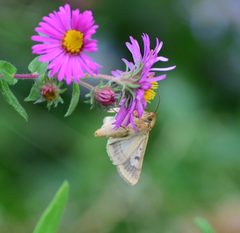
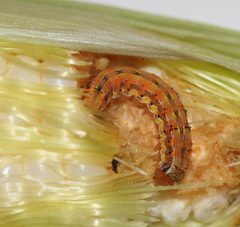
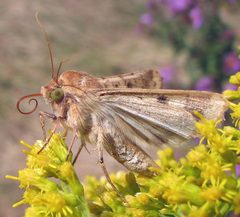
Pronunciation
How to pronounce Helicoverpa zea: /ˌhɛlɪˈkoʊvərpə ˈziːə/
These audio files are automatically generated. While they are not always 100% accurate, they are a good starting point.
Identification
Larvae distinguished from fall armyworm by absence of inverted 'Y' on capsule. From Heliothis virescens, requires microscopic examination of male genitalia or molecular methods (ITS1 marker, immunoassay). on soybean: barrel-shaped, creamy-white with light brown ring below apex, larger (~3,500 eggs/g) than related . : forewing dark spot and yellowish-brown ground color; distinguishable from H. armigera only by genitalia dissection or genetic analysis.
Images
Habitat
Agricultural landscapes, particularly fields of crops. Larvae develop on reproductive structures of plants. hide in vegetation during daylight hours. occurs in soil.
Distribution
Widely distributed across temperate and tropical regions of North, Central, and South America. Found throughout the United States except northernmost areas where winter mortality prevents ; regular seasonal recolonizes these regions. Established in Hawaii and Caribbean islands. Reported from China (2002). Cannot overwinter successfully in northern Canada, Alaska, or the eastern United States north of approximately Kansas, Ohio, Virginia, and southern New Jersey.
Seasonality
Year-round activity in tropical and subtropical regions. In temperate zones, migrate northward from southern areas in spring and summer. Peak activity varies by region and crop: corn silking period, cotton flowering, soybean pod development. Multiple per year where conditions permit; generation time shortened at higher temperatures.
Diet
Highly larvae feed primarily on reproductive structures of plants. Major include corn (silks and kernels), cotton (bolls), tomato (fruits), soybean (pods and seeds), sorghum, and numerous other vegetable and field crops. Larvae also exhibit and on other insects when larval densities are high or plant quality is low. feed on nectar and plant exudates.
Host Associations
- Zea mays - primary Feeds on silks and kernels; major economic impact
- Gossypium hirsutum - primary Damages cotton bolls
- Solanum lycopersicum - primary Feeds on tomato fruits
- Glycine max - increasingly important Pod and seed feeding; rising pest status in mid-south U.S.
- Sorghum bicolor - preferred grazed for developing seeds
- Helianthus annuus -
- Phaseolus vulgaris - Pod and seed feeding
- Nicotiana tabacum -
Life Cycle
laid singly on leaf hairs, silks, or other plant parts; hatch in 66–72 hours. Larvae pass through 4–6 instars, feeding gregariously when young, becoming solitary and cannibalistic as they mature. Mature larvae drop to soil and pupate 5–10 cm below surface for 12–16 days. Pupae may enter facultative in response to temperature, , or drought. emerge, live 5–15 days on average (up to 30+ days in optimal conditions). Females produce 500–2,500 eggs. time temperature-dependent; more generations at lower latitudes and in warmer years.
Behavior
are , hiding in vegetation during day. Seasonal nocturnal migrants; short-range within crops independent of wind, long-range dispersal up to 400 km downwind at altitudes of 1–2 km. Males engage in thermoregulatory shivering to reach optimal thoracic temperature (~26°C) before takeoff; respond to female plumes with rapid directed . Larvae become increasingly aggressive with age, attacking and consuming other insects including conspecifics.
Ecological Role
Major herbivore in agricultural . Significant prey for and ; over 100 insect recorded as natural enemies. Important for parasitoid including Cardiochiles nigriceps and Microplitis croceipes. Larval and intraguild may regulate densities. Fungal rileyi can cause at high larval densities.
Human Relevance
Second most economically important lepidopteran pest in North America (after codling moth). damage and control costs exceed $100 million, with expenditures up to $250 million. Resistance to multiple insecticide classes and Bt toxins complicates management. Subject of programs incorporating , cultural practices, and chemical control. Hybridization with H. armigera has introduced novel resistance genes, threatening control efficacy.
Similar Taxa
- Helicoverpa armigeraPhenotypically nearly identical; distinguished reliably only by male genitalia or molecular markers. Recently established in Americas and hybridizing with H. zea.
- Heliothis virescensOverlapping range and distribution; and larvae require immunoassay or feeding disruption for reliable separation. Slightly smaller eggs (~5,000 vs ~3,500 eggs/g).
- Spodoptera frugiperdaLarvae similar in size and coloration; distinguished by presence of inverted 'Y' pattern on capsule in fall armyworm.
Misconceptions
Older literature referring to 'Heliothis obsoleta' often actually concerns H. zea, not H. armigera as the name would suggest. The 'American bollworm' for H. armigera is misleading as that is native to the Old World.
More Details
Insecticide resistance
Has developed practical resistance to multiple Cry proteins in Bt corn and cotton, as well as to and other chemical classes. Resistance evolution accelerated by climate warming and high Bt crop adoption.
Introgression with H. armigera
Hybridization with Old World bollworm documented in Brazil and the United States (Colorado, 2023). Resistance genes including CYP337B3 have introgressed into H. zea , potentially spreading rapidly.
Pheromone biology
Female production induced by plant volatiles (e.g., ethylene from corn silk), enabling reproductive synchronization with food availability. Males transfer pheromonostatic that suppresses female pheromone production after mating.
Sources and further reading
- BugGuide
- Wikipedia
- GBIF taxonomy match
- iNaturalist taxon
- NCBI Taxonomy
- Catalogue of Life
- Alfalfa Insects - AgriLife Extension Entomology
- Learnings From Latin America: Potential Risk of Helicoverpa armigera to U.S. Soybean Production
- Bollworms rising! | Beetles In The Bush
- Life at 8X—Guide to lepidopteran eggs on soybean | Beetles In The Bush
- How Climate Change May Accelerate Corn Earworm's Resistance to Bt Crops
- Introgression: How the Corn Earworm Borrowed Insecticide Resistance From an Invasive Cousin
- Evaluating cross-resistance and synergy between Vip3Aa and Cry proteins from Bt in six strains of Helicoverpa zea derived via F(2) screens.