
Helicoverpa
Hardwick, 1965
Heliothine moths, bollworms, earworms
Species Guides
1- Helicoverpa zea(corn earworm)
Helicoverpa is a of noctuid established by David F. Hardwick in 1965. Several rank among the world's most destructive agricultural pests, particularly H. armigera (cotton bollworm), H. zea (/cotton bollworm), and H. punctigera. These species exhibit long-distance capabilities, with H. armigera recently expanding from the Old World into the Americas and threatening to establish in the continental United States. The genus is notable for rapid evolution of resistance, including documented of resistance genes between H. zea and H. armigera.
Pronunciation
How to pronounce Helicoverpa: /hɛlɪkoʊˈvɛrpə/
These audio files are automatically generated. While they are not always 100% accurate, they are a good starting point.
Identification
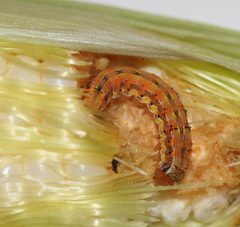
closely resemble other Heliothinae , particularly Heliothis , requiring examination of male genitalia or molecular methods for definitive identification. H. armigera and H. zea are phenotypically indistinguishable without specialized techniques. are distinctive: H. zea eggs are barrel-shaped when laid on leaves, creamy-white with a light brown ring below the apex, and approximately 3,500 eggs per gram; eggs laid on pods become spherical when attached to trichomes. Larvae distinguished from other noctuids by black pinacula on the body.
Images
Appearance
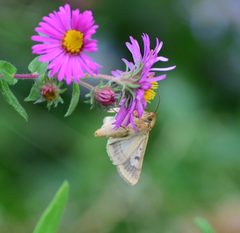
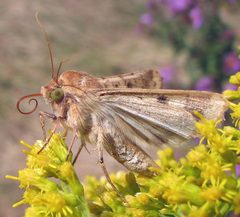
Medium-sized noctuid with stout bodies. Forewings typically exhibit variable patterns of brown, tan, and olive with distinct and spots. Hindwings pale with darker margins. Larvae have distinctive black pinacula ( bearing setae) on a background color ranging from green to brown or pink, with longitudinal stripes often present.
Habitat
Agricultural landscapes dominated by crops including corn, cotton, soybean, and tomato. Also found in associated weedy areas and non-cultivated that support wild host plants.
Distribution
distribution with -specific ranges. H. armigera: native to Africa, Asia, and Australia; established throughout Latin America since 2013; intercepted in Puerto Rico and Florida. H. zea: native to the Americas, widespread in North and South America. H. punctigera: Australia and New Zealand. H. gelotopoeon: temperate South America (Argentina, Chile, Uruguay).
Diet
Highly . Larvae feed on reproductive structures and foliage of numerous plants. Major crop include corn (silks and kernels), cotton (bolls), soybean (pods and seeds), tomato (fruit), and many other crops. H. armigera has been observed to feed more aggressively on soybean than H. zea and occurs earlier in the season with potential for more per cropping cycle.
Host Associations
- Zea mays - larval food plant derives from feeding on corn silks and kernels
- Gossypium spp. - larval food plantcotton bollworm ; feeds on developing cotton bolls
- Glycine max - larval food plantsoybean podworm ; larvae breach pod walls to consume seeds
- Solanum lycopersicum - larval food planttomato fruitworm
Life Cycle
Complete with , larva, pupa, and stages. Eggs laid singly on various plant parts including leaves, petioles, stems, pods, and flowers. Larval development includes multiple instars with feeding damage increasing dramatically in later stages. typically occurs in soil. Multiple per year possible in favorable climates; H. armigera has potential for more generations per cropping cycle than H. zea.
Behavior
activity. Strong capabilities enable long-distance ; H. armigera, H. zea, and H. punctigera documented migrating hundreds of kilometers. from Bt-selected have been observed to develop longer, stiffer wings better suited for long-distance , potentially accelerating resistance gene spread. Adults exhibit pre-oviposition feeding on nectar.
Ecological Role
Major agricultural pest causing direct yield loss through larval feeding. can significantly reduce crop productivity. Serves as prey for and , though natural control often insufficient to prevent economic damage. facilitates across regions and continents.
Human Relevance
Among the most economically damaging lepidopteran pests globally. Management relies heavily on , transgenic Bt crops, and cultural practices. Rapid evolution of and Bt toxins creates ongoing challenges for sustainable management. Interspecific hybridization between H. zea and H. armigera has introduced novel resistance into native through . Insecticide resistance management (IRM) strategies include non-Bt planting, though compliance remains problematic.
Similar Taxa
- HeliothisClosely related noctuid with similar ; historically some Helicoverpa were classified in Heliothis. require genitalia dissection or molecular methods for reliable separation.
- Chloridea virescensFormerly Heliothis virescens; tobacco budworm overlaps in use and distribution. and young larvae nearly identical to H. zea; -specific immunoassay or Bt feeding disruption required for reliable identification.
More Details
Insecticide Resistance
H. armigera has more documented cases of resistance than H. zea. Resistance to has been linked to P450 337B3 (CYP337B3) gene variants. In 2023, Colorado of H. zea were found carrying H. armigera-derived CYP337B3 through introgressive hybridization, conferring unexpected resistance.
Bt Crop Interactions
Exposure to Bt corn has been observed to alter wing in H. zea within a single . developing on seed-blend (80% Bt/20% non-Bt) developed longer, narrower, stiffer wings compared to non-selected controls—traits associated with enhanced long-distance capability. This may accelerate resistance spread.
Interspecific Hybridization
H. armigera and H. zea are capable of hybridization, documented under field conditions in Brazil. Hybrid offspring are viable and can backcross, enabling bidirectional . This has significant implications for resistance management as resistance can transfer between .
Sources and further reading
- BugGuide
- Wikipedia
- GBIF taxonomy match
- iNaturalist taxon
- NCBI Taxonomy
- Catalogue of Life
- Learnings From Latin America: Potential Risk of Helicoverpa armigera to U.S. Soybean Production
- Bollworms rising! | Beetles In The Bush
- Introgression: How the Corn Earworm Borrowed Insecticide Resistance From an Invasive Cousin
- The Problems Driving Resistance to Bt Crops—and Some Proposed Solutions
- Life at 8X—Guide to lepidopteran eggs on soybean | Beetles In The Bush
- Bt Corn Changes Corn Earworm Moths' Wing Shape, Possibly Boosting Migration Ability