
Chloridea virescens
(Fabricius, 1777)
Tobacco Budworm Moth, Tobacco Budworm
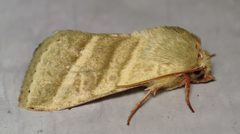
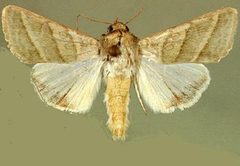
Chloridea virescens, the tobacco budworm , is a noctuid moth native to the Americas and a major agricultural pest. The was transferred from Heliothis to Chloridea in 2013 based on genetic and morphological evidence. are brownish with green tinge and distinctive wing banding. Larvae feed on buds, blossoms, and fruit of diverse plants, causing significant crop damage. The species has developed rapid resistance to multiple classes, making management challenging.

Pronunciation
How to pronounce Chloridea virescens: //klɔːˈrɪdiə vɪˈrɛskɛnz//
These audio files are automatically generated. While they are not always 100% accurate, they are a good starting point.
Identification
distinguished from similar noctuids by three dark forewing bands with cream borders and whitish hindwings with dark band. nearly identical to Helicoverpa zea (corn earworm); primary ribs terminate before reaching in C. virescens versus extending to rosette in H. zea. Early instar larvae difficult to separate from H. zea; microspine patterns differ. Reliable separation of eggs and young larvae requires -specific immunoassay or Bacillus thuringiensis feeding disruption .
Images
Appearance
are brownish with a light green tinge, measuring 28–35 mm wingspan. Forewings display three dark bands, each bordered by whitish or cream coloration. Hindwings are whitish with a dark band at the margin. Females are generally darker than males. Larvae are yellow to yellowish-green upon hatching, becoming variable in later instars—greenish, pinkish, dark red, or maroon—with a broad brown capsule. Whitish and bands run the body length, with a broad brown lateral band. Larvae bear black thornlike microspines. are spherical with flattened base, 0.5–0.6 mm , with 18–25 radiating ridges; initially whitish or yellowish, turning grey with age.
Habitat
Agricultural fields, particularly tobacco and cotton; also vegetable crops, flower crops, and weedy areas. Overwinters in soil as pupae in southern states; can survive northern climates in sheltered environments such as greenhouses.
Distribution
Eastern and southwestern United States; disperses northward to New England and southern Canada during late summer. Established in California, Caribbean, Central America (Mexico, Guatemala, Panama), and South America (Brazil). Specific documented in Louisiana, Florida, Virginia, North Carolina, South Carolina, Georgia, Texas, Colorado, and the Antilles.
Seasonality
Active during warmer months, late spring to early fall. emerge March–May in southern United States. Undergoes 4–5 annually depending on region and temperature. Overwinters as pupae.
Diet
Larvae feed on buds, blossoms, terminal growth, leaf petioles, stalks, and fruit of plants. Documented hosts include tobacco (Nicotiana), cotton, alfalfa, clovers, soybean, flax, cabbage, cantaloupe, lettuce, pea, tomato, geranium, and numerous weeds including cranesbill, toadflax, deergrass, beggarweed, wild tobacco, vervain, ruellia, and mallow. Host preference varies regionally; maternal inheritance of host preference has been demonstrated.
Host Associations
- Nicotiana - primary source of
- Gossypium - major principal in Texas
- Gossypium hirsutum - cotton
- Medicago sativa - alfalfa
- Trifolium - clovers
- Glycine max - soybean
- Linum usitatissimum - flax
- Brassica oleracea - cabbage
- Cucumis melo - cantaloupe
- Lactuca sativa - lettuce
- Pisum sativum - pea
- Solanum lycopersicum - tomato
- Pelargonium - geranium
- Geranium dissectum -
- Geranium carolinianum - cranesbill, key early season in Mississippi
- Linaria canadensis - toadflax, early season in Georgia
- Panicum - deergrass, for third in Georgia
- Desmodium - beggarweed, for later in Georgia
- Nicotiana repanda - wild tobacco, Texas
- Verbena - vervain, Texas
- Ruellia - Texas
- Malva - mallow, Texas
Life Cycle
Complete with four stages: , larva, pupa, . Eggs laid on blossoms, fruit, or terminal growth; hatch in 2.6–10.1 days at 20°C, faster at higher temperatures. Larvae undergo 5–6 instars (rarely 7), lasting 1.9–10.1 days depending on temperature and instar. observed from third or fourth instar. occurs in soil; pupal stage lasts 11–22 days, temperature-dependent. Adults live 15–25 days depending on temperature. Overwinters as pupae; induced by short days or low temperatures.
Behavior
Larvae tunnel into plant buds, blossoms, and fruit, causing characteristic ragged, distorted leaf growth from damaged buds. Cannibalistic from third or fourth instar. Larvae defend against by expelling oral exudate that agitates attackers, enabling escape. Males produce hair-pencil during mating that attract females; females rely on to detect these signals. Maternal inheritance of oviposition preference demonstrated.
Ecological Role
Agricultural pest causing significant crop damage. Serves as for multiple including Trichogramma pretiosum ( parasitoid), Microplitis croceipes (larval parasitoid), Cardiochiles nigriceps (larval parasitoid on tobacco), and Meteorus autographae. High natural rates documented across all life stages.
Human Relevance
Major pest of field crops, particularly tobacco and cotton, with historical records of damage dating to early 1800s. Rapid evolution of resistance documented: resistance within 14 years, carbaryl within 10 years, within 7 years, methomyl within 5 years. Successfully controlled in U.S. and Mexico by Bt cotton producing Cry1Ac and Cry1Ab toxins. Resistance to Bt toxins evolving; 7-fold resistance increase observed after 12 laboratory selection episodes. Subject of sterile insect release and irradiation studies. Monitoring conducted via -baited cone traps.
Similar Taxa
- Helicoverpa zeaCorn earworm; and early instar larvae nearly identical, requiring molecular or methods for reliable separation. distinguished by wing pattern details. Both occur on similar and may be found together.
- Helicoverpa armigeraOld World bollworm; similar and pest status, but geographic ranges largely non-overlapping.
More Details
Taxonomic history
Transferred from Heliothis to reinstated Chloridea in 2013 based on genetic and morphological research. Formerly treated as Heliothis virescens.
Temperature effects on development
Development rate negatively correlated with temperature. Larval instar development: 2.6–10.1 days at 20°C versus 1.9–5.7 days at 25°C. Pupal stage: 22 days at 20°C, 13 days at 25°C, 11.2 days at 30°C. longevity: 25 days at 20°C, 15 days at 30°C.
Insecticide resistance timeline
Resistance acquired to (14 years after introduction), carbaryl (10 years), (7 years), methomyl (<5 years). Resistance to Bt toxins documented with frequency estimated at 0.001 in wild .
Parasitoid defenses
Larvars expel oral exudate against approaching Cardiochiles nigriceps females, causing to groom and allowing larval escape. Winthemia rufopicta on larvae are destroyed by biting, crushing, puncturing, or ingestion.
Juvenile hormone physiology
Mating induces 5–15 fold increase in production by in females, stimulating and production. Males synthesize juvenile hormone in accessory glands and transfer to females during copulation.
Regional host shifts
Documented seasonal plant in Georgia: 1–2 on toadflax (April–May), generation 3 on deergrass (June–July), generations 4+ on beggarweed (July–October).
Sources and further reading
- BugGuide
- Wikipedia
- GBIF taxonomy match
- iNaturalist taxon
- The State of Insect Resistance to Transgenic Bt Crops
- Sweet times for sweat bees: Sweat bees, Halictus ligatus and Agapostemon virescens — Bug of the Week
- Life at 8X—Guide to lepidopteran eggs on soybean | Beetles In The Bush
- Tabloid Sensationalism Aside, Lady Bugs Are Still Fascinating
- Bug Eric: Insidious Insect Fungi