
Trichogramma
Westwood, 1833
Trichogramma wasps, egg parasitoid wasps
Trichogramma is a of minute that are endoparasitoids of insect . With over 200 worldwide, it is one of approximately 80 genera in the Trichogrammatidae. These wasps are among the most extensively studied and widely used agents globally, with more than a thousand published papers on their and applications. Trichogramma species have also gained attention in neuroscience research due to their extremely small brain size—fewer than 10,000 —while still exhibiting complex .

Pronunciation
How to pronounce Trichogramma: //ˌtrɪkoʊˈɡræmə//
These audio files are automatically generated. While they are not always 100% accurate, they are a good starting point.
Identification
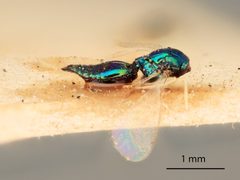
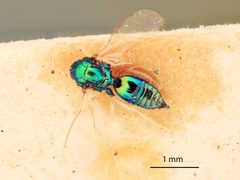
Trichogramma are extremely small, typically less than 1 mm in length. Females are morphologically uniform across , making identification difficult. Taxonomists rely on male characteristics, particularly features of the and genitalia, to distinguish species. The is characterized by reduced wing venation and compact body structure typical of Trichogrammatidae.
Images
Habitat
Trichogramma occur in diverse terrestrial including agricultural fields, orchards, vineyards, forests, and grasslands. They are found in rice paddies, cotton fields, sugarcane plantations, and vegetable crops. Natural inhabit areas where insect are available.
Distribution
Worldwide distribution with documented occurrence in North America, South America, Europe, Asia (including China, Laos, Myanmar, Nepal), Africa (including East Africa), and Australia. Specific distribution records include: Adygey, Alberta, Andhra Pradesh, Arizona, Arkansas.
Seasonality
Activity patterns vary by and region. Multiple per year are common in temperate and tropical climates. Mass releases for are typically timed to coincide with peak oviposition by target pest species.
Diet
Endoparasitoids of insect . Larvae feed on and develop within eggs, consuming the embryo. Host range is broad (), including eggs of Lepidoptera ( and butterflies), particularly stem borers (Scirpophaga spp., Chilo spp.), leaffolders (Cnaphalocrocis spp.), cotton bollworm (Helicoverpa armigera), codling moth (Cydia pomonella), light brown apple moth (Epiphyas postvittana), European corn borer (Ostrinia nubilalis), and fall armyworm (Spodoptera frugiperda). Some also parasitize eggs of Hemiptera including leafhoppers and planthoppers.
Life Cycle
Females locate using chemical and visual cues including egg shape and color. Upon finding a suitable egg, females use antennal drumming (tapping on the egg surface) with the ovipositor to assess whether the egg has been previously parasitized and to determine egg size and quality. The number of eggs inserted depends on host egg quality. A single female can parasitize up to 10 host eggs per day. Development occurs entirely within the host egg; emerge approximately 10 days after oviposition. Some are infected with bacteria, which can induce , feminization, or .
Behavior
females actively search for using highly developed chemosensory organs. They exhibit antennal drumming to assess host egg suitability and avoid . The possesses at least 13 types of on , , mouthparts, wings, legs, and external genitalia. Complex host-finding behaviors are maintained despite extremely small brain size.
Ecological Role
Important natural enemies of agricultural pests, particularly Lepidopteran . Serve as key agents in programs. Their activity can reduce pest below . Sensitive to chemical , which can deplete natural populations and disrupt biological control.
Human Relevance
Most extensively used agents worldwide. Nine are produced commercially in insectaries across 30 countries: T. atopovirilia, T. brevicapillum, T. deion, T. exiguum, T. fuentesi, T. minutum, T. nubilale, T. platneri, T. pretiosum, and T. thalense. Used for control of lepidopteran pests on cotton, sugarcane, vegetables, sugar beets, orchards, and forests. Mass-reared on alternative such as Corcyra cephalonica (rice meal moth) and Sitotroga cerealella for inundative releases. Research models in neuroscience due to minimal brain size. Used in resistance management strategies where Bt crops are deployed.
Similar Taxa
- TelenomusBoth are used in , but Telenomus belongs to Scelionidae and typically has different ranges and morphological features including distinct antennal structure.
- GonatocerusBoth are minute in Chalcidoidea, but Gonatocerus belongs to Mymaridae and parasitizes eggs of Hemiptera (leafhoppers and planthoppers) rather than Lepidoptera, with different wing venation and body proportions.
Sources and further reading
- BugGuide
- Wikipedia
- GBIF taxonomy match
- iNaturalist taxon
- NCBI Taxonomy
- Catalogue of Life
- Publications | Entomology Research Museum
- Primary Type List | Entomology Research Museum
- Remounting Procedure for Aphytis | Entomology Research Museum
- Trichogramma Wasps Used as Biocontrol Agents in the Greater Mekong Region
- Making a Case for Safer Ways to Fight Rice Pests in the Greater Mekong
- New Study Reveals Natural Enemies of Fall Armyworm in Both Asia and Africa