
Trichogrammatidae
Haliday in Walker, 1851
trichogrammatid wasps, egg parasitoid wasps
Subfamily Guides
2- Oligositinae
- Trichogramma(Trichogramma wasps)
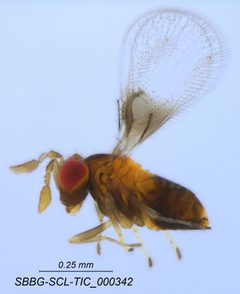
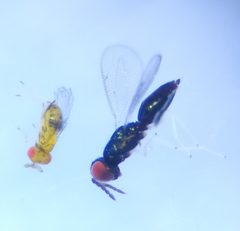
are a of minute endoparasitoid in the superfamily Chalcidoidea, containing over 840 in approximately 80 with worldwide distribution. of most species measure less than 1 mm in length, with some species of Megaphragma reaching less than 300 μm—among the smallest insects known. The family is distinguished by 3-segmented , paddle-shaped forewings fringed with marginal cilia, and a unique where adult function without . Trichogrammatids are economically important as agents, parasitizing of Lepidoptera, Coleoptera, Hemiptera, Hymenoptera, and Diptera.
Pronunciation
How to pronounce Trichogrammatidae: //ˌtrɪkoʊɡræˈmeɪtɪdiː//
These audio files are automatically generated. While they are not always 100% accurate, they are a good starting point.
Identification
Distinguished from other Chalcidoidea by the combination of 3-segmented , paddle-shaped forewings with long marginal cilia, and the absence of a strigil on the foretarsus. The can be separated from the similar Mymaridae (fairyflies) by wing venation and antennal structure: trichogrammatids have reduced wing venation with characteristic fringed margins, and the funicle never exceeds 2 segments (often absent). Molecular identification via ITS2 rDNA sequencing is increasingly used due to the minute size and morphological similarity of .
Images
Appearance
are extremely small, with most under 1 mm in length. The body is compact with short, elbowed bearing 1-2 annuli and a of up to 7 segments in females. The forewings are stubby and paddle-shaped, fringed with long hinged setae around the outer margin that increase surface area during ; hindwings are smaller. are 3-segmented without strigil on the foretarsus. The is broadly jointed to the and penetrated by a muscle-bearing mesophragma. Males of some species are wingless.
Habitat
Found in diverse terrestrial worldwide, particularly in agricultural and natural where insect are available. are associated with vegetation supporting lepidopteran, hemipteran, and other host insects. Some species have been recorded from bracket fungi and eggs in forest habitats.
Distribution
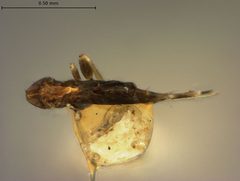
Worldwide distribution across all biogeographic regions. Fossil record extends to Eocene-aged Baltic amber. Documented from North and South America, Europe, Asia, Africa, and Australia. Individual show varying ranges from to regionally restricted.
Seasonality
Activity patterns vary by and climate; many species are active during the growing season of their insects. Some species enter at the prepupal stage (documented in Trichogramma dendrolimi), allowing survival through unfavorable conditions. Multiple per year are typical in temperate and tropical regions.
Diet
Endoparasitoids of insect . include eggs of Lepidoptera ( and butterflies), Coleoptera (beetles), Hemiptera (true bugs including leafhoppers and planthoppers), Hymenoptera (), Diptera (flies), and Thysanoptera (thrips). Specific host associations vary by and .
Host Associations
- Lepidoptera - Major order; includes pests such as Helicoverpa armigera, Ostrinia nubilalis, Tuta absoluta, Phthorimaea operculella, Neoleucinodes elegantalis
- Coleoptera - Includes various pests
- Hemiptera - Includes leafhoppers (Cicadellidae) such as Circulifer tenellus, Dalbulus maidis, Homalodisca vitripennis, and planthoppers (Delphacidae)
- Hymenoptera - Includes
- Diptera - Includes various fly
- Thysanoptera - for Megaphragma
Life Cycle
Development occurs entirely within the . Females lay eggs inside host eggs using a short ovipositor. Larvae feed on the developing host embryo, pupate within the host egg, and emerge as by chewing an exit hole. Some exhibit (males developing from unfertilized eggs). Wingless males of some species mate with sisters inside the host egg and die without leaving. time varies from approximately 7-14 days under favorable conditions.
Behavior
Poor fliers that rely primarily on wind . Females use chemical and physical cues to locate . Oviposition includes antennal drumming on host egg surfaces and insertion of the ovipositor through the . Some show higher rates when host eggs are separated versus grouped together. Trichogramma pretiosum exhibits 43-88% parasitism rates depending on host species and spatial arrangement of eggs.
Ecological Role
Important agents that regulate of herbivorous insects through . Serve as natural enemies of major agricultural pests including corn borers, tomato leafminers, and sharpshooters. Contribute to trophic cascade effects in both natural and managed . Some are hyperparasitoids or compete with other for resources.
Human Relevance
Widely used in augmentative and programs globally. Mass-reared such as Trichogramma pretiosum, T. brassicae, T. dendrolimi, and T. chilonis are commercially available for pest management in crops including tomato, corn, sugarcane, and citrus. Research focuses on improving mass rearing, storage via induction, selectivity, and integration with other pest management tactics. Some species show susceptibility to (chlorantraniliprole affects malformation rates; herbicides such as paraquat dichloride and diuron affect hatching and survival).
Similar Taxa
- MymaridaeSimilar minute size and ; distinguished by wing venation, antennal structure (Mymaridae have longer funicle with more segments), and tarsal segmentation
- AphelinidaeSome members are and similar in size; distinguished by wing structure and larval development mode
More Details
Nervous System Specialization
possess one of the smallest known . Megaphragma mymaripenne contains only ~7,400 . Uniquely among animals, have functioning neurons without ; nuclei are destroyed during after sufficient protein synthesis occurs, allowing reduced size.
Genetic Studies
Molecular techniques are essential for identification due to morphological constraints. ITS2 rDNA sequencing is standard, though some cryptic species require additional markers (ISSR-, COI) for discrimination.
Taxonomic Complexity
The Trichogramma contains numerous cryptic with complex species boundaries requiring integrated morphological, molecular, and biological data for resolution.
Sources and further reading
- BugGuide
- Wikipedia
- GBIF taxonomy match
- iNaturalist taxon
- NCBI Taxonomy
- Catalogue of Life
- Primary Type List | Entomology Research Museum
- Publications | Entomology Research Museum
- Remounting Procedure for Aphytis | Entomology Research Museum
- Zookeys | Blog - Part 27
- Parasitismo de huevos de lepidópteros plagas (Insecta: Lepidoptera) por Trichogramma pretiosum (Hymenoptera: Trichogrammatidae) en tomate (Solanum lycopersicum) Egg parasitism of Lepidoptera pests (Insecta: Lepidoptera) by Trichogramma pretiosum (Hymenoptera: Trichogrammatidae) in tomato (Solanum lycopersicum)
- Determination of the Genetic Variation within the Egg Parasitoid, Trichogramma brassicae, Bezdenko (Hymenoptera: Trichogrammatidae) Populations in Düzce Province, Turkey Yumurta Parazitoiti, Trichogramma brassicae Bezdenko (Hymenoptera: Trichogrammatidae)’nin Düzce İlindeki Popülasyonları İçerisindeki Genetik Varyasyonların Belirlenmesi
- Oviposition behaviour of Trichogramma australicum Girault (Hymenoptera: Trichogrammatidae) on eggs of Helicoverpa armigera (Hubner) (Lepidoptera: Noctuidae)
- Caracterização de espécies de Trichogramma Westwood (Hymenoptera: Trichogrammatidae), parasitoides de ovos de Erinnyis ello (L.) (Lepidoptera: Sphingidae)
- Pengaruh Aplikasi Pestisida Pada Tanaman Tebu Terhadap Parasitoid Trichogramma Japonicum L. (Hymenoptera: Trichogrammatidae) The Effect Of Sugarcane Pesticide Application On Parasitoid Trichogramma Japonicum L. (Hymenoptera: Trichogrammatidae)
- Parasitoids of the genus Trichogramma (Hymenoptera: Trichogrammatidae), natural enemies of European corn borer Ostrinia nubilalis (Hübner, 1796) (Lepidoptera: Crambidae)
- Selectivity of insecticides with two active ingredients on the parasitoid >i<Trichogramma pretiosum>/i< (Hymenoptera: Trichogrammatidae)
- Integrating inundative egg parasitoid release with the application of biopesticides: behavioural and developmental responses of trichogramma pretiosum (Hymenoptera : Trichogrammatidae) to neen
- Inseticidas em pomares de citros e sua seletividade sobre o parasitoide >i<Trichogramma atopovirilia>/i< (Hymenoptera: Trichogrammatidae)
- Toxicidade de inseticidas registrados para uso em cana-de-açúcar ao parasitoide >i<Trichogramma galloi >/i<(Hymenoptera: Trichogrammatidae)
- High-throughput profiling of diapause regulated genes from Trichogramma dendrolimi (Hymenoptera: Trichogrammatidae)
- The species of Megaphragma Timberlake (Hymenoptera: Trichogrammatidae) from Argentina
- Exploration of Wolbachia strains in Amrasca biguttula Ishida (Hemiptera: Cicadellidae) and its egg parasitoid Trichogramma chilonis (Hymenoptera: Trichogrammatidae).