
Telenomus
Haliday, 1833
Species Guides
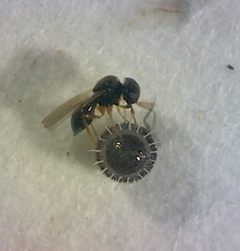
3Telenomus is a of minute egg parasitoid wasps in the Telenominae, Scelionidae. First described by Alexander Henry Haliday in 1833, in this genus develop as within the of other insects, primarily targeting Lepidoptera and Hemiptera. Several species, notably T. remus and T. podisi, are important agents used in programs against agricultural pests including fall armyworm (Spodoptera frugiperda) and stink bugs (Euschistus spp.). The genus exhibits a distribution with particular significance in tropical and subtropical agricultural systems.
Pronunciation
How to pronounce Telenomus: /tɛ.lɛˈno.mus/
These audio files are automatically generated. While they are not always 100% accurate, they are a good starting point.
Images
Habitat
Agricultural and natural where insect occur; associated with crops including maize, soybean, sugarcane, and cotton. Laboratory rearing typically conducted at 25–27°C with 65–70% relative humidity and 12–16 hour .
Distribution
distribution including the Americas, Africa, Asia, and Europe. Documented occurrences include Brazil (extensive use on 100,000–200,000 hectares of soybean), East Africa (Kenya, Tanzania), Asia (Nepal, China), and North America. Native to the Americas; introduced to other regions for purposes.
Seasonality
Activity synchronized with availability; multiple per year possible under favorable conditions. Generation time approximately 10 days at 25°C for T. remus, with temperature range of 15–31°C. T. podisi requires approximately 15 days from egg to at 25°C.
Diet
feed on honey or other sources. Larvae develop as endoparasitoids within , consuming egg contents.
Host Associations
- Spodoptera frugiperda - primary for T. remus ()Fall armyworm, major pest of maize and other crops
- Spodoptera litura - for T. remus ()Less preferred than S. frugiperda
- Spodoptera exigua - for T. remus ()Approximately equal preference to S. frugiperda
- Euschistus heros - primary for T. podisi ()Brown stink bug, main pest of soybean in Brazil
- Euschistus crenator - for T. podisi ()Confirmed documented
- Niesthrea louisianica - ()Hibiscus scentless plant bug
- Agrius convolvuli - ()Convolvulus hawk-
- Helicoverpa armigera - ()Cotton bollworm
- Helicoverpa punctigera - ()Native budworm
- Chilo auricilius - ()Rice stem borer
- Bagrada hilaris - ()Bagrada bug
- Leptocybe invasa - ()Blue gum chalcid
- Orgyia postica - ()Tussock
- Piezodorus hybneri - ()Red-banded shield bug
- Sahlbergella singularis - ()Cocoa
- Amsacta moorei - ()Red hairy caterpillar
- Cricula trifenestrata - ()Cricula silkmoth
- Eudocima fullonia - ()Fruit-piercing moth
- Helopeltis antonii - ()Tea mosquito
- Helopeltis theivora - ()Tea mosquito
Life Cycle
-to- development occurs within eggs. time varies by and temperature: approximately 10 days at 25°C for T. remus, 15 days at 25°C for T. podisi. Temperature range 15–31°C for T. remus. Sex ratio typically female-biased. Adults emerge from parasitized host eggs.
Behavior
Females locate using volatile ; T. remus exhibits stronger olfactory preference for Spodoptera frugiperda eggs over related . T. remus can overcome protective villi covering S. frugiperda egg masses, achieving greater than 90% even of innermost eggs. Host selection mediated by specific compounds: attracted to trans-1,2-dimethylcyclohexane and 2-heptadecanone, repelled by 2-hexanol. provided with honey solution in laboratory rearing.
Ecological Role
Important agent of lepidopteran and hemipteran agricultural pests. Acts as natural enemy that kills pest before larval , preventing crop damage. Reduces need for chemical in systems. Potential for integration with fungi without reduction in or survival.
Human Relevance
Widely used in programs. T. remus mass-reared on alternative Corcyra cephalonica (rice ) at approximately half the cost of rearing on natural host, enabling economical large- production. Applied on approximately 100,000–200,000 hectares in Brazil. Mass release rates of at least 18,000 individuals per hectare recommended for effective control. Subject of technology transfer programs between Africa, Asia, and the Americas for fall armyworm management.
Similar Taxa
- TrichogrammaAlso egg parasitoid wasps used in ; distinguished by -level placement (Trichogrammatidae vs. Scelionidae) and morphological differences in wing venation and
- GonatocerusEgg parasitoid wasps in Mymaridae; generally smaller body size and different wing
- OoencyrtusEgg parasitoid wasps in Encyrtidae; differ in antennal structure and association patterns
Sources and further reading
- BugGuide
- Wikipedia
- GBIF taxonomy match
- iNaturalist taxon
- NCBI Taxonomy
- Catalogue of Life
- Publications | Entomology Research Museum
- Telenomus remus wasp parasitizing Spodoptera frugiperda eggs - Entomology Today
- Pennies for Parasitoids: Savings Add Up When Rearing Wasps on Alternate Hosts
- New Study Reveals Natural Enemies of Fall Armyworm in Both Asia and Africa
- Bug Eric: Hibiscus Scentless Plant Bug Life Cycle
- Fighting Nature With Nature: Scientists Mobilize Biological Control Against Devastating Fall Armyworm
- Potential of Beauveria bassiana in the control of Euschistus crenator (Hemiptera: Pentatomidae) and selectivity to the parasitoid Telenomus podisi (Hymenoptera: Scelionidae).
- Chemical Recognition Mechanism of Telenomus remus Preference for Spodoptera frugiperda Eggs Based on Metabolomics with GC-MS.
- Storage of Euschistus heros (Fabricius, 1794) Eggs for Biological Control with Telenomus podisi Ashmead, 1851 in Open Fields in Brazil.
- Influence of egg traits on parasitism by Trichogramma chilonis Ishii, 1941 and Telenomus remus Nixon, 1937 against Spodoptera frugiperda (J.E. Smith, 1797).