
Bagrada hilaris
(Burmeister, 1835)
Bagrada bug, Painted bug
Bagrada hilaris is an shield bug native to Africa and Asia that has become a significant agricultural pest in North America, South America, and Europe. First detected in the Western Hemisphere in Los Angeles in 2008, it has since spread throughout California, Arizona, and other southwestern states, as well as establishing in Chile and Italy. The is a major pest of Brassicaceae crops including cabbage, kale, broccoli, and cauliflower, causing damage through sap-sucking by both and nymphs. Its rapid spread and broad range have made it a priority for research.
Pronunciation
How to pronounce Bagrada hilaris: /ˈbæɡrəˌdə hɪˈlærɪs/
These audio files are automatically generated. While they are not always 100% accurate, they are a good starting point.
Identification
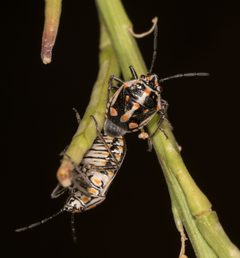
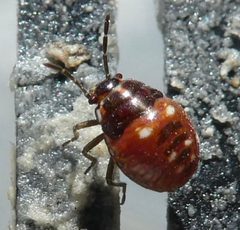
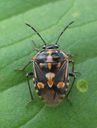
Distinguished from the native harlequin bug (Murgantia histrionica) by its smaller size—approximately half the length at 5–7 mm versus 10–12 mm for M. histrionica. The bright orange-red first-instar nymphs may be mistaken for lady beetles (Coccinellidae) but can be distinguished by their shield-shaped body form and association with Brassicaceae plants. are recognized by the combination of small size, black ground color, and white and orange markings on the shield-shaped body.
Images
Habitat
Agricultural fields, particularly those cultivating Brassicaceae crops; also found in weedy areas with wild crucifers and other plants. In invaded regions, it has been observed along river corridors with weedy vegetation. Caper bush (Capparis spinosa) cultivations in Mediterranean climates provide suitable . The thrives in warm, arid to semi-arid conditions typical of its native range.
Distribution
Native to southeastern Africa and parts of Asia including India, Pakistan, Afghanistan, Iran, and Iraq. Introduced and established in: United States (California, Arizona, Nevada, New Mexico, Texas, Utah, Hawaii), Mexico, Chile, Italy (including Sicily), and Malta. In the United States, first reported in Los Angeles County, California in June 2008; by 2020 had spread as far north as Yolo County, California. In Chile, first detected in 2016 and rapidly established with economic impact.
Seasonality
Activity peaks during summer months when levels are highest. In California's Central Valley and desert agricultural regions, build through the growing season with highest densities typically observed from late spring through early fall. Specific voltinism not documented in available sources.
Diet
feeder on Brassicaceae, with documented including cabbage (Brassica oleracea var. capitata), kale (B. oleracea var. sabellica), cauliflower (B. oleracea var. botrytis), Brussels sprouts (B. oleracea var. gemmifera), broccoli (B. oleracea var. italica), turnips (Brassica rapa), mustard (Sinapis alba, Brassica juncea), rape, arugula (Eruca sativa), and radish. Also recorded on non-brassicaceous crops: papaya, sorghum, maize, potato, cotton, caper (Capparis spinosa), pearl millet, and various legumes. Both and nymphs feed by sucking sap from leaves, causing wilting, yellowing, and stunting.
Host Associations
- Brassica oleracea (cabbage, kale, cauliflower, Brussels sprouts, broccoli) - primary major economic damage
- Brassica rapa (turnip) -
- Brassica carinata (Abyssinian cabbage) - less preferred than other brassicas
- Sinapis alba (white mustard) -
- Brassica juncea (brown mustard) -
- Eruca sativa (rocket/arugula) - highly attractive at seedling stage
- Capparis spinosa (caper bush) - major pest in Mediterranean
- Carica papaya (papaya) -
- Sorghum bicolor (sorghum) -
- Zea mays (maize) -
- Solanum tuberosum (potato) -
- Gossypium spp. (cotton) -
- Pennisetum glaucum (pearl millet) -
- Various legumes -
- Lobularia maritima (sweet alyssum) - ornamental
- Iberis spp. (candytuft) - ornamental
Life Cycle
(Hemimetabola) with , nymph, and stages. Female lays up to 100 oval to barrel-shaped eggs on leaves or in soil beneath plants. Eggs white when freshly deposited, turning orange over time. First-instar nymph emerges within approximately 8 days. Five nymphal instars occur, with nymphs progressing from bright orange-red to dark coloration, becoming black by the final instar. Developmental rate and number of per year vary with temperature; specific details not documented in available sources.
Behavior
and nymphs aggregate in large numbers on plants, causing extensive localized damage. Laboratory studies demonstrate that adults orient toward Brassicaceae seedling volatiles, with stronger attraction to cauliflower and rocket than to Abyssinian cabbage. Oviposition occurs both on leaves and in soil beneath plants, an unusual among pentatomids. behavior is influenced by starvation status. Feeding behavior involves sap-sucking from leaf tissue using .
Ecological Role
Herbivore and agricultural pest; can cause significant crop damage through direct feeding. Serves as for multiple , providing potential for . In invaded regions, it has become a novel host for native parasitoids that have expanded their host range, and for introduced parasitoids under evaluation for .
Human Relevance
Major economic pest of cole crops and related vegetables, particularly affecting organic agriculture where chemical control options are limited. Damage includes reduced yield and quality through stunting, wilting, and yellowing of plants. Management challenges arise from its rapid spread, broad host range, and lack of established natural enemies in invaded regions. Research programs focus on including , trap cropping with Brassicaceae seedlings, and resistance management. Potential biological control agents under investigation include the Trissolcus basalis, Gryon spp., Ooencyrtus mirus, Ooencyrtus lucidus, and Idris elba.
Similar Taxa
- Murgantia histrionica (Harlequin bug)Similar and appearance; distinguished by larger size (approximately 10–12 mm versus 5–7 mm for B. hilaris) and native status in North America
- Murgantia histrionica nymphsBoth have bright coloration; distinguished by size, body shape, and plant associations
More Details
Biological Control Research
Multiple have been identified as potential control agents. In Mexico, Idris elba (Platygastridae) was discovered parasitizing B. hilaris eggs in 2019. In California, Ooencyrtus mirus (Pakistani origin) and O. lucidus (apparently native to California) are under evaluation. In Kenya, Trissolcus basalis and Gryon sp. have been identified as native parasitoids. In Mexico, Gryon myrmecophilum, Telenomus podisi, and Trissolcus basalis have been recorded.
Trap Crop Potential
Seedlings of Brassica oleracea and Eruca sativa have demonstrated effectiveness as trap plants in caper bush cultivations, diverting hundreds of individuals from main crops.
Invasion History
The 2008 Los Angeles detection represents the first Western Hemisphere record. The ' rapid northward expansion in California (reaching Yolo County by 2020) and establishment in Chile (2016) demonstrate significant potential in Mediterranean and semi-arid climates worldwide.
Sources and further reading
- BugGuide
- Wikipedia
- GBIF taxonomy match
- iNaturalist taxon
- NCBI Taxonomy
- A New Wasp Species? EGSA's Winning T-Shirt | Bug Squad
- Stacey Rice's Stag Beetle T-Shirt Wins UC Davis Contest | Bug Squad
- Please Pass the Chocolate Chirp Cookies | Bug Squad
- A Gathering of Entomologists: UC Davis Faculty on Way to Portland, Ore. | Bug Squad
- Ian Grettenberger Targets a Variety of Pests | Bug Squad
- Bug Eric: The Bagrada Bug
- Bagrada hilaris . [Distribution map].
- Bagrada hilaris . [Distribution map].
- Evaluation of biological control option for Bagrada bug (Bagrada hilaris (Burmeister)) in Kenya
- Influence of starvation on walking behavior of Bagrada hilaris (Hemiptera: Pentatomidae)
- Figure 1 from: Triapitsyn SV, Andreason SA, Power N, Ganjisaffar F, Fusu L, Dominguez C, Perring TM (2020) Two new species of Ooencyrtus (Hymenoptera, Encyrtidae), egg parasitoids of the bagrada bug Bagrada hilaris (Hemiptera, Pentatomidae), with taxonomic notes on Ooencyrtus telenomicida. Journal of Hymenoptera Research 76: 57-98. https://doi.org/10.3897/jhr.76.48004
- Plants outside the field matter: Interactions betweenBagradahilarisand non-crop hosts
- Invasion, predictive distribution, and management ofBagrada hilarisin North America
- Natural Biological Control of Bagrada Hilaris by Egg Predators and Parasitoids in North-Central Californianatural Biological Control of Bagrada Hilaris by Egg Predators and Parasitoids in North-Central California
- Feeding behavior of the stink bugBagrada hilarisis changed by the electrical signals applied during EPG recordings
- Supplementary data for: Unusual Ovipositional Behavior of the Stink Bug Bagrada hilaris (Hemiptera: Heteroptera: Pentatomidae)
- How an egg parasitoid responds to an unusual stinkbug oviposition behavior: the case of Gryon gonikopalense Sharma (Hymenoptera: Scelionidae) and Bagrada hilaris (Burmeister) (Hemiptera: Pentatomidae)
- Evaluation of Brassicaceae Seedlings as Trap Plants for Bagrada Hilaris Burmeister in Caper Bush Cultivations
- Scelionidae (Hymenoptera) parasitizing eggs of Bagrada hilaris (Hemiptera, Pentatomidae) in Mexico
- Two new species of Ooencyrtus (Hymenoptera, Encyrtidae), egg parasitoids of the bagrada bug Bagrada hilaris (Hemiptera, Pentatomidae), with taxonomic notes on Ooencyrtus telenomicida