
Murgantia histrionica
(Hahn, 1834)
Harlequin Bug, Harlequin Cabbage Bug, Calico Bug, Fire Bug
is a brightly colored native to Mexico and Central America, first recorded in the United States in Texas in 1864. The has since expanded northward and now ranges across much of North America. measure 8–11.5 mm and display striking orange, red, or yellow markings on black. The species exhibits thermal melanism: nymphs reared at colder temperatures develop darker adult coloration with up to 33% more black pigmentation. It is a significant agricultural pest of cruciferous crops, sequestering defensive glucosinolates from plants.
Pronunciation
How to pronounce Murgantia histrionica: /mʊrˈɡæn.ti.ə hɪs.triˈɒ.ni.kə/
These audio files are automatically generated. While they are not always 100% accurate, they are a good starting point.
Identification
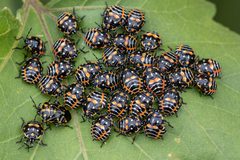
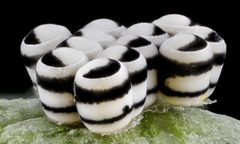
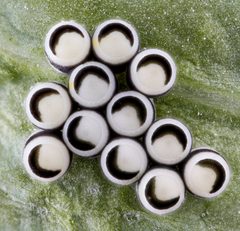
are distinguished by their vivid harlequin pattern of orange, red, or yellow on black, with a shield-shaped body typical of Pentatomidae. The can be separated from the similar Bagrada bug (Bagrada hilaris) by its larger size—8–11.5 mm versus 5–7 mm for Bagrada—and its more extensive orange coloration. Southern California may appear almost entirely black, representing an extreme of the species' thermal melanism plasticity. are diagnostic: black-and-white banded, barrel-shaped, and deposited in double rows on leaf surfaces. Nymphs are wingless with bright orange and black coloration.
Images
Habitat
Agricultural fields and gardens, particularly those containing cruciferous crops. overwinter in protected locations including plant debris, fence rows, and wooded areas. Wild mustard plants serve as early spring before cultivated crops become available.
Distribution
Native to Mexico and Central America; introduced to the United States with first record in Washington County, Texas in 1864. Currently ranges from New England south and west to Colorado, Arizona, and southern California. Sporadic records exist for northern Illinois, Minnesota, Iowa, and South Dakota. Also present in Hawaii.
Seasonality
Activity resumes in spring when wild mustard plants emerge. Two to three occur annually in the Mid-Atlantic region; up to eight generations possible in southernmost latitudes. Only one or two generations complete development in northern parts of the range. migrate to sites in fall.
Diet
Phloem sap from plants in the Brassicaceae (mustard ), with strong preference for cabbage, broccoli, kale, turnip, radish, horseradish, and Brussels sprouts. Also feeds on weeds including yellow rocket, black mustard, and peppergrass. Has been observed feeding on eggplant and other Solanaceae.
Life Cycle
to development requires 29–50 days at 27°C. Eggs incubate 4–5 days and are laid in double rows averaging 12 eggs per mass; females produce 100–300 eggs over their lifetime. Five nymphal instars span 20–31 days. Adult longevity averages 70–81 days for females and approximately 25 days for males. The is multivoltine with overlapping . occurs as adults.
Behavior
and nymphs aggregate on plants. Both sexes locate mates in part through vibrational signals transmitted through plant stems and foliage. Mating success is context-dependent: individuals reared on broccoli are more likely to mate in general, but all individuals show higher mating success when encountering potential mates on mustard. Natal host plant experience influences female preference based on male odor cues. Early instar nymphs exhibit tonic immobility as an antipredator defense, transitioning to chemical defense as glucosinolate increases with feeding. Adults cannot alter coloration once developed; melanization is fixed at .
Ecological Role
Agricultural pest causing direct feeding damage to crucifer crops; feeding produces characteristic yellow or white blotches, stunting, and distortion of leaves. Serves as prey for including the wheel bug (Arilus cristatus) and the sand wasp Bicyrtes quadrifasciata. are parasitized by Trissolcus murgantiae and Ooencyrtus johnsoni.
Human Relevance
Significant economic pest of cabbage and related crops in the southern United States. Management strategies include hand removal, trap cropping with early- or late-planted cabbage or kale, and removal of plant debris to reduce survival. Thermal composting of may limit overwintering . Warming winters have been associated with increased survival and northward range expansion.
Similar Taxa
- Bagrada hilarisFrequently mistaken for M. histrionica, but approximately half the size (5–7 mm versus 8–11.5 mm) with more restricted color pattern of orange and black.
Sources and further reading
- BugGuide
- GBIF taxonomy match
- iNaturalist taxon
- NCBI Taxonomy
- Harlequin hijinks - Harlequin bug, Murgantia histrionica — Bug of the Week
- Harlequin hijinks: Harlequin bug, Murgantia histrionica — Bug of the Week
- Bugs in Orange and Black, Part 1: Nightmare for collards when harlequin bugs arrive - Murgantia histrionica — Bug of the Week
- Bug Eric: Harlequin Bug
- Harlequin Bug Coloration Influenced by Temperature During Nymphal Stages
- Bug Eric: The Bagrada Bug
- Biology of the Harlequin Bug, Murgantia histrionica
- Harlequin Bug, Murgantia histrionica (Hahn) (Insecta: Hemiptera: Pentatomidae)
- Sexual Behavior of Murgantia Histrionica (Hemiptera: Pentatomidae)
- Context-Dependent Mating Success in Murgantia histrionica (Hemiptera: Pentatomidae)
- Phenology and Parasitism of Harlequin Bugs, Murgantia histrionica (Hahn) (Hemiptera: Pentatomidae), in Southwest Virginia
- On the Biology of the Harlequin Bug, Murgantia histrionica (Hemiptera: Pentatomidae)
- Oncopeltus-like gene expression patterns in Murgantia histrionica, a new hemipteran model system, suggest ancient regulatory network divergence
- Chemical defense and tonic immobility in early life stages of the Harlequin cabbage bug, Murgantia histrionica (Heteroptera: Pentatomidae)
- Nonmigratory Movement of Adult Harlequin Bugs Murgantia histrionica (Hemiptera: Pentatomidae) as Affected by Sex, Age and Host Plant Quality
- Chemical Cues from Murgantia histrionica Eliciting Host Location and Recognition in the Egg Parasitoid Trissolcus brochymenae
- Role of symbiotic gut bacteria in the development ofAcrosternum hilareandMurgantia histrionica
- Biology and Reproductive Behavior of <I>Murgantia histrionica</I> (Heteroptera: Pentatomidae)