
Murgantia
Stål, 1862
Species Guides
3- Murgantia histrionica(Harlequin Bug)
- Murgantia varicolor
- Murgantia violascens
Murgantia is a of shield bugs ( Pentatomidae, tribe Pentatomini) comprising approximately six described . The genus is best known for , commonly called the harlequin , a significant agricultural pest of cruciferous crops in North America. Species in this genus exhibit bright aposematic coloration—typically combinations of orange, black, and yellow—and possess chemical defense mechanisms derived from plant compounds. Research on M. histrionica has established it as a laboratory model for studying developmental plasticity, thermal melanism, and patterns in hemimetabolous insects.
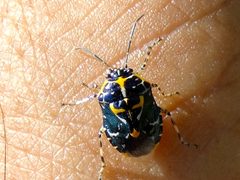
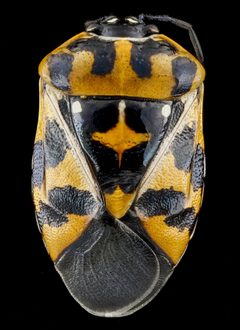
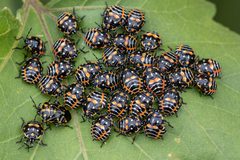
Pronunciation
How to pronounce Murgantia: /mɜːrˈɡæn.ti.ə/
These audio files are automatically generated. While they are not always 100% accurate, they are a good starting point.
Images
Habitat
Associated with plants in the mustard (Brassicaceae), including both cultivated crops and wild . occupy agricultural fields, gardens, and areas supporting wild cruciferous vegetation. occurs in protected ground-level locations such as plant debris, fence rows, and wooded margins.
Distribution
Native to Mexico and Central America; introduced and established in the United States. ranges from New England south and west to Colorado, Arizona, and southern California, with sporadic records in northern Illinois, Minnesota, Iowa, and South Dakota.
Seasonality
Activity begins in spring when overwintered emerge to feed and reproduce. Multiple occur annually in southern regions (tropics and Deep South), with two generations and a partial third in the Mid-Atlantic, and one to two generations in northern portions of the range. Activity ceases with onset of winter, when adults seek sites.
Diet
Phytophagous, feeding on phloem sap of plants in the Brassicaceae (mustard ). Documented include cabbage, broccoli, kale, turnip, horseradish, radish, mustard, and wild such as yellow rocket, black mustard, and peppergrass. has also been observed feeding on plants in the nightshade family (Solanaceae), including eggplant.
Host Associations
- Brassica oleracea - collard greens, cabbage, broccoli, kale, Brussels sprouts
- Brassica rapa - turnip, field mustard
- Raphanus sativus - radish
- Armoracia rusticana - horseradish
- Barbarea vulgaris - yellow rocket, winter cress
- Brassica nigra - black mustard
- Lepidium spp. - peppergrass
- Solanum melongena - eggplant
Life Cycle
with , nymph, and stages. Eggs are deposited in clusters on leaf surfaces, appearing as small barrel-shaped structures with black and white banding. Five nymphal instars precede the adult stage. Development from egg to adult requires approximately 30–50 days under laboratory conditions at 77°F (25°C), with duration varying by temperature. Developmental plasticity in pigmentation occurs: nymphs exposed to colder temperatures develop darker adult coloration through increased melanin deposition. Adult coloration is fixed upon and does not change with ambient temperature.
Behavior
and nymphs aggregate on plants. Females deposit clusters approximately every three days beginning ten days after adult . Mating success is context-dependent, influenced by natal host plant and encounter environment; individuals reared on broccoli show higher mating rates, but all individuals mate more readily when encountering potential mates on mustard. Females use vibrational signals transmitted through plant stems and foliage to locate mates. Tonic immobility occurs in early nymphal stages as an antipredator strategy, decreasing in frequency as chemical defenses develop through feeding. Adults can secrete defensive compounds from metathoracic when disturbed.
Ecological Role
Agricultural pest causing direct damage to cruciferous crops through feeding. Feeding destroys and vascular tissues, producing characteristic yellow or white blotches, stunting, wilting, and plant death. Serves as for including Trissolcus murgantiae and Ooencyrtus johnsoni. Chemical of glucosinolates from host plants creates defensive compounds that render the unpalatable to vertebrate , contributing to aposematic coloration function.
Human Relevance
Significant economic pest of cabbage, broccoli, kale, and related vegetable crops in the southern United States. Management strategies include hand removal, trap cropping with early- or late-planted mustard or kale, destruction of crop debris to reduce survival, and thermal composting of plant residue. Climate warming has expanded overwintering survival and pest pressure in historically cooler regions. Research value as a laboratory model for developmental , thermal physiology, and hemipteran genetics.
Similar Taxa
- Bagrada hilarisSimilar size, shape, and color pattern (orange/black); Bagrada bug is smaller (5–7 mm versus 8–11.5 mm), more rounded, and has different . Bagrada is an African established in southwestern US, while is native to the Americas.
- Eurydema spp.European cabbage with similar associations and warning coloration; differ in geographic distribution and specific color pattern details.
Sources and further reading
- BugGuide
- Wikipedia
- GBIF taxonomy match
- iNaturalist taxon
- NCBI Taxonomy
- Harlequin hijinks - Harlequin bug, Murgantia histrionica — Bug of the Week
- Harlequin hijinks: Harlequin bug, Murgantia histrionica — Bug of the Week
- Bugs in Orange and Black, Part 1: Nightmare for collards when harlequin bugs arrive - Murgantia histrionica — Bug of the Week
- Bug Eric: Harlequin Bug
- Harlequin Bug Coloration Influenced by Temperature During Nymphal Stages
- Bug Eric: The Bagrada Bug
- Biology of the Harlequin Bug, Murgantia histrionica
- Harlequin Bug, Murgantia histrionica (Hahn) (Insecta: Hemiptera: Pentatomidae)
- Semiochemistry of Cabbage Bugs (Heteroptera: Pentatomidae: Eurydema and Murgantia)1,3
- Phenology and Parasitism of Harlequin Bugs, Murgantia histrionica (Hahn) (Hemiptera: Pentatomidae), in Southwest Virginia
- On the Biology of the Harlequin Bug, Murgantia histrionica (Hemiptera: Pentatomidae)
- Chemical defense and tonic immobility in early life stages of the Harlequin cabbage bug, Murgantia histrionica (Heteroptera: Pentatomidae)
- Context-Dependent Mating Success in Murgantia histrionica (Hemiptera: Pentatomidae)
- Oncopeltus-like gene expression patterns in Murgantia histrionica, a new hemipteran model system, suggest ancient regulatory network divergence
- Sexual Behavior of Murgantia Histrionica (Hemiptera: Pentatomidae)
- Role of symbiotic gut bacteria in the development ofAcrosternum hilareandMurgantia histrionica
- Chemical Cues from Murgantia histrionica Eliciting Host Location and Recognition in the Egg Parasitoid Trissolcus brochymenae
- Nonmigratory Movement of Adult Harlequin Bugs Murgantia histrionica (Hemiptera: Pentatomidae) as Affected by Sex, Age and Host Plant Quality