
Trissolcus
Ashmead, 1893
samurai wasps
Species Guides
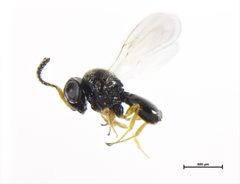
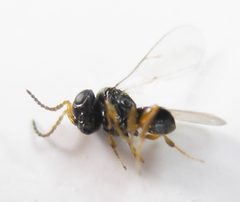
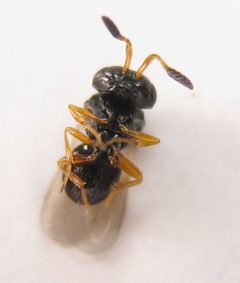
3Trissolcus is a of minute in the Scelionidae, comprising at least 180 described . Members are obligate parasitoids of true bugs in the infraorder Pentatomomorpha, including stink bugs (Pentatomidae). The genus has gained significant attention due to the potential of several species, particularly Trissolcus japonicus (the "samurai wasp"), against the brown marmorated stink bug (Halyomorpha halys). Taxonomic challenges have historically complicated identification, with recent revisionary work resolving numerous synonymies and clarifying species boundaries.
Pronunciation
How to pronounce Trissolcus: /trɪˈsɒl.kəs/
These audio files are automatically generated. While they are not always 100% accurate, they are a good starting point.
Identification
Identification to requires microscopic examination and specialized taxonomic expertise. The is distinguished from other Telenominae by combinations of antennal structure, mesosomal , and wing venation. Recent taxonomic revisions provide updated identification keys, particularly for North American species. Trissolcus japonicus can be distinguished from native North American by subtle morphological characters and confirmed through molecular markers; misidentification has been common in historical literature, with T. halyomorphae and other names now synonymized under T. japonicus.
Images
Habitat
Diverse terrestrial wherever occur, including agricultural fields, orchards, forests, and urban parks. Specific microhabitat depends on host egg placement; Trissolcus japonicus has been detected primarily in mid- to upper- zones of host trees, with ground-based sampling consistently underestimating presence. Chinese of T. cultratus occur in mixed orchards and mountainous natural habitats; Swiss populations in urban parks.
Distribution
distribution with highest diversity in the Palearctic and Oriental regions. Native range includes East Asia (China, Japan, Korea, Taiwan), with multiple now in North America and Europe following tracking or unintentional introduction. Specific distribution varies by species; T. japonicus now established in the United States, Canada, and Europe. GBIF records indicate presence in Colombia, Denmark, Norway, and Sweden.
Seasonality
Activity patterns track availability; timed to coincide with oviposition periods. In temperate regions, multiple per year possible with overlapping cohorts. Trissolcus japonicus detected in field surveys from spring through fall, with peak activity correlating with brown marmorated stink bug reproductive periods.
Diet
Obligate ; females do not feed on tissues but may consume nectar or honeydew. Larvae develop exclusively within host , consuming embryonic tissues. Laboratory colonies maintained on 20% honey water.
Host Associations
- Halyomorpha halys - Brown marmorated stink bug; primary for T. japonicus and T. cultratus
- Murgantia histrionica - Harlequin bug; for T. murgantiae, T. basalis, and other Trissolcus
- Pentatomomorpha (multiple families) - General range across Pentatomidae, Scutelleridae, and related
Life Cycle
Development occurs entirely within . Female locate egg masses using chemical and vibrational cues, then deposit one or more eggs per host egg. Larvae develop through multiple instars, consuming host embryo; occurs within the host egg shell. creates a distinct circular exit hole. Development time varies with temperature and host ; T. cultratus shows -level variation in development success on fresh versus cold-stored host eggs. Multiple per year possible in favorable climates.
Behavior
Females are patient hunters, seeking through chemical and possibly vibrational cues. Trissolcus japonicus shows vertical stratification in host trees, with detection positively correlated with tree height and position. Some exhibit facultative hyperparasitism, with T. cultratus retaining this in geographically separated . Chinese populations of T. cultratus demonstrate intrinsic competitive superiority over T. japonicus when competing for host eggs. attracted to yellow pan traps, a common collection method.
Ecological Role
Key natural enemy of stink bugs, regulating of native and pentatomids. In invaded regions, Trissolcus may provide substantial of agricultural pests. T. japonicus and T. cultratus are among the most important of the brown marmorated stink bug in kiwi orchards and other agricultural systems. Native species contribute to of stink bugs, though often with lower success on novel .
Human Relevance
Significant agent for agricultural pests, particularly the brown marmorated stink bug. Intentional redistribution of T. japonicus is underway in some U.S. states; unintentional introductions have occurred in North America and Europe. Detection in Canada concurrent with regulatory review illustrates challenges in controlling movement of biological control agents. Taxonomic preparedness has been critical to successful deployment and monitoring of these agents. No known negative impacts; specialized range limits risk to non-target .
Similar Taxa
- OoencyrtusAlso of stink bugs; distinguished by different antennal structure and wing venation
- TelenomusCongeneric in Telenominae; distinguished by antennal club structure and mesosomal characters
- HeinrichiellusIchneumonid with similar ecological roles but different range and morphological features
Misconceptions
Historical confusion between Trissolcus halyomorphae and T. japonicus has been resolved, with the former synonymized under the latter. Native North American Trissolcus were sometimes assumed to provide effective control of stink bugs, but studies show their larvae rarely complete development in novel such as Halyomorpha halys.
More Details
Taxonomic Complexity
The contains nearly 200 described with complicated taxonomic history. Last major Asian revision completed in the 1970s; recent coordinated efforts ("Team Trissolcus") have modernized identification resources and resolved multiple synonymies.
Population Variation
Geographically separated of T. cultratus show divergent parasitic capacities: Chinese strains successfully develop on fresh brown marmorated stink bug , while Swiss strains show only 4.2% development success on fresh eggs but can utilize frozen sentinel eggs.
Regulatory Significance
Unintentional introduction of T. japonicus to North America and Europe concurrent with formal regulatory review highlights challenges in controlling agent movement across borders.
Sources and further reading
- BugGuide
- Wikipedia
- GBIF taxonomy match
- iNaturalist taxon
- NCBI Taxonomy
- Why Taxonomic Preparedness is Critical for Invasive Species Response
- Non-native pest-controlling wasp in Canada | Blog
- In Search for Better Stink Bug Management, Scientists Look Up
- parasitoid wasp | Blog
- Bug Eric: Harlequin Bug
- Transcriptomic Resource of Trissolcus cultratus: A Key Biological Control Agent for Halyomorpha halys.