
Trissolcus euschisti
(Ashmead, 1888)
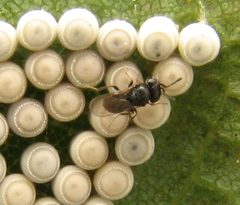
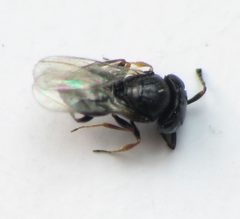
Trissolcus euschisti is a scelionid approximately 1.5 mm in length that attacks the of stink bugs (Pentatomidae), particularly in the Euschistus. The species exhibits partitioning with the congeneric parasitoid Telenomus podisi, showing greater abundance on woody plants while T. podisi dominates herbaceous vegetation. It has been investigated as a potential agent for brown marmorated stink bug (Halyomorpha halys) and demonstrates flexible reproductive strategies, including the ability to develop in hosts where resources have been partially utilized by prior parasitoid activity.
Pronunciation
How to pronounce Trissolcus euschisti: /ˈtrɪs.oʊl.kəs juːˈskɪs.taɪ/
These audio files are automatically generated. While they are not always 100% accurate, they are a good starting point.
Identification
Distinguished from Telenomus podisi by preference (T. euschisti predominates on woody plants, T. podisi on herbaceous plants). Differentiation from other Trissolcus requires examination of morphological characters; the species was historically confused with related prior to modern taxonomic revisions. Identification to species level typically requires microscopic examination by a .
Images
Appearance
Minute approximately 1.5 mm in length. Typical scelionid with compact body form characteristic of .
Habitat
Woody plants; shows clear preference for woody vegetation over herbaceous plants. Associated with supporting on woody plants.
Distribution
Records from Brazil (Mato Grosso). North American distribution includes regions where Euschistus occur.
Host Associations
- Euschistus spp. - of pentatomid stink bugs
- Halyomorpha halys - investigated as potential agent; can develop in of this pest
Life Cycle
Develops as an internal within . emerge from eggs after completing development.
Behavior
Exhibits partitioning with Telenomus podisi, occupying woody plants while the dominates herbaceous plants, thereby reducing . Demonstrates intra- and interspecific host discrimination abilities. Capable of utilizing partially depleted host resources where prior activity has occurred.
Ecological Role
of stink bugs (Pentatomidae). Contributes to of through parasitization of eggs. Competes with congeneric parasitoids through spatial partitioning rather than direct interference.
Human Relevance
Investigated as a potential agent for brown marmorated stink bug (Halyomorpha halys), a major agricultural pest. Its ability to develop in partially parasitized may enhance its effectiveness as a biocontrol agent in competitive situations. Subject of taxonomic research to clarify boundaries within the Trissolcus.
Similar Taxa
- Telenomus podisiOverlapping range and ; distinguished by partitioning (T. euschisti on woody plants, T. podisi on herbaceous plants)
- Trissolcus japonicusBoth are scelionid of stink bugs investigated for ; T. japonicus has been more extensively studied for H. halys control and shows higher success rates
More Details
Taxonomic History
The Trissolcus contains nearly 200 described worldwide. Modern taxonomic revisions, including work by Elijah Talamas and colleagues, have clarified species boundaries and resolved synonymies within the genus. Historical descriptions of many species were insufficient and lacked quality illustrations, complicating identification.
Collection Method
Can be collected using yellow pan traps, as scelionid show attraction to yellow coloration. This method has been used successfully for related Trissolcus .
Sources and further reading
- BugGuide
- GBIF taxonomy match
- iNaturalist taxon
- NCBI Taxonomy
- A visit to Ohio State University's Department of Entomology
- Why Taxonomic Preparedness is Critical for Invasive Species Response
- Non-native pest-controlling wasp in Canada | Blog
- In Search for Better Stink Bug Management, Scientists Look Up
- parasitoid wasp | Blog
- Intra- and Interspecific Host Discrimination in Telenomus podisi and Trissolcus euschisti (Hymenoptera: Scelionidae)
- Reproductive Strategy of Trissolcus euschisti (Hymenoptera: Scelionidae) under Conditions of Partially Used Host Resources
- Habitat Partitioning by Telenomus podisi and Trissolcus euschisti (Hymenoptera: Scelionidae) Between Herbaceous and Woody Host Plants