
Telenomus podisi
Ashmead, 1893
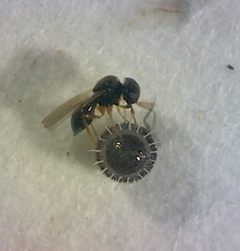
Telenomus podisi is an first described by William Harris Ashmead in 1893. It is a primary natural enemy of stink bugs (Pentatomidae), with documented as its principal . The has been extensively studied for applications in soybean and other agricultural systems, particularly in Brazil. Laboratory studies demonstrate that females can form olfactory memories during development, with learned preferences persisting up to 72 hours post-. The species is susceptible to several including imidacloprid, which is lethal, while some organic products show greater selectivity.
Pronunciation
How to pronounce Telenomus podisi: //tɛˈlɛnəməs pəˈdiːsi//
These audio files are automatically generated. While they are not always 100% accurate, they are a good starting point.
Identification
Telenomus podisi can be distinguished from related by its associations and morphological features typical of the Telenomus. It is smaller than Trissolcus that parasitize similar hosts. Identification to species level requires examination of with 10 segments (scape, , and 8 flagellomeres in females), wing venation patterns, and genitalic structures. Molecular markers may be necessary to separate from cryptic species within the Telenomus genus complex.
Images
Habitat
Agricultural fields, particularly soybean crops; associated with herbaceous plants where hosts occur. Studies indicate partitioning with related , with T. podisi more abundant on herbaceous vegetation compared to woody plants.
Distribution
South America, primarily Brazil. GBIF records indicate presence in multiple Brazilian states including Distrito Federal, Goiás, Maranhão, Minas Gerais, Mato Grosso do Sul, Mato Grosso, Pará, Pernambuco, Piauí, Paraná, Rio Grande do Sul, Santa Catarina, and São Paulo.
Host Associations
- Euschistus heros - primary Brown stink bug; principal for and maintenance
- Cosmopepla lintneriana - laboratory Can be reared on in laboratory conditions
- Podisus maculiventris - laboratory Spined soldier bug; used for laboratory rearing
- Euschistus servus - laboratory Brown stink bug; laboratory rearing documented
- Tibraca limbativentris - Rice stink bug; cited from literature
- Nezara viridula - Southern green stink bug; cited from literature
- Acrosternum aseadum - Cited from literature
- Diceraeus melacanthus - laboratory Used in quality assessment studies
Life Cycle
with development occurring entirely within eggs. development from to approximately 12 days under laboratory conditions (26°C, 65% RH, 12-hour photophase). Females deposit eggs within host eggs; larvae feed internally, pupate, and emerge as adults. capability assessed as quality indicator for agents.
Behavior
Females demonstrate learning and memory formation during developmental stages. Exposure to lemongrass (Cymbopogon citratus) extract throughout phase alters chemotactic orientation, causing preferential orientation toward learned odors. This olfactory memory persists up to 72 hours post- but is lost by 96 hours. Inexperienced females show no innate preference for lemongrass over control solvents. and capacity monitored as indicators of foraging and potential in field conditions.
Ecological Role
Important natural control agent of in agricultural . Acts as population regulator of Pentatomidae pests, particularly in soybean agroecosystems. Contributes to services that reduce crop damage from stink bug feeding. Potential for integration into conservation and programs.
Human Relevance
Significant agent for of stink bugs in soybean and other crops. Mass rearing systems developed using , with production capacity of approximately 313,300 eggs per month from 35 rearing cages sufficient to colonize 35 hectares. Computational modeling indicates optimal release strategies involve 15,000 female parasitoids per hectare in 3-4 releases of 5,000+ individuals, with 25-meter spacing between release points. Susceptibility to requires careful selection to preserve ; ethiprole classified as harmless while imidacloprid is lethal.
Similar Taxa
- Trissolcus basalisAlso an of Pentatomidae; distinguished by larger size and different range preferences
- Trissolcus euschistiSympatric with overlapping range; shows partitioning with T. podisi between herbaceous and woody plants
- Telenomus remusCongeneric used for fall armyworm control; differs in associations (Noctuidae ) and geographic distribution
- Trissolcus teretisRelated of stink bugs; differs in physiological susceptibility to
Sources and further reading
- BugGuide
- Wikipedia
- GBIF taxonomy match
- iNaturalist taxon
- NCBI Taxonomy
- Catalogue of Life
- Publications | Entomology Research Museum
- Telenomus remus wasp parasitizing Spodoptera frugiperda eggs - Entomology Today
- Pennies for Parasitoids: Savings Add Up When Rearing Wasps on Alternate Hosts
- New Study Reveals Natural Enemies of Fall Armyworm in Both Asia and Africa
- Bug Eric: Hibiscus Scentless Plant Bug Life Cycle
- Fighting Nature With Nature: Scientists Mobilize Biological Control Against Devastating Fall Armyworm
- Aprendizagem e memória de Telenomus podisi (Hymenoptera, Platygastridae)
- Side Effects of Organic Products on Telenomus podisi (Hymenoptera: Platygastridae)
- Euschistus heros mass rearing technique for the multiplication of Telenomus podisi
- Selectivity of Insecticides Against Telenomus podisi Ashmead (Hymenoptera: Platygastridae) on Corn
- Toxicity of organic supplies for the egg parasitoid Telenomus podisi
- Behavior of Telenomus podisi (Hymenoptera: Platygastridae) Adults under Overwintering Conditions
- Respostas comportamentais dos parasitoides de ovos Telenomus podisi e Trissolcus basalis (Hymenoptera : Platygastridae) a rastros químicos de percevejos (Hemiptera : Pentatomidae)
- Plant architecture and host abundance modulate biological control by >i<Telenomus podisi>/i< (Hymenoptera: Scelionidae): Implications for inundative release in soybean fields
- Teste de voo como critério de avaliação da qualidade de Telenomus podisi (Hymenoptera: Scelionidae)
- Habitat Partitioning by Telenomus podisi and Trissolcus euschisti (Hymenoptera: Scelionidae) Between Herbaceous and Woody Host Plants
- Physiological selectivity of insecticides to the egg parasitoids Telenomus podisi and Trissolcus teretis (Hymenoptera: Scelionidae)
- Release Strategies of Telenomus Podisi for Control of Euschistus Heros: A Computational Modeling Approach
- Cold storage of the egg parasitoids Trissolcus basalis (Wollaston) and Telenomus podisi Ashmead (Hymenoptera: Scelionidae)
- Reproductive Potential of Telenomus cristatus and T. podisi (Hymenoptera: Scelionidae), Two Egg Parasitoids of Pentatomids (Heteroptera)
- Intra- and Interspecific Host Discrimination in Telenomus podisi and Trissolcus euschisti (Hymenoptera: Scelionidae)
- Potential of Beauveria bassiana in the control of Euschistus crenator (Hemiptera: Pentatomidae) and selectivity to the parasitoid Telenomus podisi (Hymenoptera: Scelionidae).
- Storage of Euschistus heros (Fabricius, 1794) Eggs for Biological Control with Telenomus podisi Ashmead, 1851 in Open Fields in Brazil.