
Podisus maculiventris
(Say, 1832)
Spined Soldier Bug
Podisus maculiventris, the , is a native North American widely studied for applications. It is a of over 70 insect , including agricultural pests such as the Colorado potato beetle, Mexican bean beetle, and brown marmorated stink bug. Unlike plant-feeding stink bugs, it actively hunts and kills prey using toxic venom and digestive . overwinter and become active on warm winter days. The species has been extensively researched for augmentative release in agricultural systems, particularly against coleopteran and lepidopteran larvae.
Pronunciation
How to pronounce Podisus maculiventris: /poʊˈdaɪsəs ˌmækjʊˈvɛntrɪs/
These audio files are automatically generated. While they are not always 100% accurate, they are a good starting point.
Identification
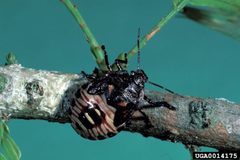
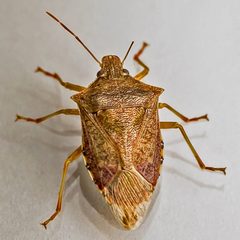
Distinguished from plant-feeding stink bugs by its predatory lifestyle and morphological features. have prominent spines on the shoulders (pronotum), giving the its . Medium-sized body with a somewhat elongated shape compared to many herbivorous pentatomids. Can be separated from the two-spotted stink bug (Perillus bioculatus) and Florida predatory stink bug by color pattern and shoulder spine configuration. Distinguished from southern green stink bug (Nezara viridula) and green stink bug (Chinavia hilaris) by the absence of green coloration and presence of predatory mouthpart structure.
Images
Habitat
Found in agricultural fields, gardens, forest edges, and areas with abundant prey . Often associated with crops hosting pest insects, including potatoes, soybeans, and cruciferous vegetables. Overwinters as in sheltered locations, becoming active on warm winter days when temperatures rise sufficiently.
Distribution
Native to North America. Recorded from the United States and Canada. Introduced or recorded in parts of Europe (Montenegro, Serbia), the Caribbean, Middle America, and Europe & Northern Asia according to GBIF distribution records. Most common and well-documented in the eastern and central United States.
Seasonality
overwinter and can be active on unseasonably warm winter days. Multiple per year in temperate regions, with beginning in spring after from sites. Activity peaks during growing season when prey are abundant.
Diet
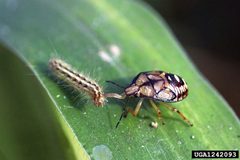
feeding on over 70 insect . Prey includes larvae of Coleoptera (beetles) and Lepidoptera ( and butterflies), including agricultural pests such as Colorado potato beetle (Leptinotarsa decemlineata), Mexican bean beetle (Epilachna varivestis), brown marmorated stink bug (Halyomorpha halys), and yellowmargined leaf beetle (Microtheca ochroloma). In laboratory studies, feeds on Galleria mellonella larvae and Tenebrio molitor larvae. Shows feeding preferences: prefers large larvae over small larvae, and smooth larvae over hairy or coleopteran larvae. Feeds by piercing prey with , injecting toxic venom to immobilize, then injecting digestive to liquefy tissues for consumption.
Life Cycle
Development includes , five nymphal instars, and stages. Egg coloration varies: females lay darker eggs on light surfaces (such as upper leaf surfaces) and lighter eggs on dark surfaces, an to protect against UV radiation. Nymphs progress through five instars before becoming winged adults. Fifth instar nymphs consume the highest amount of prey per day relative to other nymphal stages. Adults reach sexual maturity approximately one week post-, correlated with abdominal gland development and sperm production in males.
Behavior
Actively hunts prey rather than waiting in ambush. Uses synthetic as cue for prey presence; starved show positive anemotaxis toward pheromone source while well-fed individuals do not. Fifth instar nymphs do not respond to synthetic pheromone in wind tunnel assays. When feeding, lifts -pierced prey off the ground, which limits ability to kill larger prey items. Field-collected individuals show greater behavioral response to synthetic pheromone than laboratory-reared individuals from long-term colonies. Males release pheromones from abdominal gland primarily during scotophase (dark period).
Ecological Role
that contributes to of agricultural pest . Potential for augmentative release in programs. Natural enemy of such as brown marmorated stink bug, though effectiveness limited against fourth instar and older prey due to size constraints in prey-handling .
Human Relevance
Valued as agent in agriculture. Commercially available for augmentative release against crop pests. Used in organic farming systems as alternative to synthetic . Subject of extensive research for mass rearing techniques and optimization of biological control applications.
Similar Taxa
- Perillus bioculatusBoth are native North American predatory stink bugs (Asopinae) that prey on Colorado potato beetle; distinguished by color pattern (P. bioculatus has two prominent black spots on red/orange background) and shoulder spine configuration.
- Podisus nigrispinusCongeneric with similar and ; separation requires examination of genitalia and other fine morphological characters.
- Nezara viridulaSouthern green stink bug is a major plant-feeding pest of similar size; distinguished by green coloration, rounded spine on , and plant-feeding mouthparts versus predatory of P. maculiventris.
Sources and further reading
- BugGuide
- GBIF taxonomy match
- iNaturalist taxon
- NCBI Taxonomy
- Soybean Insects: Late-Season Pests (R1 to R7) - AgriLife Extension Entomology
- Stink Bugs as Biocontrol Agents Against … Stink Bugs
- Stink Bugs Lay Dark or Light Eggs, Depending on Amount of Light
- Bug Eric: New Year’s Insects and Spiders
- Yellowmargined Leaf Beetle: New Guide Offers Pest Management Tips for Organic Growers
- Bugs in orange and black, Part 3 – Trick or treat? Two-spotted stink bug, Perillus bioculatus, has a lethal trick that turns Colorado potato beetle, Leptinotarsa decemlineata, into a tasty treat — Bug of the Week
- Spined Soldier Bug, Podisus maculiventris (Say) (Insecta: Hemiptera: Pentatomidae)
- A STUDY ON ENERGETICS OF PODISUS MACULIVENTRIS (HEMIPTERA: PENTATOMIDAE)
- Feeding Behavior of Podisus maculiventris (Say) (Hemiptera: Pentatomidae): Implications for Mass Rearing and Biological Control
- Life History of Podisus maculiventris Given Low Numbers of Epilachna varivestis as Prey
- Semiochemical release and ontogenetic changes in a primary scent gland of Podisus maculiventris
- Behavioral Response of Podisus maculiventris (Hemiptera: Pentatomidae) to its Synthetic Pheromone
- Effects of Host Plants and Feeding Regimes on Selected Life History Characteristics of Podisus maculiventris (Say) (Heteroptera: Pentatomidae)