
Ooencyrtus
Ashmead, 1900
Species Guides
1- Ooencyrtus kuvanae(gypsy moth egg parasitoid)
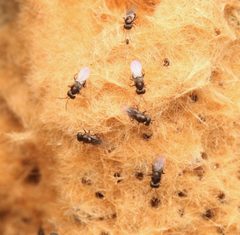
Ooencyrtus is a of chalcid wasps in the Encyrtidae, established by William Harris Ashmead in 1900. The genus comprises approximately 320 recognized as of 2017, making it one of the larger genera within Encyrtidae. Species of Ooencyrtus are primarily , attacking eggs of various insects including true bugs, beetles, and . Several species have been investigated for of agricultural pests, including O. kuvanae for gypsy moth control and O. nezarae for kudzu bug management.
Pronunciation
How to pronounce Ooencyrtus: //oʊ.ɛnˈsɪr.təs//
These audio files are automatically generated. While they are not always 100% accurate, they are a good starting point.
Identification
Ooencyrtus are small chalcid wasps, typically 1-3 mm in length. Diagnostic features for the include characteristics of the , mesosoma, and wing venation typical of Encyrtidae, though species-level identification requires examination of microscopic morphological details. Species are distinguished by features of the antennae (number of segments, proportions of funicular segments), mesoscutal , and genitalia structure. The genus can be separated from related encyrtid genera by combinations of antennal segment proportions, mesoscutal setation patterns, and wing venation details.
Images
Distribution
The Ooencyrtus has a worldwide distribution, with recorded from North America, South America, Europe, Asia, Africa, and Oceania. Distribution records include Beijing (China), Bihar (India), Buryat (Russia), California and Connecticut (USA). Specific species have more restricted ranges: O. kuvanae is native to Japan and was introduced to North America for ; O. nezarae is native to Asia and was first discovered in North America in 2016.
Diet
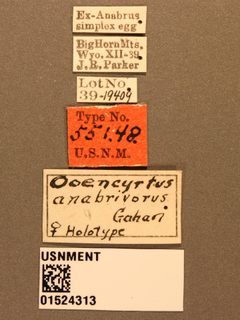
of Ooencyrtus are obligate . records include eggs of various insects: O. kuvanae parasitizes gypsy moth (Lymantria dispar) eggs; O. nezarae attacks kudzu bug (Megacopta cribraria) eggs; O. anabrivorus parasitizes eggs of the brown-tail moth; O. clisiocampae attacks eggs; O. johnsoni parasitizes eggs of the bagworm; O. papilionis attacks eggs. Host specificity varies among species, with some relatively specialized and others more .
Host Associations
- Lymantria dispar - O. kuvanae
- Megacopta cribraria - O. nezarae
- Euproctis chrysorrhoea - O. anabrivorus, brown-tail moth
- Malacosoma americanum - O. clisiocampae, eastern tent caterpillar
- Thyridopteryx ephemeraeformis - O. johnsoni, bagworm
- Papilio spp. - O. papilionis, swallowtail butterflies
- Bagrada hilaris - O. telenomicida and related
Behavior
Ooencyrtus females search for masses and oviposit into individual eggs. The develops within the host egg, with larvae feeding on the developing embryo. occurs through a hole chewed in the host egg ; the position of this emergence hole can be diagnostic (e.g., O. nezarae emerges from the side of kudzu bug eggs, while some related parasitoids emerge from the top). Development is typically rapid, with multiple per year possible under favorable conditions. Sex ratio varies but females typically predominate.
Ecological Role
Ooencyrtus function as agents of various insect pests in natural and agricultural . By parasitizing , they reduce of herbivorous insects before significant damage occurs. Some species have been introduced for of pests. In native ecosystems, they contribute to of their insects.
Human Relevance
Several Ooencyrtus have been used or investigated for of agricultural and forestry pests. Ooencyrtus kuvanae was introduced from Japan to North America in the early 20th century for control of the gypsy moth, though its effectiveness has been debated. Ooencyrtus nezarae shows promise for biological control of the kudzu bug in the southern United States. Other species have been studied for control of bagworms, tent caterpillars, and stink bugs. The is of ongoing interest to biological control researchers.
Similar Taxa
- AnagrusBoth are small Encyrtidae, but Anagrus are typically even smaller (often under 1 mm), have reduced wing venation with very short , and are associated with leafhopper and planthopper rather than lepidopteran or hemipteran eggs.
- MetaphycusBoth are Encyrtidae with similar general body plan, but Metaphycus are of scale insects (Coccoidea) rather than , and have different antennal structure and mesoscutal .
- TelenomusBoth are , but Telenomus belongs to Platygastridae (formerly Scelionidae), not Encyrtidae. Telenomus typically have elbowed with compact club and different wing venation with reduced venation.
- TrichogrammaBoth are used in , but Trichogramma belongs to Trichogrammatidae, not Encyrtidae. Trichogramma are generally smaller (0.3-0.6 mm), have distinctive wing venation with extremely reduced venation, and often show different patterns from eggs.
More Details
Taxonomic history
The was established by Ashmead in 1900. The name is derived from Greek 'oon' () and 'encyrtus', referring to its egg habit and placement in Encyrtidae. Some have been moved into or out of the genus as concepts of generic limits have changed.
Species diversity
With approximately 320 recognized as of 2017, Ooencyrtus is among the most species-rich in Encyrtidae. New species continue to be described, particularly from under-sampled regions and associated with emerging pest problems.
Molecular studies
Recent molecular studies have helped clarify relationships within Ooencyrtus and between Ooencyrtus and related . Some previously placed in Ooencyrtus have been transferred to other genera based on molecular and morphological data.
Biological control research
The University of California Riverside Entomology Research Museum holds significant collections of Ooencyrtus, including voucher specimens from projects. The museum's Encyrtidae collection, curated by S.V. Triapitsyn, contains numerous identified specimens and type material.
Sources and further reading
- BugGuide
- Wikipedia
- GBIF taxonomy match
- iNaturalist taxon
- NCBI Taxonomy
- Catalogue of Life
- ooencyrtus_limeirae_myartseva_holotype_female_ucrc_ent_222398_lateral.jpg | Entomology Research Museum
- Primary Type List | Entomology Research Museum
- Encyrtid Holdings | Entomology Research Museum
- Publications | Entomology Research Museum
- kudzu bug and Ooencyrtus nezarae - Entomology Today
- kudzu bug eggs parasitized by Ooencyrtus nezarae and Paratelenomus saccharalis - Entomology Today