
Lymantria dispar
(Linnaeus, 1758)
spongy moth, gypsy moth
is a forest-defoliating native to Europe and Asia, now across multiple continents including North America. The is notable for pronounced in and variable capability among —females of the European subspecies (L. d. dispar) are flightless, while Asian subspecies possess flight-capable females. Larvae are and have been documented feeding on over 500 plant species. The species ranks among the world's most destructive invasive forest pests, with documented exceeding 2.5 million caterpillars per hectare.
Pronunciation
How to pronounce Lymantria dispar: //lɪˈmæn.tri.ə ˈdɪs.pɑːr//
These audio files are automatically generated. While they are not always 100% accurate, they are a good starting point.
Identification
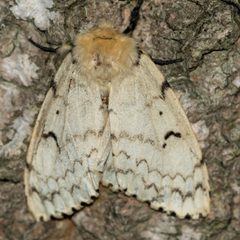
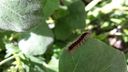
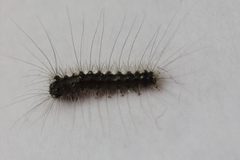
Distinguished from native North American tussock moths (Orgyia spp.) by larval color pattern—L. dispar larvae display distinct alternating blue and red rather than prominent hair tufts. Separated from flighted by female : L. d. dispar females have reduced, non-functional wings and enlarged ; -capable possess fully developed wings. Molecular diagnostics required for definitive subspecies identification. masses are uniquely sponge-like in texture, unlike the felted or hair-covered masses of related .
Images
Habitat
Temperate deciduous and mixed forests; also established in urban and suburban environments with suitable trees. Thrives in disturbed forest edges and areas with oak (Quercus spp.) dominance. exploit a broad range of forest types from to oak-hickory transition zones.
Distribution
Native to temperate Europe and Asia; introduced and in eastern North America (since 1869), Canada, and scattered South American locations. Asian L. d. asiatica detected along the Pacific coast of North America. Expanding range in Europe northward from southern .
Seasonality
emerge July through August; larval feeding occurs May through June in temperate regions; masses overwinter and hatch the following spring. cycles typically occur every 8–12 years, though climate change has extended outbreak duration in some regions.
Diet
Highly larvae feed on foliage of deciduous and coniferous trees. Documented include oak (Quercus), maple (Acer), birch (Betula), aspen (Populus), willow (Salix), pine (Pinus), and spruce (Picea), among over 500 recorded . Preferred hosts vary regionally; oak species are favored where available.
Host Associations
- Quercus spp. - primary Preferred in North American
- Acer spp. - Significant defoliation documented
- Betula spp. - Common in regions
- Populus tremuloides - Defoliation triggers chemical defense changes affecting other Lepidoptera
Life Cycle
. overwinter and hatch in spring; larvae progress through five to six instars over 7–10 weeks; occurs in late June to July; peaks in mid-summer; females deposit single egg mass before death. No adult feeding occurs.
Behavior
First-instar larvae exhibit ballooning —releasing silk threads to catch wind and disperse up to several kilometers. Flightless females (L. d. dispar) release and remain stationary to attract flying males. of both sexes are attracted to light. masses deposited on diverse substrates facilitate human-mediated .
Ecological Role
function as engineers through massive defoliation, altering forest composition by temporarily reducing competitive dominance of preferred . Defoliation of quaking aspen has been observed to induce chemical defenses that render trees unsuitable for other Lepidoptera including Antheraea polyphemus. Serves as host for introduced agents including and .
Human Relevance
Major economic pest of forestry; cumulative defoliation of 33 million hectares in North America from 1970–2013. U.S. Forest Service allocates approximately $30 million annually for management. programs introduced multiple and , some with documented non-target effects on native Lepidoptera. changed from "" to "spongy " in 2022 by Entomological Society of America due to ethnic slur concerns.
Similar Taxa
- Orgyia leucostigma (white-marked tussock moth)Larvae share general tussock appearance but possess prominent white hair tufts and lack the distinct blue-red pattern of L. dispar; not a major forest defoliator.
- Lymantria monacha (nun moth)European with similar but larvae display different color pattern (black with red spots) and of both sexes are -capable.
- Lymantria dispar asiatica (flighted spongy moth) distinguished only by female capability and subtle morphological differences; requires molecular or detailed morphological examination for separation.
More Details
Subspecies differentiation
Three primary recognized: L. d. dispar (Europe, flightless females), L. d. asiatica (temperate Asia, -capable females), and L. d. japonica (Japan, flight-capable females). USDA defines Asian subspecies operationally as "any possessing female flight capability," though this encompasses multiple genetic lineages.
Biological control history
Over ten and introduced to North America beginning in the late 1800s. Compsilura concinnata (tachinid fly) and Ooencyrtus kuvanae (encyrtid ) proved to be damaging attacking native Lepidoptera. Most effective current controls are native or introduced : multiple (LdMNPV) and the fungus Entomophaga maimaiga.
Detection and management
traps target males; mass surveys conducted on tree boles and artificial substrates. Regulatory focus on preventing establishment of flighted , which pose greater spread risk. International shipping inspections target egg masses on vessels and cargo.