
Orgyia leucostigma
(Smith, 1797)
White-marked Tussock Moth
A tussock native to North America, distinguished by sexually dimorphic : females are flightless with reduced wings, while males are winged and active. The caterpillar is conspicuously colored with defensive hair tufts and can cause allergic reactions in humans. Multiple occur annually in eastern North America, with occasionally reported on urban trees.
Pronunciation
How to pronounce Orgyia leucostigma: /ɔrˈɡɪ.iə luːkoʊˈstɪɡmə/
These audio files are automatically generated. While they are not always 100% accurate, they are a good starting point.
Identification
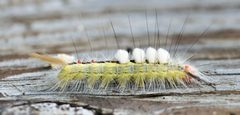
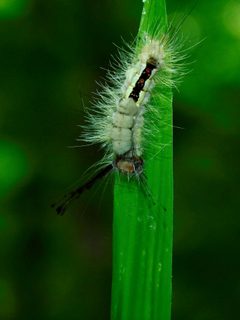
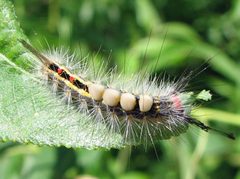
males distinguished from the similar Vapourer (Orgyia antiqua) by gray coloration rather than rusty brown; both share the white forewing spot and feathery . Larvae identified by the combination of red , four white tufts, and red glands; no other eastern North American tussock moth larva matches this pattern. Females are flightless with reduced wings, unlike most moth species.
Images
Habitat
Found in diverse wooded including deciduous and coniferous forests, urban parks, and suburban areas. Larvae occur on trees across a range of forest types and developed landscapes.
Distribution
Eastern North America from the Atlantic coast west to Texas, Colorado, and Alberta. Also reported from Europe and Taiwan. Multiple recognized across the range: O. l. leucostigma (southeastern), O. l. intermedia (northeastern and central), O. l. plagiata (Maritime Canada), O. l. oslari (southwestern), O. l. sablensis (Sable Island).
Seasonality
active from June to October. Two or more per year in eastern North America. Larvae most conspicuous in late summer. Overwinters as .
Diet
Larvae feed on an exceptionally broad range of woody plants including apple, birch, black locust, cherry, elm, fir, hackberry, hemlock, hickory, larch, oak, rose, spruce, chestnut, and willow. Young larvae skeletonize leaf surfaces; older larvae consume all leaf tissue except major .
Host Associations
- Malus - larval foodplantapple
- Betula - larval foodplantbirch
- Robinia pseudoacacia - larval foodplantblack locust
- Prunus - larval foodplantcherry
- Ulmus - larval foodplantelm; defoliating reported on Manitoba maple and urban elm
- Abies - larval foodplantfir
- Celtis - larval foodplanthackberry
- Tsuga - larval foodplanthemlock
- Carya - larval foodplanthickory
- Larix - larval foodplantlarch
- Quercus - larval foodplantoak
- Rosa - larval foodplantrose
- Picea - larval foodplantspruce
- Castanea - larval foodplantchestnut
- Salix - larval foodplantwillow
Life Cycle
are laid in a single mass of up to 300 over the female's cocoon, covered with froth. Eggs overwinter. Larvae feed and develop through multiple instars. occurs in a cocoon spun in bark crevices; emerge after approximately two weeks. Females remain at the cocoon and emit to attract males; after mating and egg-laying, females die without dispersing.
Behavior
Females are flightless and exhibit extreme , remaining at their cocoon to mate and oviposit. Larval occurs by ballooning on silk threads. Larvae possess urticating setae that trigger allergic reactions upon contact with human skin.
Ecological Role
Defoliator of broadleaf and coniferous trees; occasional can cause significant tree damage in urban areas. Outbreaks are typically terminated by viral . The four white tufts of larvae have been hypothesized to mimic the cocoons of parasitic , potentially serving as a visual defense against . Large larvae are preyed upon by birds; small larvae experience high mortality during . The introduced fungus Entomophaga maimaiga, originally released for spongy moth control, also infects this .
Human Relevance
Larval setae cause allergic dermatitis in sensitive individuals upon contact. Occasional defoliating on urban trees (particularly Manitoba maple and elm) generate management concern. The is not a major economic pest but can be a nuisance in residential areas.
Similar Taxa
- Orgyia antiquaSimilar gray male with white forewing spot and feathery , but O. antiqua has rusty brown coloration rather than gray; females similarly flightless.
- Orgyia pseudotsugataRelated tussock with similar ; distinguished by distribution (western North America) and association primarily with Douglas-fir.
- Orgyia vetustaWestern tussock moth with overlapping range in western North America; similar larval appearance but different geographic distribution.
More Details
Etymology
The name Orgyia derives from Greek ὄργυια (órgyia), meaning 'outstretched arms', referring to the posture of resting with forelegs extended forward.
Sexual dimorphism
Among the most extreme in Lepidoptera: females are completely flightless with wings, while males are fully winged and active fliers. This has led to females being historically overlooked or described separately in early literature.