
Orgyia antiqua
(Linnaeus, 1758)
rusty tussock moth, vapourer
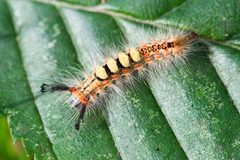
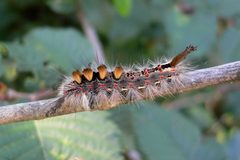
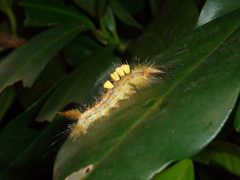
Orgyia antiqua, commonly known as the rusty tussock or vapourer, is a moth in the Erebidae native to Europe with a transcontinental distribution across the Palaearctic and Nearctic regions. The exhibits pronounced : males are fully winged with orange- to red-brown forewings marked by white comma-shaped spots, while females are flightless with wings. Caterpillars are visually distinctive with dark grey to black bodies, red , and prominent hair tufts including four toothbrush-like tufts and hair pencils at the front and rear. The species is on deciduous trees and shrubs, with in Scotland showing strong association with birch.
Pronunciation
How to pronounce Orgyia antiqua: //ˈɔːrɡiə ˈæn.tɪ.kwə//
These audio files are automatically generated. While they are not always 100% accurate, they are a good starting point.
Identification
males distinguished from similar Orgyia by orange-red forewings with white comma-shaped tornal spot and markedly . Flightless females with wings are unique among sympatric ; grey-brown coloration and swollen aid recognition. Caterpillars unmistakable due to combination of dark body, red , and prominent hair tufts including four 'humps' and / 'horns' and 'tail' projections. In North America, may be confused with O. leucostigma (white-marked tussock moth) or O. pseudotsugata (Douglas-fir tussock moth), but O. antiqua males lack the white forewing markings of O. leucostigma and have different plant associations than O. pseudotsugata.
Images
Habitat
Shrub-based including gardens, parks, open woodland, fens, hedgerows, heaths, and moors. In North America, occurs in forested areas where plants are present. Associated with birch woodlands in Scotland.
Distribution
Native to Europe; transcontinental distribution in Palaearctic and Nearctic regions. Present in UK as common resident. GBIF records confirm presence in North America, Belgium, and multiple Belgian regions.
Seasonality
In UK, protracted single from July to October in south, September to October in north. In North America, one generation per year with flying from May to October. Caterpillars present May to early September in UK. Overwinters as .
Diet
caterpillars feed on wide range of deciduous trees and shrubs including birch (Betula), hawthorn (Crataegus), lime (Tilia), Prunus, oak (Quercus), Rubus, willow (Salix), tamarisk (Tamarix), Vaccinium, and others. In Scotland, almost exclusively associated with birch; also recorded on Sitka spruce.
Host Associations
- Betula - primary especially in Scotland
- Salix myrsinifolia - affects resistance
- Salix viminalis - higher phenolic glycosides, reduced larval growth but better resistance
- Crataegus -
- Tilia -
- Prunus -
- Quercus -
- Rubus -
- Tamarix -
- Vaccinium -
- Picea sitchensis - recorded damaging in Scotland
Life Cycle
: several hundred laid on exterior of female's empty cocoon, attached to plant or nearby structures; brownish, rounded, somewhat flattened with small darker depression on upperside; stage. Larvae: hatch early spring when foliage appears; present May to early September in UK; defensive glands at rear used to charge setae with toxins; females considerably larger than males. Pupae: formed in crevices inside silk cocoons. : males fly in zigzag pattern, often high, or , attracted to traps; females flightless, remain attached to cocoon, release pheromone to attract males.
Behavior
Males fly in zigzag pattern, often at height, searching for females; active day or night and occasionally attracted to light. Females are sedentary, releasing from their cocoon to attract males via concentration gradient; mate and lay on their own cocoon. Caterpillars exhibit defensive : wipe setae against glands to charge them with toxins. Group rearing affects individual condition (body weight, development time) but plant dominates resistance outcomes.
Ecological Role
Herbivore in deciduous woodland and shrubland ; tritrophic interactions involving plant quality, herbivore performance, and fungal (Metarhizium anisopliae) resistance. Minor forest pest in North America; potential urban pest in UK cities. Serves as host for (OaNPV) which has been studied for cross- potential with gypsy moth (Lymantria dispar).
Human Relevance
Minor forest pest in North America; occasional pest in UK cities. Subject of disruption studies for potential management using (Z)-6-heneicosen-11-one. sequenced as part of Darwin Tree of Life project. Used in research on insect- interactions, immune , and evolutionary trade-offs between growth and resistance.
Similar Taxa
- Orgyia leucostigmaWhite-marked tussock ; males have white forewing markings unlike O. antiqua's orange-red wings with single white comma spot; both share sensitivity to (Z)-6-heneicosen-11-one
- Orgyia pseudotsugataDouglas-fir tussock ; conifer-feeding in western North America, unlike O. antiqua; females also flightless but associated with Douglas-fir forests
- Dasychira plagiataConifer-feeding tussock ; also susceptible to disruption with same compound, but in different with different associations
More Details
Sex pheromone
Female attracts males who locate females via concentration gradient; synthetic compound (Z)-6-heneicosen-11-one disrupts mating communication in laboratory and field conditions at 20-50 mg/ha/day release rates
Genome
sequenced as part of Wellcome Trust Darwin Tree of Life project (PMCID: PMC11502997)
Pathogen resistance
plant is main determinant of larval survival after fungal ; Salix viminalis (high phenolic glycosides) supports poorer growth but better resistance than S. myrsinifolia, indicating growth-resistance trade-off
IUCN status
Not listed on IUCN Red List (2007); considered common resident in UK
Sources and further reading
- BugGuide
- Wikipedia
- GBIF taxonomy match
- iNaturalist taxon
- NCBI Taxonomy
- Catalogue of Life
- Plant hunting in South Essex - Buglife Blog - Buglife
- Bug Eric: National Moth Week Recap, 2015
- Bug Eric: National Science Foundation Suspends Funding Support for Biological Collections
- RFID Tracking: Where It Fits in an Entomologist's Toolbox
- How Students Can Get Involved Entomological Preservation Projects
- Hate mail | Beetles In The Bush
- DISRUPTION OF PHEROMONE COMMUNICATION OF THE RUSTY TUSSOCK MOTH, ORGYIA ANTIQUA (LEPIDOPTERA: LYMANTRIIDAE), WITH (Z)-6-HENEICOSEN-11-ONE
- Pathogen resistance in the mothOrgyia antiqua: direct influence of host plant dominates over the effects of individual condition
- On the susceptibility of different geographical races of the gypsy moth (Lymantria dispar L.; Lep., Lymantriidae) to a nuclear polyhedrosis virus of the rusty tussock moth (Orgyia antiqua Hbn.; Lep., Lymantriidae)1
- The genome sequence of the Vapourer moth, Orgyia antiqua (Linnaeus, 1758).