
Orgyia pseudotsugata
McDunnough, 1921
Douglas-fir tussock moth
A western North American tussock known for periodic that cause significant defoliation of conifer forests. Males are winged and grayish-brown with feathery , while females are flightless with wings. Caterpillars are distinctive with red spots, white spines, and prominent red-tipped white tussocks. The undergoes cyclical outbreaks every 8-12 years that can persist for up to four years.
Pronunciation
How to pronounce Orgyia pseudotsugata: /ˈɔːrɡiə ˌsjuːdoʊtsuːˈɡɑːtə/
These audio files are automatically generated. While they are not always 100% accurate, they are a good starting point.
Identification
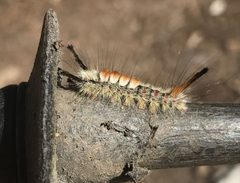
Males distinguished by grayish-brown mottled coloration, feathery , and wingspread of 25-34 mm. Flightless females with wings are unique among local fauna. Caterpillars unmistakable due to combination of red spots, white spines, red-tipped white tussocks, and long black hair tufts at both ends. Similar to Orgyia vetusta (western tussock moth) but associated with different preferences and geographic range.
Images
Appearance
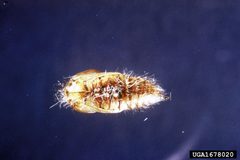
males are grayish-brown with mottled light and dark markings, wingspread 25-34 mm, with brown hindwings visible when spread. are (feathery). Northern are darker; southern populations lighter. Females are flightless with only wings. Caterpillars are 20-26 mm, colorful with red spots, white spines, conspicuous red-tipped white tufts (tussocks), and dense bunches of long black hairs projecting forward and backward.
Habitat
Coniferous forests of western North America, particularly stands of Douglas-fir, true fir, and spruce. occur across a broad elevational range wherever trees are abundant.
Distribution
Western North America: British Columbia, Idaho, Washington, Oregon, Nevada, California, Arizona, New Mexico, Colorado, western Montana. Three recognized with somewhat different ranges: O. p. pseudotsugata (British Columbia to Idaho, western Montana, eastern Washington, Oregon, Colorado, Nevada, California), O. p. morosa (British Columbia to California), and O. p. benigna (Arizona).
Seasonality
hatch in spring (May-June). Caterpillars feed through summer. occurs in July-August within silken cocoons. emerge July/August to November. Females remain near cocoons; males fly to locate mates.
Diet
Larvae feed on needles of Pseudotsuga and Abies , especially Douglas-fir (Pseudotsuga menziesii), grand fir (Abies grandis), and white fir (Abies concolor). Also feeds on true fir and spruce species. Young larvae initially feed on new foliage (current season's growth), later consuming both new and old needles.
Host Associations
- Pseudotsuga menziesii - primary Douglas-fir, namesake
- Abies grandis - primary grand fir
- Abies concolor - primary white fir
- Picea - secondary spruce
Life Cycle
are spherical, white, laid in protective masses and overwinter. Larvae hatch May-June and progress through instars feeding on conifer needles. Caterpillars produce long silky threads enabling wind-assisted between branches. occurs July-August in loose silken webbing forming a cocoon. emerge late summer through November. Flightless females remain at site, emitting to attract flying males. Because females are sedentary, always form in place rather than spreading through female dispersal.
Behavior
Caterpillars are the primary stage, using silk threads to drop from branches and catch wind currents. During , extensive webbing is produced. are ; males fly to locate sedentary females. Females do not disperse, remaining at their cocoon site for mating and oviposition.
Ecological Role
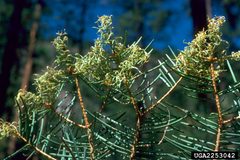
Periodic cause extensive defoliation of conifer forests, temporarily altering forest structure and nutrient cycling. Outbreak collapse may be mediated by natural enemies including viral and . Serves as for parasitoid wasps including Pimpla sanguinipes (Coccygomimus sanguinipes). Defoliation events create pulses of dead needle litter and alter understory light conditions.
Human Relevance
Major forest pest in western North America; cause timber loss, tree mortality, and increased fire risk. Management includes trap monitoring for early detection, silvicultural techniques, and aerial application of carbaryl. Outbreaks typically subside naturally after 1-4 years. Economic impacts on forestry industry and forest services.
Similar Taxa
- Orgyia vetustaWestern tussock moth; similar caterpillar appearance with tussocks and hair tufts, but different geographic distribution and associations
- Orgyia antiquaVapourer ; related tussock moth with flightless female, but Palearctic distribution and different color pattern
- Lymantria disparGypsy moth; also causes cyclical and defoliation, but males and females both winged (though females weak fliers), and different caterpillar appearance
More Details
Population Dynamics
follow cycles of approximately 8-12 years, with major events recorded in 2011 (Idaho, Washington) and 2015 (Colorado). Outbreak duration typically 1-4 years. collapse often attributed to (NPV) and natural enemies.
Management History
-based monitoring systems developed for early warning. Aerial spraying of carbaryl has been employed during severe , though outbreaks generally self-limit without intervention.
Taxonomic Note
Originally described as Hemerocampa pseudotsugata by McDunnough in 1921. placement has varied between and Erebidae ( Lymantriinae) depending on classification system used.