
Orgyia
Ochsenheimer, 1810
tussock moths, vapourer moths
Species Guides
9- Orgyia antiqua(rusty tussock moth)
- Orgyia definita(Definite Tussock Moth)
- Orgyia detrita(Fir Tussock Moth)
- Orgyia falcata
- Orgyia leucostigma(White-marked Tussock Moth)
- Orgyia leuschneri(Box-elder Tussock Moth)
- Orgyia magna(Great Tussock Moth)
- Orgyia pseudotsugata(Douglas-fir tussock moth)
- Orgyia vetusta(Western Tussock Moth)
Orgyia is a of tussock moths in the Erebidae, characterized by pronounced : males are fully winged and , while females are wingless with reduced, -like wings and remain flightless. The genus was established by Ochsenheimer in 1810 and contains distributed across most global regions except the Neotropics. Several species are significant forest and agricultural pests, notably Orgyia pseudotsugata (Douglas-fir Tussock ), which undergoes periodic in western North America.
Pronunciation
How to pronounce Orgyia: //ˈɔːrdʒiə//
These audio files are automatically generated. While they are not always 100% accurate, they are a good starting point.
Identification
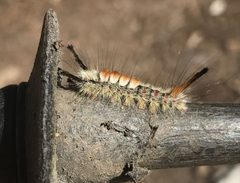
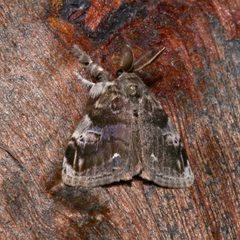
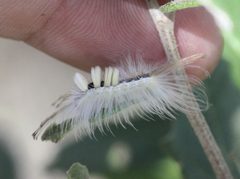
Males distinguished from similar tussock moths by combination of and specific wing venation patterns (areole formation in forewing, stalked 6 and 7 in hindwing). Females readily identified by wingless condition and hairy, dilated . Larvae possess characteristic tussock features including dense hair tufts and tussocks, though specific identification to requires examination of .
Images
Habitat
Diverse including forests, woodlands, scrublands, and brownfield sites. Specific habitat associations vary by ; Orgyia recens restricted to fen habitats in Great Britain. plant availability is a primary habitat determinant.
Distribution
distribution across Palearctic, Nearctic, Oriental, Afrotropical, and Australasian realms. Absent from Neotropical region. Specific range limits vary by .
Seasonality
timing varies by and latitude. Orgyia recens: late May through July with partial second August to October. Orgyia pseudotsugata: in western North America with adult emergence typically summer months.
Diet
Larvae feed on broad-leaved trees and shrubs. Specific associations vary by ; documented hosts include Rubus fruticosus (bramble), Salix spp. (willows), Crataegus monogyna (hawthorn), Quercus spp. (oaks), and Pseudotsuga menziesii (Douglas-fir) for O. pseudotsugata.
Host Associations
- Rubus fruticosus - larval food plantbramble
- Salix spp. - larval food plantwillows
- Salix cinerea subsp. oleifolia - larval food plant
- Salix caprea - larval food plant
- Crataegus monogyna - larval food planthawthorn
- Quercus robur - larval food plantpedunculate oak
- Quercus petraea - larval food plant oak
- Pseudotsuga menziesii - larval food plantDouglas-fir; primary of O. pseudotsugata
Life Cycle
with partial second in some and . Larvae overwinter as larvae, typically in loose silk spinning between leaves or in protected locations. Resume feeding in spring, pupate, and emerge as . Orgyia recens: larvae overwinter as larvae in loose silk spinning between two leaves, resume feeding April, pupate May.
Behavior
Males are fliers, unusual among . Females are flightless, remain on or near pupal case, and emit immediately upon to attract males. Mating occurs promptly with first arriving male. Females lay on or near pupal case; in O. recens, up to approximately 350 eggs.
Ecological Role
Larvae function as defoliators of woody plants. Periodic of O. pseudotsugata cause significant forest defoliation in western North America. Serve as for including Pimpla sanguinipes (Ichneumonidae), which attacks O. pseudotsugata and O. vetusta larvae.
Human Relevance
Several are significant forest and agricultural pests. Orgyia pseudotsugata (Douglas-fir Tussock ) undergoes periodic causing extensive defoliation of Douglas-fir and true firs in western North America, with economic impacts on forestry. Orgyia recens (Scarce Vapourer) is a Red Data Book species in Great Britain, listed as Endangered and Nationally Rare, with documented decline across its range.
Similar Taxa
- LymantriaBoth are tussock moths in Lymantriinae; distinguished by Orgyia male and specific wing venation patterns, plus extreme female wing reduction in Orgyia
- DasychiraTussock moths with hairy larvae; Orgyia males distinguished by habit and wing venation, females by complete winglessness
More Details
Sexual dimorphism evolution
The extreme in Orgyia, with wingless females, represents an where females allocate resources to production rather than structures, relying on signaling to attract mobile males.
Genomic resources
sequence available for Orgyia recens (Scarce Vapourer), published 2025 (Wellcome Open Research), providing molecular resources for this declining European .