
Dasychira
Hübner, 1809
tussock moths
Species Guides
15- Dasychira atrivenosa(diminutive tussock moth)
- Dasychira basiflava(Yellow-based Tussock Moth)
- Dasychira cinnamomea(Cinnamon Tussock Moth)
- Dasychira dominickaria(Dominick's tussock moth)
- Dasychira dorsipennata(Sharp-lined Tussock Moth)
- Dasychira grisefacta(Grizzled Tussock Moth)
- Dasychira leucophaea(pale-banded tussock moth)
- Dasychira manto(Manto tussock moth)
- Dasychira meridionalis(Southern Tussock Moth)
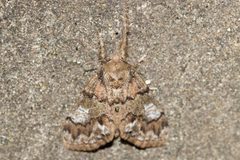
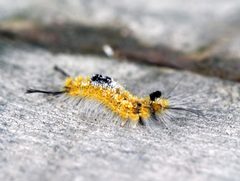
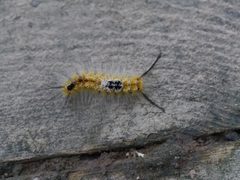
Dasychira is a of tussock moths in the Erebidae, established by Jacob Hübner in 1809. The genus has a broad geographic distribution spanning Africa, Europe, North America, Madagascar, Japan, China, India, Sri Lanka, Myanmar, Java, and Australia. Several are economically significant as defoliating pests of cultivated plants including oil palm, tea, and black wattle, with some species capable of . The genus is characterized by distinctive morphological features including porrect palpi with heavily haired second joints and sexually dimorphic .
Pronunciation
How to pronounce Dasychira: /ˌdæsɪˈkaɪrə/
These audio files are automatically generated. While they are not always 100% accurate, they are a good starting point.
Identification
Distinguished from related lymantriine by the combination of porrect, heavily haired palpi and the specific wing venation pattern in the hindwing ( 3-5 from near angle, veins 6-7 stalked). in antennal branching provides additional diagnostic characters. -level identification requires examination of genitalia and often larval characteristics.
Images
Appearance
Palpi porrect (extending forward) with second joint heavily haired. with long branches in males, short in females. Legs hairy. Forewings with oblique outer margin. Hindwings with 3, 4, and 5 arising close to angle of ; veins 6 and 7 stalked.
Habitat
varies by : D. selenitica occupies warm, dry southern slopes and sun-exposed forest edges; D. baibarana is associated with tea plantations; D. mendosa and D. inclusa occur in oil palm nurseries and mature estates; D. georgiana inhabits black wattle plantations. Some species show affinity for disturbed or plantation environments.
Distribution
Africa, Europe, North America, Madagascar, Japan, China, India, Sri Lanka, Myanmar, Java, and Australia. Specific records include: D. mendosa in Andhra Pradesh, India; D. inclusa in Johor and Pahang, Malaysia; D. georgiana in Kenya; D. selenitica in Bavaria, Germany; D. baibarana in China.
Seasonality
D. mendosa shows peak activity from July through the first fortnight of November in oil palm nurseries. D. selenitica occurred during 1964-1966 in Bavaria. Seasonal patterns likely vary by and geographic location.
Behavior
Newly emerged D. inclusa larvae display ballooning for to neighboring trees. D. baibarana show electrophysiological and behavioral responses to plant volatiles, with sex-specific differences in antennal sensitivity. D. mendosa females lay predominantly on the undersurface of leaves.
Ecological Role
Herbivorous larvae of several function as defoliators in forest and plantation . Natural enemies include tachinid flies (10.2% in D. mendosa), Brachymeria albotibialis (40% pupal parasitism in D. mendosa), Compsophorus fumosus (pupal of D. georgiana), and . D. pudibunda is susceptible to (DpCPV) which shows and cross-species .
Human Relevance
Several are significant agricultural and forestry pests. D. mendosa causes severe defoliation of oil palm in nurseries. D. inclusa has emerged as a significant pest in mature oil palm estates with dynamics. D. baibarana is a devastating pest of tea in China. D. selenitica can become a nuisance forest insect, feeding on young broad-leaved trees and larches. D. georgiana is a minor pest of black wattle in Kenya. Control measures include Bacillus thuringiensis subsp. kurstaki and strategies. D. baibarana components have been characterized for potential monitoring and control applications.
Similar Taxa
- LymantriaBoth are lymantriine tussock moths with similar larval ; distinguished by wing venation and antennal structure in
- OrgyiaRelated tussock in tribe Orgyiini; Dasychira differs in palpal structure and hindwing venation
More Details
Viral Pathogens
Dasychira pudibunda is to DpCPV, a causing epithelium with including growth inhibition, irregular molting, and reduced . Mixed with show synergistic effects on mortality. DpCPV has broad host range extending across multiple insect .
Sex Pheromone Chemistry
D. baibarana uses a ternary Type-II blend containing (3Z,6Z)-cis-9,10-epoxyhenicosa-3,6-diene, (3Z,6Z,11E)-cis-9,10-epoxyhenicosa-3,6,11-triene, and (3Z,6Z)-henicosa-3,6-dien-11-one for mate communication. Candidate P450 genes for pheromone biosynthesis include CYP4G (likely decarbonylase) and CYP341B65 (likely epoxidase).
Sources and further reading
- BugGuide
- Wikipedia
- GBIF taxonomy match
- iNaturalist taxon
- NCBI Taxonomy
- Catalogue of Life
- Biology, seasonal activity and natural enemies of Tussock caterpillar, Dasychira mendosa Hubner infesting on oil palm nursery
- The Outbreak of Tussock Caterpillar, Dasychira inclusa Walker (Lepidoptera: Eribidae) in Two Mature Oil Palm Estates
- Electrophysiological and Behavioral Responses of Dasychira baibarana (Lepidoptera: Lymantriidae) to Tea Plant Volatiles
- Zur Morphologie, Biologie und Ökologie des Mondfleckbürstenspinners, Dasychira selenitica Esp. (Lepidopt., Lymantriidae)1
- The bionomics and control of Argyrostagma niobe (Weym.) and Dasychira georgiana Fawc. (Lep., Lymantriidae) On black wattle in kenya
- Synergistische Wirkung eines Cytoplasmapolyedervirus des Buchenrotschwanz Dasychira pudibunda L. (Lep., Lymantriidae) bei Mischinfektion mit verschiedenen Kernpolyeder‐Virusstammen1
- Untersuchungen zu Wirkung und Wirtsspektrum einer Cytoplasmapolyedrose beim Buchenrotschwanz Dasychira pudibunda L. (Lep., Lymantriidae)1
- Transcriptome-Wide Identification of Cytochrome P450s in Tea Black Tussock Moth (Dasychira baibarana) and Candidate Genes Involved in Type-II Sex Pheromone Biosynthesis