
Lymantria
Hübner, 1819
tussock moths
Species Guides
1- Lymantria dispar(spongy moth)
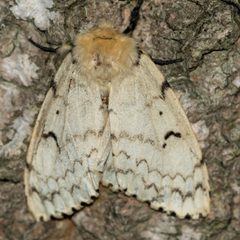
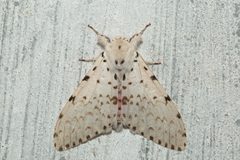
Lymantria is a of tussock moths in the Erebidae, established by Jacob Hübner in 1819. The genus includes several economically significant forest pests, most notably (spongy ), which has been introduced to North America where it causes extensive defoliation. Some in the genus exhibit striking in wing development, with females of certain having fully developed wings while others have reduced or wings. The "flighted spongy moth complex"—comprising L. dispar asiatica, L. dispar japonica, L. albescens, L. umbrosa, and L. postalba—poses particular regulatory concern due to the capability of females, which enables more rapid range expansion than flightless strains.
Pronunciation
How to pronounce Lymantria: /lɪˈmæntriə/
These audio files are automatically generated. While they are not always 100% accurate, they are a good starting point.
Identification
Distinguished from related tussock by the specific wing venation pattern, particularly the stalked 7–10 in the forewing with characteristic spacing. Male with long branches (bipectinate) versus female serrate antennae. Female wing condition is diagnostic at / level: L. dispar dispar females have wings and cannot fly, while L. dispar asiatica and L. dispar japonica females have fully developed wings. Molecular tools have been developed to differentiate among Lymantria , particularly to distinguish flighted from flightless for regulatory purposes.
Images
Appearance
Males possess porrect (forward-extending), hairy palpi and with long branches. Forewings have 3, 4, and 5 arising close to the angle, vein 6 from below the upper angle, and veins 7–10 stalked with vein 7 originating further from the cell than vein 10. Hindwings have veins 3, 4, and 5 from near the cell angle, with veins 6 and 7 from the upper angle. Females have serrate antennae (tooth-like on one side). Female wings are variable: fully developed, partially reduced, or completely reduced to depending on and .
Habitat
Forest and woodland , with occupying temperate to subtropical regions. Native range species occur in diverse forest types including broadleaf and mixed forests. of L. dispar occupy urban and suburban landscapes as well as natural forests with suitable tree composition.
Distribution
Native to Europe, Asia (Japan, India, Sri Lanka, Myanmar), and Southeast Asian islands (Java, Celebes/Sulawesi). has been introduced to North America where it is established in the northeastern United States and eastern Canada. Individual have more restricted ranges within this broad distribution; the flighted spongy complex (L. dispar asiatica, L. dispar japonica, L. albescens, L. umbrosa, L. postalba) is native to East Asia and represents a regulatory concern for potential introduction to North America.
Diet
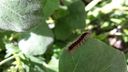
Larvae are folivores with broad ranges. Caterpillars of L. dispar have been documented feeding on over 500 woody and non-woody host plants. Preferred hosts include oaks (Quercus spp.) and other broadleaf trees. Specific host associations vary by .
Life Cycle
Holometabolous with complete : , larva (caterpillar), pupa, . larvae of some exhibit ballooning , releasing silk strands that catch wind for long-distance . Eggs are laid in masses, often on tree bark, rocks, soil, or human-made objects. Eggs are not freeze-tolerant; some species lay eggs in rock cracks or near soil to exploit warmer microclimates.
Behavior
males are attracted to female and can be trapped using synthetic lures. Mating success is influenced by climate, adult age, and . Some larvae balloon on silk threads for wind . Larvae infected with multiple (LdMNPV) exhibit Tree-top : enhanced locomotory activity, climbing to elevated locations before death, extended instar duration, increased photosensitivity, and disrupted circadian rhythmicity.
Ecological Role
As defoliators, Lymantria can function as disturbance agents in forest . can cause extensive tree mortality, altering forest composition and structure. Larvae serve as for that regulate . populations disrupt native forest ecosystems and compete with or affect populations of associated Lepidoptera species.
Human Relevance
Major forest and urban pests, particularly . Causes significant economic damage through tree defoliation, timber loss, and management costs. Subject to extensive regulatory surveillance and control programs, including the U.S. national Slow the Spread program. Flighted spongy complex are high-priority targets for exclusion from North America due to enhanced invasion potential. masses are readily transported on vehicles, cargo, and ships, facilitating human-mediated . -based is a primary management tactic.
More Details
Flighted spongy moth complex
Five are designated as the flighted spongy complex due to female capability: Lymantria albescens, L. umbrosa, L. postalba, L. dispar asiatica, and L. dispar japonica. These pose greater invasion risk than L. dispar dispar, whose flightless females limit unassisted range expansion. First detection of flighted spongy moth in the U.S. occurred in 1991 via masses laid on ships attracted to port lights.
Pheromone interactions
((+)-disparlure) acts as a behavioral antagonist to male Lymantria mathura, reducing attraction to traps when both are present. Male L. dispar japonica are unaffected by L. mathura pheromone, indicating asymmetric interspecific chemical communication.
Sources and further reading
- BugGuide
- Wikipedia
- GBIF taxonomy match
- iNaturalist taxon
- NCBI Taxonomy
- Catalogue of Life
- It Flies! Regulatory Officials on Constant Alert for Flighted Spongy Moths
- Integrated Transcriptomic and Metabolomic Analysis of Lymantria dispar multiple nucleopolyhedrovirus (LdMNPV) infected Lymantria dispar in Tree-top Disease
- Lymantria dispar (gypsy moth).
- Analyses of Lymantria dispar Mate-Finding Behavior in Support of Management in the STS Program
- Lymantria dispar sex pheromone is a behavioral antagonist to pheromonal attraction of male Lymantria mathura
- Population dynamics of selected Lepidoptera associated with gypsy moth [Lymantria dispar (L.)] in central Appalachia