
Malacosoma
Hübner, 1820
Tent Caterpillar Moths
Species Guides
6- Malacosoma americana(Eastern Tent Caterpillar Moth)
- Malacosoma californica(Western Tent Caterpillar Moth)
- Malacosoma constricta(Pacific tent caterpillar)
- Malacosoma disstria(Forest Tent Caterpillar Moth)
- Malacosoma incurva(Southwestern Tent Caterpillar Moth)
- Malacosoma tigris(Sonoran Tent Caterpillar)
Malacosoma is a of in the Lasiocampidae, first described by Jacob Hübner in 1820. Larvae are commonly known as tent caterpillars and are recognized for their communal nesting in silken tents. The genus includes both oligophagous with restricted ranges and species with broader diets. Several species are significant forestry pests capable of causing large- defoliation across North America and Eurasia.
Pronunciation
How to pronounce Malacosoma: /ˌmæləkəˈsoʊmə/
These audio files are automatically generated. While they are not always 100% accurate, they are a good starting point.
Identification
Larvae are distinguished from other caterpillars by their construction of large, communal silken tents in the crotches of branches, which they enlarge as they grow. The combination of hairy bodies, bold striping patterns, and trail-following along silk highways separates them from solitary caterpillar . are less frequently observed but can be recognized by their robust, furry bodies and association with known larval trees.
Images
Appearance
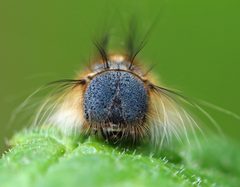
are medium-sized with stout, furry bodies. Larvae are hairy caterpillars with distinctive color patterns; for example, Malacosoma americanum has blue stripes and patches on the sides with a white stripe down the center of the back. Larvae possess a gland that deposits trail-. masses are dark brown, Styrofoam-like, and encircle small branches.
Habitat
Forest and woodland , including deciduous forests, orchards, and riparian corridors. Some occupy arid regions; for example, Malacosoma californicum occurs in the Mojave Desert on desert almond (Prunus fasciculata). Larvae require woody plants for feeding and tent construction.
Distribution
Holarctic distribution spanning the Nearctic and Palearctic regions. Malacosoma americanum occurs in eastern North America from Canada to the southeastern United States. Malacosoma californicum ranges across western North America from Alberta to California and Arizona. Malacosoma disstria is widespread across North America. Palearctic include M. neustria and M. castrense in Europe and Asia.
Seasonality
Larvae are active in spring, typically emerging with the bloom of forsythia in eastern North America. Activity occurs primarily March through April, with emerging in June or July. exhibit cyclic with multi-year periodicity.
Diet
Larvae feed on foliage of woody plants. Oligophagous such as Malacosoma americanum feed primarily on Rosaceae including cherry (Prunus), apple (Malus), and crab apple. species such as Malacosoma disstria and M. californicum consume a broader range including alder, oak, poplar, and willow in addition to Rosaceae.
Host Associations
- Prunus serotina - Preferred of M. americanum
- Prunus pennsylvanica - Wild cherry
- Prunus virginiana - Wild cherry
- Malus coronaria - Wild apple
- Malus domestica - Cultivated apple
- Prunus fasciculata - Desert almond; of M. californicum in Mojave Desert
Life Cycle
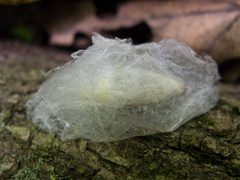
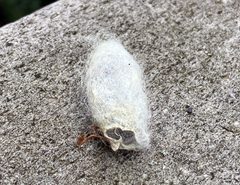
Winter is spent as in dark, foam-like masses encircling small branches. More than 300 larvae may hatch from a single egg mass in spring. Larvae construct silken tents over the egg mass and surrounding branch, expanding and relocating tents to branch crotches as they grow. Development occurs through spring, followed by a mass exodus from trees. Larvae wander to protected locations beneath logs, leaves, stones, or structures to spin yellowish-white silken cocoons. emerge from cocoons in June or July, mate, and females deposit eggs on small branches of host trees.
Behavior
Larvae exhibit highly social with communal foraging, tent construction, and maintenance. Siblings from the same mass cooperate in enlarging tents and locating food. Trail- deposited by the gland allow caterpillars to recruit nestmates to food sources. Tents serve thermoregulatory functions, elevating body temperature for faster growth on cool days, and provide protection from and . Late-instar larvae disperse individually to sites.
Ecological Role
Significant defoliators of deciduous trees and shrubs, capable of stripping foliage from small and large trees during years. Serve as for including the tachinid fly Leschenaultia exul. cycles are regulated by natural enemies including , , and . Defoliation may reduce tree vigor, though trees often recover with secondary leaf flush.
Human Relevance
Several are important forestry and orchard pests. Malacosoma americanum is associated with mare reproductive loss (MRLS) in horses; pregnant mares consuming caterpillars or their setae may abort foals due to bacterial introduced by penetrating hairs. Management includes mechanical removal of masses and tents, pruning infested branches, and professional arborist intervention for tall trees. Burning tents is not recommended due to bark damage.
Similar Taxa
- LasiocampaRelated in Lasiocampidae; larvae lack communal tent-building and are solitary rather than social.
- EriogasterEuropean lasiocampid with tent-building larvae; distinguished by geographic range and plant associations.
More Details
Population Cycles
Entomologists recognize cyclic ; after years of high abundance, natural enemies reduce to innocuous levels.
Genetic Structure
Phylogeographic studies indicate highest genetic diversity in southern , suggesting derivation from Pleistocene refugia with northward range expansion and loss of genetic variation.
Sources and further reading
- BugGuide
- Wikipedia
- iNaturalist taxon
- NCBI Taxonomy
- Catalogue of Life
- Get them when they're little - Eastern tent caterpillar, Malacosoma americanum — Bug of the Week
- Hairy wanderers - Eastern tent caterpillars, Malacosoma americanum — Bug of the Week
- Time for tents - Eastern tent caterpillar, Malacosoma americanum — Bug of the Week
- Return of the tent makers - Eastern tent caterpillar, Malacosoma americanum — Bug of the Week
- Tents in the Mojave: Western tent caterpillar, Malacosoma californicum — Bug of the Week
- The silk trail - Eastern tent caterpillar, Malacosoma americanum — Bug of the Week
- Malacosoma americanum . [Distribution map].
- The Biology of Leschenaultia Exul Townsend, a Tachinid Parasite of Malacosoma Americana Fabricius and Malacosoma Disstria Hubner1
- Figure 1: Distributions, sampling locations, and Bayesian cluster membership for three Malacosoma species.
- THE EFFECT OF VARIATION IN HOST PLANT ON THE GROWTH OF AN OLIGOPHAGOUS INSECT, MALACOSOMA AMERICANUM AND ITS POLYPHAGOUS RELATIVE, MALACOSOMA DISSTRIA
- Malacosoma parallelum . [Distribution map].
- Temperature-Dependent and Semi-Quantitative Enzyme Profiles of Malacosoma disstria (Lepidoptera: Lasiocampidae) Hemocytic Cell Lines.