
Malacosoma californica
(Packard, 1864)
Western Tent Caterpillar Moth, Western Tent Caterpillar
Malacosoma californica, the western , is a in the Lasiocampidae found in western North America. The larvae are social caterpillars that construct conspicuous silken tents in trees and shrubs. They undergo cyclical and are significant defoliators of various woody plants. The species overwinters as and completes one per year.
Pronunciation
How to pronounce Malacosoma californica: /mæləkoʊˈsoʊmə ˌkælɪˈfɔrnɪkə/
These audio files are automatically generated. While they are not always 100% accurate, they are a good starting point.
Identification
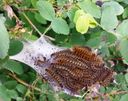
Larvae distinguished from other tent caterpillars by geographic range (western North America) and plant associations. The silken tents are constructed in branches rather than tree crotches (unlike eastern tent caterpillar, Malacosoma americanum). masses encircle branches and have a distinctive dark, foam-like appearance. Distinguished from forest (Malacosoma disstria) by tent-building —western tent caterpillars build permanent tents while forest tent caterpillars do not.
Images
Habitat
Arid and semi-arid regions including deserts, scrublands, and open woodlands. Associated with shrubs and trees in the rose (Rosaceae) as well as alders, oaks, poplars, and willows in riparian and upland areas.
Distribution
Western Nearctic ecozone: from Alberta, Saskatchewan, and Manitoba in Canada south through the western United States to southern California and Arizona. Includes the Mojave Desert and other arid western regions.
Seasonality
hatch in early spring, coinciding with bud break of plants. Larval development occurs March through May. in late spring. emerge in June or July. Eggs laid in summer overwinter until the following spring.
Diet
Larvae feed on leaves of desert almond (Prunus fasciculata), other members of Rosaceae including cherries and apples, as well as alders (Alnus), oaks (Quercus), poplars (Populus), and willows (Salix).
Host Associations
- Prunus fasciculata - primary Desert almond; significant in Mojave Desert
- Prunus - Cherries and other stone fruits
- Malus - Apple
- Alnus - Alders
- Quercus - Oaks
- Populus - Poplars
- Salix - Willows
Life Cycle
Winter is spent as in dark, foam-like masses on branches. Spring hatch coincides with plant bud break. Larvae feed gregariously in silken tents, enlarging tents as they grow. Near end of larval development, caterpillars forage solitarily. occurs within tents or in protected ground locations in silken cocoons. emerge in summer, mate, and females deposit egg masses on small branches. One per year.
Behavior
Larvae are highly social, living in communal silken tents. Group living elevates temperature inside tents, accelerating growth on cool spring days. Caterpillars use chemical communication: foragers lay down trails to recruit nest-mates to food sources. Late-instar larvae wander individually to sites. Mass larval exodus from trees occurs at end of development.
Ecological Role
Herbivore that can cause significant defoliation during years. Serves as food source for birds, rodents, predatory insects, and parasitic . (excrement) and shed caterpillar hairs contribute to nutrient cycling. cycles are regulated by natural enemies including , , and .
Human Relevance
Occasional pest of fruit trees and ornamental plantings; can defoliate trees during years. Less problematic than related eastern tent caterpillar. Fruits of desert almond, a primary , are harvested by Native American including the Cahuilla Nation. Not implicated in mare reproductive loss (unlike eastern tent caterpillar).
Similar Taxa
- Malacosoma americanumEastern tent caterpillar; distinguished by geographic range (eastern North America), tent placement in branch crotches near tree trunk, and association with eastern deciduous forests
- Malacosoma disstriaForest ; distinguished by lack of permanent tent construction, different larval color pattern (row of keyhole-shaped spots rather than stripes), and more northern and eastern distribution
More Details
Population Dynamics
exhibit cyclical ; after several years of high abundance, natural enemies reduce populations to low levels. Not associated with mare reproductive loss (MRLS) that affects horses in the eastern United States.
Thermoregulation
Communal tent living allows larvae to elevate body temperature above ambient, providing growth advantages in cool spring conditions typical of their western range.
Sources and further reading
- BugGuide
- GBIF taxonomy match
- iNaturalist taxon
- Catalogue of Life
- The Big 43: The California Native Plants, Plus One, Studied in UC Davis Research | Bug Squad
- Get them when they're little - Eastern tent caterpillar, Malacosoma americanum — Bug of the Week
- Hairy wanderers - Eastern tent caterpillars, Malacosoma americanum — Bug of the Week
- Time for tents - Eastern tent caterpillar, Malacosoma americanum — Bug of the Week
- Return of the tent makers - Eastern tent caterpillar, Malacosoma americanum — Bug of the Week
- Tents in the Mojave: Western tent caterpillar, Malacosoma californicum — Bug of the Week