
Malacosoma disstria
Hübner
Forest Tent Caterpillar Moth
The forest (Malacosoma disstria) is a native North American lasiocampid moth known for its periodic . Unlike its the eastern tent caterpillar, it does not construct true silken tents; instead, larvae form silk mats on which they rest between feeding bouts. The is highly on deciduous trees and exhibits gregarious in early instars, becoming more solitary in later stages. Population cycles are regulated by natural enemies including , flies, and .
Pronunciation
How to pronounce Malacosoma disstria: /ˌmælɪkoʊˈsoʊmə ˈdɪstriə/
These audio files are automatically generated. While they are not always 100% accurate, they are a good starting point.
Identification
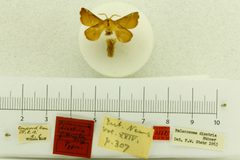
Larvae distinguished from Malacosoma americanum (eastern tent caterpillar) by white keyhole-shaped markings (versus continuous white dorsal stripe in M. americanum) and lack of true silken tents—M. disstria forms only silk resting mats. distinguished from other Malacosoma by wing pattern and geographic distribution. From other by combination of range, larval markings, and nest structure.
Images
Habitat
Deciduous forests, woodlands, and urban areas with broadleaf trees. Found in riparian zones, forest edges, and suburban landscapes where trees occur.
Distribution
Transcontinental in North America. Documented from all Canadian provinces except Nunavut, and throughout the United States from the Atlantic to the Pacific, including southern states. Absent only from the far north and extreme southwestern deserts.
Seasonality
emerge and mate in June to July. hatch in early spring, with larval development occurring April through June in most of the range; timing varies latitudinally from April in southern U.S. to July in northern regions.
Diet
Highly on foliage of deciduous broadleaf trees. Southern prefer water oak (Quercus nigra) and sweetgum (Liquidambar styraciflua); northern populations prefer sugar maple (Acer saccharum) and aspen (Populus spp.). Also feeds on birch (Betula), cherry (Prunus), and other hardwoods.
Host Associations
- Quercus nigra - preferred (southern )
- Liquidambar styraciflua - preferred (southern )
- Acer saccharum - preferred (northern )
- Populus spp. - preferred (northern )
- Betula spp. -
- Prunus serotina -
Life Cycle
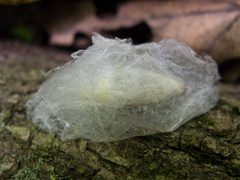
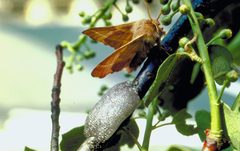
Overwinters as in dark brown, Styrofoam-like egg masses encircling small branches. Eggs hatch in spring when foliage emerges. Larvae pass through five to eight instars over four to seven weeks. Early instars are gregarious, forming silk mats on which they rest; later instars become solitary and wander more widely. occurs in silken cocoons on tree trunks, under bark, or on nearby structures. emerge, mate, and females lay eggs on branches. One per year.
Behavior
First-stage larvae exhibit behavioral with active and sluggish types; active individuals show directed toward light sources, though responses are inconsistent across days. Early instars are gregarious, forming communal silk resting mats; later instars disperse and feed more solitarily. Larvae do not construct the enclosed silken tents characteristic of M. americanum. Mass wandering occurs in late instars when food is depleted.
Ecological Role
Defoliator of deciduous forests; periodic can cause severe defoliation, though tree mortality is rare. Outbreaks may alter forest dynamics by promoting understory growth and shifting composition toward conifer dominance. Serves as for diverse complex including braconid wasps, tachinid flies, and sarcophagid flies. Microsporidian contribute to .
Human Relevance
Nuisance pest in urban and suburban areas due to defoliation of ornamental trees and mass cocoon formation on buildings, walls, and outdoor structures. Not economically impactful to forestry. Managed through mechanical removal of masses, sweeping of larvae, adhesive trunk bands, and microbial (Bacillus thuringiensis, spinosad, ).
Similar Taxa
- Malacosoma americanumConstructs enclosed silken tents in branch crotches; larvae have continuous white stripe rather than keyhole markings; more densely hairy; oligophagous on Rosaceae.
- Malacosoma californicumWestern ; larvae show more consistent active/sluggish behavioral than M. disstria.
More Details
Population Cycles
exhibit periodic cycles lasting several years, followed by decline due to natural enemies and resource depletion.
Behavioral Transition
Gregarious in early instars shifts to solitary behavior in fifth and sixth instars, possibly due to increased food requirements or reduced risk with size.
Sources and further reading
- BugGuide
- GBIF taxonomy match
- iNaturalist taxon
- NCBI Taxonomy
- Catalogue of Life
- New Guide Offers Insights on How to Manage the Forest Tent Caterpillar
- Cycloalexy in tortoise beetle larvae | Beetles In The Bush
- Get them when they're little - Eastern tent caterpillar, Malacosoma americanum — Bug of the Week
- Hairy wanderers - Eastern tent caterpillars, Malacosoma americanum — Bug of the Week
- Time for tents - Eastern tent caterpillar, Malacosoma americanum — Bug of the Week
- Return of the tent makers - Eastern tent caterpillar, Malacosoma americanum — Bug of the Week
- Malacosoma disstria . [Distribution map].
- BEHAVIORAL STUDIES ON MALACOSOMA DISSTRIA (LEPIDOPTERA: LASIOCAMPIDAE)
- A MICROSPORIDIAN PARASITE OF THE FOREST TENT CATERPILLAR, MALACOSOMA DISSTRIA HBN.
- The Biology of Leschenaultia Exul Townsend, a Tachinid Parasite of Malacosoma Americana Fabricius and Malacosoma Disstria Hubner1
- Effects of polymorphic melanism and larval diet on life history traits of Malacosoma disstria moths
- THE EFFECT OF VARIATION IN HOST PLANT ON THE GROWTH OF AN OLIGOPHAGOUS INSECT, MALACOSOMA AMERICANUM AND ITS POLYPHAGOUS RELATIVE, MALACOSOMA DISSTRIA
- Mating Behavior of Malacosoma disstria at Two Levels of Mate Competition
- LARVAL AND PUPAL PARASITISM OF THE FOREST TENT CATERPILLAR, MALACOSOMA DISSTRIA HÜBNER (LEPIDOPTERA: LASIOCAMPIDAE), IN ALBERTA, CANADA
- Temperature-Dependent and Semi-Quantitative Enzyme Profiles of Malacosoma disstria (Lepidoptera: Lasiocampidae) Hemocytic Cell Lines.