
Lasiocampidae
Harris, 1841
Lappet Moths, Eggars, Tent Caterpillars, Snout Moths
Subfamily Guides
2- Lasiocampinae(Tent caterpillar moths (informal, group includes many species with this common name))
- Poecilocampinae
is a of comprising over 2,000 worldwide, representing approximately 5% of global moth diversity. The family is characterized by large, hairy caterpillars with distinctive skin flaps on their , and that are typically large-bodied with broad wings. Many species are notable for their social larval , including that construct communal silk nests. The family is the sole member of the superfamily Lasiocampoidea and includes several economically significant forest pests.
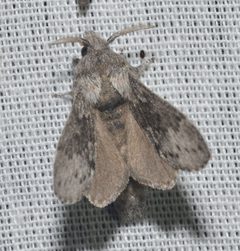
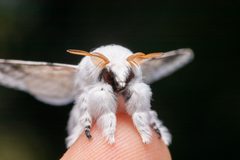
Pronunciation
How to pronounce Lasiocampidae: //ˌlæ.si.oʊˈkæm.pɪˌdiː//
These audio files are automatically generated. While they are not always 100% accurate, they are a good starting point.
Identification
distinguished from other by combination of: bipectinate in both sexes, reduced or absent , porrect palpi, and characteristic wing venation with stalked 9–10 on fore wing and precostal on hind wing. Caterpillars distinguished by five or fewer pairs of (versus six or more in larvae), presence of lappets on prolegs, and lateral hair tufts. Some have protruding mouthparts resembling a snout. (Malacosoma and related ) form conspicuous communal silk nests, while other genera are solitary.
Images
Habitat
Larvae occur on woody plants including trees and shrubs. Many inhabit deciduous and mixed forests, temperate heath and scrublands, and sub-Mediterranean shrub . construct silk nests in branch forks of trees. Some species occupy coniferous forests, particularly Dendrolimus species on conifers.
Distribution
Worldwide distribution with over 2,000 . Well-represented in North America (including Malacosoma, Phyllodesma, Tolype), Europe, India (100 species in 35 genera), Siberia/Russia, and China. Specific documented occurrences include Slovenia, Komi Republic (Russia), Baikal Nature Reserve, and Jharkhand (India).
Seasonality
Varies by and latitude. Larvae of Eriogaster catax observed from late March to mid-June in Slovenia; from mid-September to early November. Malacosoma disstria larvae emerge April–July depending on latitude, with four to seven weeks of feeding. Many species are with single per year, though voltinism varies by location.
Diet
Larvae are folivores feeding on leaves of trees and shrubs. Documented plants include: black cherry (Prunus serotina), black locust (Robinia pseudoacacia), white oak (Quercus alba), blackthorn (Prunus spinosa), hawthorn (Crataegus spp.), water oak, sweetgum, sugar maple, aspen, and various conifers including white pine (Pinus strobus). Some are ; others show regional host preferences. of many species have reduced mouthparts and do not feed.
Host Associations
- Prunus serotina - preferred for Malacosoma americana
- Prunus spinosa - primary for Eriogaster catax
- Crataegus spp. - primary for Eriogaster catax
- Quercus alba - supports high larval growth and survival for Malacosoma americana
- Robinia pseudoacacia - supports survival but not optimal growth for Malacosoma americana
- Pinus strobus - conifer for some
- Acer saccharum - preferred by northern of Malacosoma disstria
- Populus tremuloides - aspen, preferred by northern of Malacosoma disstria
Life Cycle
Complete . Females lay large numbers of flat, smooth or slightly pitted ; in , eggs deposited in masses covered with material that hardens in air. Larvae pass through five to eight instars over four to seven weeks. Some overwinter as eggs, others as larvae in cocoons. occurs in silk cocoons woven with hair, attached to plants or concealed in bark. emerge to mate; females generally larger and slower than males.
Behavior
Many exhibit gregarious larval . construct communal silk nests in tree branches and use to recruit nestmates to feeding sites. Nests serve for and avoidance through safety-in-numbers. Caterpillars leave silk trails to coordinate foraging. Some species are solitary. may be or . Males of some species captured in pheromone traps, indicating sex-specific behavior.
Ecological Role
Larvae function as primary consumers in forest , converting foliage to . Periodic cause defoliation that can alter forest dynamics; one study found overstory defoliation by Malacosoma disstria promoted understory growth and shifted aspen forest toward conifer dominance. Serve as prey for birds, , and other natural enemies. Contribute to nutrient cycling through deposition. Some are ecosystem engineers through nest construction.
Human Relevance
Several are significant forest and ornamental pests. Malacosoma disstria (forest ), Malacosoma americanum (eastern tent caterpillar), and Dendrolimus sibiricus (Siberian ) cause defoliation of timber and shade trees. Cocoons on buildings create nuisance conditions. Managed through mechanical removal of masses, adhesive bands on trunks, and microbial including Bacillus thuringiensis and . Some species reared on artificial diets (McMorran diet) for research. has been subject of citizen science documentation through National Week.
Similar Taxa
- SaturniidaeBoth have large, hairy caterpillars, but Saturniidae caterpillars often possess urticating spines (scoli) and have more reduced mouthparts; distinguished by lappets on and bipectinate in both sexes versus often sexually dimorphic antennae in Saturniidae.
- Erebidae (Arctiinae)Both have hairy caterpillars, but larvae have distinctive lappets on and lack the tymbal organs found in many Arctiinae; wing venation and structure differ.
- Psychidae (bagworms)Both construct silk shelters, but Psychidae larvae build portable cases from environmental materials and have reduced wings in females; nests are fixed silk structures and adults are fully winged with characteristic .
Sources and further reading
- BugGuide
- Wikipedia
- GBIF taxonomy match
- iNaturalist taxon
- NCBI Taxonomy
- Catalogue of Life
- Lasiocampidae Archives - Entomology Today
- Catch a Glimpse of Caterpillars During National Moth Week
- New Guide Offers Insights on How to Manage the Forest Tent Caterpillar
- This Artificial Diet May Make Insect Rearing Easier
- Larval habitat characteristics of eastern eggar Eriogaster catax (Linnaeus, 1758) (Lepidoptera: Lasiocampidae) in Slovenia Značilnosti larvalnega habitata hromega volnoritca Eriogaster catax (Linnaeus, 1758) (Lepidoptera: Lasiocampidae) v Sloveniji
- TO THE FAUNA AND ECOLOGY OF BOMBYCOIDEA AND NOCTUOIDEA MOTHS (LEPIDOPTERA: LASIOCAMPIDAE, ENDROMIDIDAE, SPHINGIDAE, NOTODONTIDAE, EREBIDAE, NOLIDAE, NOCTUIDAE) OF BAIKAL NATURE RESERVE
- An annotated catalogue of Indian Lasiocampidae (Lasiocampoidea, Lepidoptera)
- New data on the distribution and abundance of Dendrolimus sibiricus (Tshetverikov, 1908) (Lepidoptera: Lasiocampidae) in the Komi Republic.
- Age-Specific Host Utilization in the Eastern Tent Caterpillar (Lepidoptera: Lasiocampidae)
- Prispevek k poznavanju razširjenosti hromega volnoritca Eriogaster catax (Linnaeus, 1758) (Lepidoptera: Lasiocampidae) v Sloveniji Contribution to the knowledge of Eriogaster catax (Linnaeus, 1758) (Lepidoptera: Lasiocampidae) distribution in Slovenia
- Trabala vishnou (Lepidoptera: Lasiocampidae) : A polyphagous pest of forest trees in Jharkhand, India
- Biology and Management of the Forest Tent Caterpillar (Lepidoptera: Lasiocampidae)
- The Morphometry of Male Genitalia as a Reliable Tool for Identifying Forest Pests Dendrolimus sibiricus, D. pini (Lepidoptera: Lasiocampidae), and Their Hybrids in Eurasia.
- First record of the complete mitochondrial genome of Streblote castanea (Swinhoe, 1892) (Lepidoptera: Lasiocampidae).