
Pyralidae
pyralid moths, snout moths, grass moths
Subfamily Guides
5- Chrysauginae(Scaly-legged Pyralids)
- Epipaschiinae(snout moths)
- Galleriinae(wax moths)
- Phycitinae(Knot-horn Moths)
- Pyralinae(snout moths)
is a diverse of Lepidoptera in the superfamily Pyraloidea, comprising over 6,000 described worldwide. The family is commonly known as snout moths due to the prominent elongated labial palps that project forward from the . Historically, the Crambidae (grass moths) were included within Pyralidae as a , but modern classifications treat them as a separate family. Pyralidae includes numerous economically important pest species affecting stored products, agriculture, and forestry.
Pronunciation
How to pronounce Pyralidae: /pɪˈrælɪdiː/
These audio files are automatically generated. While they are not always 100% accurate, they are a good starting point.
Identification
Distinguished from Crambidae by genitalic characters: females have a of one bristle (compound), while Crambidae females have two or more bristles. Labial palps are prominent and forward-projecting, creating the 'snout' appearance. Chrysauginae larvae possess a sclerotised ring around seta SD1 of the ; Galleriinae larvae have a sclerotised ring around seta SD1 of the first abdominal segment; Phycitinae larvae have a sclerotised area encircling the base of seta SD1 on the . Epipaschiinae males have upturned and pointed third segment of labial palps and usually a scaly projection from the base.
Images
Appearance
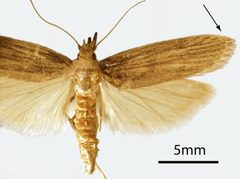
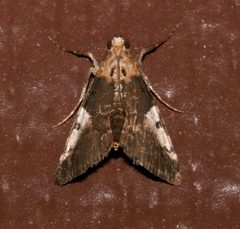
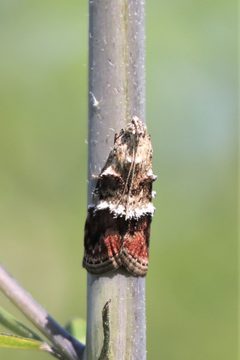
Small to medium-sized with wingspans typically ranging from 9 to 37 mm. The most distinctive feature is the elongated labial palps that project forward from the , creating a 'snout' appearance. Forewings are generally triangular and held tent-like over the body at rest. Coloration is typically cryptic—brown, gray, or ochre—though some such as Epipaschiinae contain brightly colored with pink, orange, or yellow wings. Wing patterns vary widely but often include lines, spots, or bands.
Habitat
Highly diverse; occupies terrestrial, freshwater, and some semi-aquatic environments. Larval range from leaf litter and soil to living plant tissues, stored products, and animal nests. Some are associated with sloths (Chrysauginae sloth ), while others inhabit beehives (Galleriinae). Many species are , occurring in warehouses, granaries, and domestic settings.
Distribution
distribution with over 6,000 described worldwide. More than 600 species occur in North America north of Mexico, making it the third largest in the region. At least 42 species recorded from North Dakota. Chrysauginae predominantly Neotropical. Pyralinae diverse in Old World with roughly 900 species. Epipaschiinae absent from Europe but present in tropical and temperate regions elsewhere.
Seasonality
Variable by and region. Many stored product pests are active year-round in controlled environments. Field species generally follow seasonal patterns corresponding to plant and local climate. Some species have multiple annually; others have extended up to 25 weeks in cooler conditions.
Diet
Larval feeding habits are highly diverse: herbivory on living plants (leaf rollers, tiers, miners, borers, defoliators), detritivory on decaying plant matter, myrmecophily, and / in some cases. Many are pests of stored products including grains, dried fruits, nuts, flour, and other dry vegetable materials. Some species feed on animal products such as wax (Galleriinae in beehives) and grease.
Host Associations
- Theobroma cacao - pestCadra cautella (almond moth) infests stored cocoa
- Coffea canephora - pestPhidotricha erigens and Cryptoblabes gnidiella infest coffee
- Coffea arabica - pestPhidotricha erigens recorded on leaves and beans
- Solanum melongena - pestLeucinodes orbonalis (eggplant fruit and shoot borer)
- Zea mays - pestElasmopalpus lignosellus (lesser cornstalk borer)
- Helianthus annuus - pestHomoeosoma nebulella (sunflower moth)
- Swietenia - pestMacalla thyrsisalis (mahogany webworm)
- Pinus - pestPococera robustella (pine webworm), Dioryctria amatella (southern pine coneworm)
- Opuntia - Cactoblastis cactorum used for prickly pear control
- Alternanthera philoxeroides - Arcola malloi (alligatorweed stem borer)
- honeybee hives - pestGalleria mellonella and Achroia grisella (wax moths)
- sloths - obligate associationSome Chrysauginae sloth dependent on sloths for entire
Life Cycle
Complete : , larva (typically 5 instars), pupa, . often occurs in silken cocoons or within larval tunnels. Some have facultative . duration varies from 5 weeks under optimal summer conditions to 25 weeks in winter. Multiple per year common in tropical and subtropical regions; fewer in temperate zones.
Behavior
are predominantly and attracted to light. Many larvae are concealed feeders—leaf rollers, tiers, miners, or borers—while others feed exposed in silken webbing. Some larvae are gregarious. Defensive include accumulation of plant toxins (quinolizidine alkaloids) in some such as Uresiphita reversalis. Adults of some species are and easily startled from resting places.
Ecological Role
Significant agricultural and stored product pests causing economic damage worldwide. Some used as agents for plants. Serve as food resources for and including ichneumon wasps (Mesostenus), Trichogramma wasps, and various vertebrates. Pollination role likely minor compared to other Lepidoptera. Nutrient cycling through detritivory in some lineages.
Human Relevance
Major economic impact as pests of stored products (grains, flour, dried fruits, nuts, cocoa, coffee) and agricultural crops (corn, sunflower, eggplant, pine, mahogany). Notable include the Indian mealmoth (Plodia interpunctella), Mediterranean flour moth (Ephestia kuehniella), almond moth (Cadra cautella), and greater wax moth (Galleria mellonella). Wax moths are commercially bred as live food for reptile and bird pets and as fishing . Some species used in of plants.
Similar Taxa
- CrambidaeFormerly treated as within ; distinguished by female of two or more bristles (versus one compound bristle in Pyralidae) and other genitalic characters. Many 'grass moths' and 'sod webworms' now placed in Crambidae.
Misconceptions
The 'snout moths' is sometimes incorrectly applied only to when it properly applies to both Pyralidae and Crambidae. Many internet resources incorrectly place such as Uresiphita reversalis in Pyralidae when they are now classified in Crambidae. The historical lumping of Crambidae within Pyralidae causes ongoing confusion in older literature and databases.
More Details
Taxonomic History
The circumscription of has changed dramatically. Older classifications included Crambidae as a , creating one of the largest in Lepidoptera. Modern treatments following Munroe and Solis (in Kristensen 1999) recognize Crambidae as a separate family. Five subfamilies are currently recognized in Pyralidae: Chrysauginae, Galleriinae, Pyralinae, Epipaschiinae, and Phycitinae. Several remain incertae sedis due to uncertain placement.
Research Significance
Jeff Smith, curator of Lepidoptera at the Bohart Museum, notes that most new discoveries in Lepidoptera will likely come from , with perhaps 90% of smaller moth species still undescribed. and related families are particularly important as pests and thus economically significant for research.
Sources and further reading
- BugGuide
- Wikipedia
- GBIF taxonomy match
- iNaturalist taxon
- NCBI Taxonomy
- Catalogue of Life
- Oh, What a (Moth) Night! | Bug Squad
- Blacklighting at the Bohart: They Saw the Light | Bug Squad
- Oh, What a (Moth) Night This Will Be! A Conversation With Bohart's Lepidoptera Curator Jeff Smith | Bug Squad
- Bug Eric: Moth Monday: Sophora Worm
- Bug Eric: Wasp Wednesday: Mesostenus
- China | Blog - Part 3
- Biology of the Eggplant Fruit and Shoot Borer, Leucinodes orbonalis Guenee (Lepidoptera: Pyralidae) in the Philippines
- First record of Phidotricha erigens (Lepidoptera: Pyralidae) as a pest in coffee plants in the world and Cryptoblabes gnidiella (Millière, 1867) (Lepidoptera: Pyralidae) in Amazonian Robusta in Brazil1
- Survival and development of Cadra cautella (Walker) (Lepidoptera: Pyralidae) on cocoa bean and cocoa powder
- Lepidopteran Pests: Family Crambidae (Formerly Pyralidae), Subfamily Crambinae
- Uji Daya Parasitasi Trichogramma australicum Gir. (Hymenoptera : Trichogrammatidae) Terhadap Telur Corcyra cephalonica Staint (Lepidoptera : Pyralidae) Dan Telur Chilo aurilicius Dudg (Lepidoptera : Pyralidae) Di Laboratorium