
Crambidae
Crambid Snout Moths, grass moths
Subfamily Guides
10- Acentropinae(China-mark Moths)
- Crambinae(Grass-veneers and Allies)
- Glaphyriinae
- Lathrotelinae(Spotted-costa Crambid Snout Moths)
- Musotiminae
- Odontiinae
- Pyraustinae
- Schoenobiinae
- Scopariinae(Moss-eating Crambid Snout Moths)
Crambidae is a large of Lepidoptera comprising over 10,000 in more than 1,000 across 15 . The family includes economically significant agricultural pests such as the European corn borer (Ostrinia nubilalis), sod webworms (Crambus spp.), and the box tree moth (Cydalima perspectalis). Historically treated as a subfamily of Pyralidae, Crambidae was elevated to full family status based on the presence of a praecinctorium—a structure joining two tympanic absent in Pyralidae. Members exhibit diverse morphologies: Crambinae (grass moths) are slender with wings folded tightly around the body at rest, while other subfamilies display bright coloration and rest with wings spread.
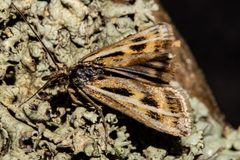
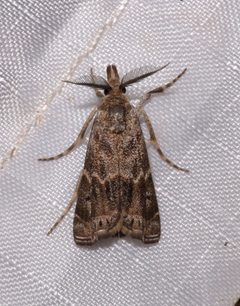
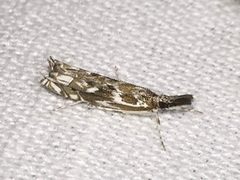
Pronunciation
How to pronounce Crambidae: //ˈkræm.bɪˌdeɪ//
These audio files are automatically generated. While they are not always 100% accurate, they are a good starting point.
Identification
Presence of enlarged, heavily scaled labial palps projecting forward distinguishes Crambidae from most other Lepidoptera . Separation from Pyralidae requires examination of tympanal organs: Crambidae possess praecinctorum joining two tympanic , absent in Pyralidae. identification relies on resting posture (wings folded vs. spread), body shape, and wing pattern. identification often requires dissection of genitalia or examination of wing venation landmarks; geometric morphometry of forewing has been used to distinguish pest species like Ostrinia nubilalis from similar sympatric crambids.
Images
Habitat
Diverse including grasslands, meadows, agricultural fields, wetlands, forests, and aquatic environments. Crambinae strongly associated with grasses (Poaceae). Acentropinae are aquatic or semi-aquatic, with larvae in ponds, streams, and other freshwater habitats. Many occupy human-modified environments including lawns, gardens, and crop fields.
Distribution
Worldwide distribution. Present on all continents except Antarctica. Particularly diverse in tropical regions where undescribed species likely exceed described ones. Well-represented in North America, Europe, Asia, Africa, South America, and Australia. Specific distributions vary by and ; some species have been introduced widely as pests.
Seasonality
Variable by and latitude. Many temperate species have multiple annually (multivoltine), with active spring through fall. Some species overwinter as larvae or pupae; others as adults. periods often correspond to crop for agricultural pests. Tropical species may breed continuously where conditions permit.
Host Associations
- Poaceae (grasses) - larval Primary for Crambinae; larvae are stem borers, root feeders, or foliage feeders
- Buxus sempervirens (common boxwood) - larval for pest Cydalima perspectalis
- Zea mays (corn) - larval for major pest Ostrinia nubilalis
- Saccharum officinarum (sugarcane) - larval for Diatraea saccharalis
- Oryza sativa (rice) - larval for Chilo suppressalis and other rice borers
- Ananas comosus (pineapple) - larval for Sufetula anania root borer
- Cucumis sativus (cucumber) - larval for Diaphania indica
- Sophora secundiflora (Texas mountain laurel) - larval Native for Uresiphita reversalis
- Genista monspessulana (French broom) - larval Non-native for Uresiphita reversalis
- Eichhornia crassipes (water hyacinth) - larval for biocontrol agent Niphograpta albiguttalis
- Myriophyllum spicatum (Eurasian watermilfoil) - larval for biocontrol agent Acentria ephemerella
Life Cycle
Complete : → larva → pupa → . Larval instars typically 5, though variable (5-8 observed in some ). Duration highly temperature-dependent and variable by species: total cycle from 25 days to 25 weeks reported. Some species produce multiple annually; others have extended . occurs in silk webbing, within plant stems, or in soil. Some species form protective silk cases (Acentropinae) or double-layered cocoons for .
Behavior
Crambinae rest with wings folded tightly against grass stems, enhancing . Many are and attracted to light. Some adults are and easily startled from resting positions. Larvae of many species are concealed feeders: stem borers, root borers, or leaf folders. Some larvae feed gregariously in silken webs (Uresiphita reversalis). Acentropinae larvae are aquatic, surviving via air-trapping silk cases or external gills; adult females can remain submerged for hours using air trapped in body hairs and . Some species exhibit (observed in Cydalima perspectalis pupae).
Ecological Role
Larvae function as herbivores, with many specialized on grasses or other plants. Some species are significant agricultural pests causing billions of dollars in crop damage annually. Others serve as biocontrol agents for aquatic plants (Niphograpta albiguttalis, Acentria ephemerella). Acentropinae contribute to freshwater dynamics as aquatic herbivores. serve as prey for birds, bats, and other . Larvae are parasitized by various and flies, including Trichogramma spp. used in .
Human Relevance
Major economic impact as agricultural pests. European corn borer (Ostrinia nubilalis) causes up to $2 billion annually in U.S. damage; other significant pests include sugarcane borer (Diatraea saccharalis), rice borers (Chilo spp.), sod webworms (Crambus spp.), and box tree moth (Cydalima perspectalis). Some used for of plants. Bamboo borer (Omphisa fuscidentalis) larvae consumed as food in some cultures. Several species are harmless or minor pests; mint moth (Pyrausta aurata) noted as non-damaging. Light attraction makes common in surveys and citizen science observations.
Similar Taxa
- PyralidaeHistorically confused with Crambidae; distinguished by absence of praecinctorum in tympanal organs and generally different wing venation patterns. Many 'snout moth' characteristics overlap, requiring dissection for definitive separation.
- NoctuidaeSome crambids, particularly larger Spilomelinae, resemble noctuids in size and wing shape; distinguished by presence of prominent labial palps and different tympanal organ structure.
- GelechiidaeSome micro-crambids resemble gelechiids in size; distinguished by snout-like labial palps and resting posture differences.
Misconceptions
Historical classification as of Pyralidae persists in some literature and online resources; current recognizes Crambidae as distinct . The 'grass moths' applies specifically to subfamily Crambinae, not entire family. Many agricultural pests previously identified as 'Pyralidae' are now correctly placed in Crambidae.
More Details
Systematics
comprises 15 : Acentropinae, Crambinae, Erupinae, Glaphyriinae, Heliothelinae, Hoploscopinae, Lathrotelinae, Linostinae, Midilinae, Musotiminae, Odontiinae, Pyraustinae, Schoenobiinae, Scopariinae, and Spilomelinae. Classification revised by Munroe and Solis (1999).
Taxonomic history
Long treated as Crambinae of Pyralidae. Elevated to status based on tympanal organ (presence of praecinctorum). Some authorities still debate rank, but family-level treatment widely accepted in contemporary literature.
Conservation and discovery
Tropical regions harbor enormous undescribed diversity; possibly >90% of micro-crambid in tropics remain unnamed. New species continue to be discovered in well-studied regions (e.g., Coloradactria frigida described 2025 from Colorado, USA).
Sources and further reading
- BugGuide
- Wikipedia
- GBIF taxonomy match
- iNaturalist taxon
- NCBI Taxonomy
- Catalogue of Life
- Insect Treasures from Papua New Guinea | Bug Squad
- Bug Eric: Moth Monday: Sophora Worm
- Bug Eric: Accidental Achievement
- New Technique May Help Farmers Identify the European Corn Borer
- Brazil Bugs #1 | Beetles In The Bush
- Bug Eric: New Mexico Night Bugs
- Studies on African Crambidae I- a new genus and species from Africa (Pyraloidea: Crambidae: Spilomelinae)
- STATISTIK DEMOGRAFI DIAPHANIA INDICA SAUNDERS (LEPIDOPTERA: CRAMBIDAE)
- Biology of development of Cydalima perspectalis (Lepidoptera: Crambidae) in laboratory conditions
- Biología del barrenador de raíces de piña Sufetula anania (Lepidoptera: Crambidae) Biology of the pineapple root borer Sufetula anania (Lepidoptera: Crambidae)
- Lepidopteran Pests: Family Crambidae (Formerly Pyralidae), Subfamily Crambinae
- Studies on Crambidae VI: <i>Cristabotys<i> <b>gen. nov.<b> a new genus of Spilomelinae from Africa (Lepidoptera: Pyraloidea: Crambidae: Spilomelinae)
- Overview of invasion and control management options of Cydalima perspectalis (Lepidoptera, Crambidae) Pregled invazije i mogućnosti upravljanja kontrolom Cydalima perspectalis (Lepidoptera, Crambidae)
- A New Host-Plant for Larvae of Hellula undalis (Fabricius, 1781) in Turkey (Lepidoptera: Crambidae) Hellula undalis (Fabricius, 1781) Larvaları İçin Türkiye’den Yeni Bir Konukçu Bitki (Lepidoptera: Crambidae)
- Cydalima perspectalis (Walker) (Lepidoptera: Crambidae, Spilomelinae)’in Türkiye’de Coğrafi Yayılışı, Yaşam Döngüsü Ve Zararı Geographic Distribution, Lifecycle and Damage of Cydalima perspectalis (Walker) (Lepidoptera: Crambidae, Spilomelinae) in Turkey
- An annotated checklist of the Crambidae of the region of Murcia (Spain) with new records, distribution and biological data (Lepidoptera: Pyraloidea, Crambidae)
- Biology of Plassey Borer, Chilo Tumidicostalis (Hampson) (Crambidae: Lepidoptera)
- Inheritance and fitness of field-evolved Cry1Fa-resistant Ostrinia nubilalis (Lepidoptera: Crambidae) under laboratory conditions.