
Malacosoma americana
(Fabricius, 1793)
Eastern Tent Caterpillar Moth, Eastern Tent Caterpillar
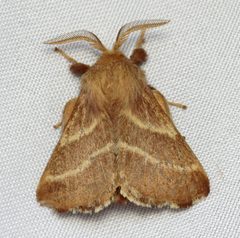
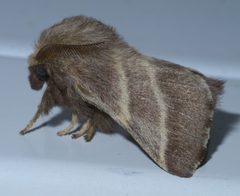
Malacosoma americana is a in the Lasiocampidae, known for its gregarious larval stage that forms conspicuous silken tents in the branches of trees. The caterpillars are social, using chemical communication via to coordinate foraging and recruit nestmates to food sources. exhibit cyclic , with larvae capable of defoliating cherry, apple, and other rosaceous trees. The species overwinters as encircling small branches in foam-like masses, with hatching synchronized to the blooming of forsythia in early spring.
Pronunciation
How to pronounce Malacosoma americana: /ˌmæləkəˈsoʊmə əˌmɛrɪˈkænə/
These audio files are automatically generated. While they are not always 100% accurate, they are a good starting point.
Identification
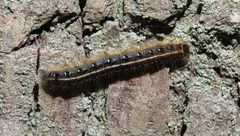
Caterpillars have a white stripe running down the center of the back, flanked by blue stripes and patches on the sides. Larvae are densely hairy, with long setae covering the body. masses are dark brown, Styrofoam-like, and encircle small branches. Tents are constructed in branch crotches and near the trunk, distinct from the terminal-branch webs of fall webworm (Hyphantria cunea) and the scattered nests of gypsy moth (Lymantria dispar).
Images
Habitat
Found in deciduous woodlands, orchards, and suburban landscapes where trees occur. Larvae require trees in the rose (Rosaceae), particularly cherry (Prunus), apple (Malus), and crabapple. Tents are built in branch crotches and near the trunk, with larvae expanding and relocating tents as they grow.
Distribution
Eastern North America, ranging from Canada (Manitoba, Saskatchewan) through the eastern United States. Core range includes the mid-Atlantic region, with extending westward and northward into southern Canada.
Seasonality
, with one per year. hatch in early spring, coinciding with forsythia bloom (March-April). Larval development occurs through spring, with emerging in June-July to mate and lay eggs.
Diet
Larvae feed on leaves of rosaceous trees, primarily cherry (Prunus spp.), apple (Malus spp.), and crabapple. Caterpillars have been observed moving to alternative , including mountain laurel (Kalmia latifolia), when primary hosts are depleted.
Life Cycle
Females deposit in masses of 300+ encircling small branches. Eggs overwinter and hatch with spring warmth. Larvae build silken tents, expanding them as they grow through instars. Late-instar larvae wander from trees to pupate in protected locations under logs, leaves, stones, or structures, spinning yellowish-white silken cocoons. emerge from cocoons, mate, and females lay eggs on small branches of host trees to complete the cycle.
Behavior
Highly social larvae engage in communal tent-building, foraging, and . Caterpillars use trail- from a gland on the to recruit nestmates to food sources. The writhing mass of larvae in tents elevates internal temperature, accelerating growth on cool spring days. Late-instar larvae undergo mass exodus from trees to find sites.
Ecological Role
Larvars serve as significant herbivores that can defoliate trees during years, potentially reducing tree vigor with repeated defoliation. Serve as host for tachinid Leschenaultia exul, which contributes to . Tents may provide microhabitat for other arthropods.
Human Relevance
Considered a pest of cherry and apple orchards and ornamental trees. can strip trees of foliage; management includes physical removal of masses and tents. Burning tents is discouraged due to bark damage. Associated with mare reproductive loss (MRLS) in horses—pregnant mares consuming caterpillars or setae in pasture may abort foals. Subject of citizen science documentation through National Week and iNaturalist.
Similar Taxa
- Malacosoma californicumWestern tent caterpillar occupies western North America and uses similar tent-building , but differs in geographic range and some preferences including desert almond (Prunus fasciculata).
- Malacosoma disstriaForest lacks the central white stripe and builds silken resting mats rather than enclosed tents; also has different range including oaks and aspen.
- Hyphantria cuneaFall webworm constructs loose webs at branch terminals rather than in crotches near the trunk, and has multiple per year with later-season activity.
- Lymantria disparGypsy moth larvae are solitary, do not build tents, and have distinctive paired blue and red spots rather than longitudinal stripes.
Sources and further reading
- BugGuide
- GBIF taxonomy match
- iNaturalist taxon
- Catalogue of Life
- Catch a Glimpse of Caterpillars During National Moth Week
- Get them when they're little - Eastern tent caterpillar, Malacosoma americanum — Bug of the Week
- Hairy wanderers - Eastern tent caterpillars, Malacosoma americanum — Bug of the Week
- Time for tents - Eastern tent caterpillar, Malacosoma americanum — Bug of the Week
- Return of the tent makers - Eastern tent caterpillar, Malacosoma americanum — Bug of the Week
- Tents in the Mojave: Western tent caterpillar, Malacosoma californicum — Bug of the Week
- The Biology of Leschenaultia Exul Townsend, a Tachinid Parasite of Malacosoma Americana Fabricius and Malacosoma Disstria Hubner1