
Hyphantria cunea
(Drury, 1773)
Fall Webworm, Fall Webworm Moth, American White Moth
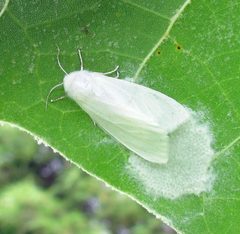
The fall webworm (Hyphantria cunea) is a native to North America, ranging from southern Canada through the United States to northern Mexico. It is best known for its larval stage, in which caterpillars construct large silken webs on the terminal branches of trees during late summer and fall. The exhibits two color races that vary geographically: white moths with black-headed caterpillars predominate in northern , while spotted moths with red-headed caterpillars are more common in the south. Accidentally introduced to Hungary in the 1940s, it has become a destructive pest across Europe and Asia, particularly in China where it is known as the 'North American White Moth.'
Pronunciation
How to pronounce Hyphantria cunea: /hɪˈfæntɹiə ˈkjuːniə/
These audio files are automatically generated. While they are not always 100% accurate, they are a good starting point.
Identification
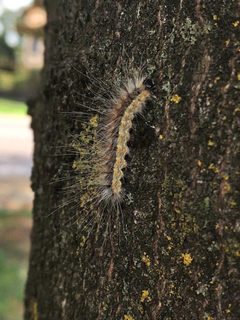
Fall webworm is distinguished from the eastern tent caterpillar (Malacosoma americanum) by web placement and timing: fall webworm webs appear in May–June and again in late summer, enclosing the terminal ends of branches with incorporated foliage, whereas eastern tent caterpillar webs are built in March–April in branch crotches near the trunk and rarely include leaves. Fall webworm caterpillars remain within their web while feeding, unlike tent caterpillars that leave the nest to forage. The two color races of fall webworm are distinguished by larval color (black versus red) and wing pattern (pure white versus spotted).
Images
Habitat
Occurs in deciduous forests, orchards, urban landscapes, and ornamental plantings. In its native range, it is found on a wide variety of hardwood trees. In invaded regions such as China and Turkey, it has established in hazelnut orchards, mulberry plantations, and walnut groves. rates are negatively correlated with altitude.
Distribution
Native to North America: southern Canada, contiguous United States, and northern Mexico. Introduced and in Europe (Hungary, Austria, Czechoslovakia, former Yugoslavia, Romania) and Asia (China, Japan, Turkey). In Turkey, established in Düzce Province and the Black Sea and Marmara regions.
Seasonality
In Maryland and similar temperate regions, two occur annually with peaking in June and August. In southern states such as Georgia and Texas, up to four generations may occur. Adult begins in late spring, with peak larval activity in late summer and fall. occurs as pupae in soil or leaf litter from autumn through early spring.
Diet
Larvae feed on leaves of more than 200 plant , including hardwood trees such as cherry, crabapple, maple, sweet gum, sycamore, pecan, and walnut, as well as some conifers. In invaded regions, significant include hazelnut, mulberry, and walnut.
Host Associations
- Corylus avellana - larval hazelnut, significant in invaded regions
- Morus spp. - larval mulberry, significant in Turkey
- Juglans spp. - larval walnut
- Prunus spp. - larval cherry
- Malus spp. - larval crabapple, apple
- Acer spp. - larval maple
- Liquidambar styraciflua - larval sweet gum
- Platanus spp. - larval sycamore
- Carya illinoinensis - larval pecan
- Gleditsia triacanthos - larval honeylocust, susceptible to related mimosa webworm
Life Cycle
Females lay in masses on leaf undersides. Larvae hatch and immediately construct small silken webs around their natal leaf, later expanding to enclose clusters of leaves and entire branch terminals. Larvae feed gregariously within the web, which provides and protection from natural enemies. After completing development, larvae descend to the ground and pupate in leaf litter or soil. emerge to mate and begin the next . In temperate regions, two generations are typical; in warmer southern regions, three to four generations occur.
Behavior
Larvae exhibit synchronous twitching movements when disturbed. They construct and continuously expand silken webs that enclose foliage, using the web for (internal temperatures may reach 50°C) and avoidance. Caterpillars remain within the web while feeding, unlike related tent caterpillars. Larvae are freeze avoiders, producing cryoprotectants including and antifreeze proteins to survive winter temperatures as pupae in soil or leaf litter .
Ecological Role
Native in North America are regulated by a complex of natural enemies including more than 50 of and 30 species of . Parasitoids include in Eulophidae, Braconidae, Ichneumonidae, and Tachinidae flies; predators include birds, spiders, predatory wasps, assassin bugs, and lacewings. Hyperparasitism affects approximately 50% of parasitoid cocoons within webs in some populations. In invaded regions where natural enemies are absent or reduced, populations can reach levels causing significant defoliation.
Human Relevance
In its native range, primarily an aesthetic pest of ornamental trees; does not typically cause significant harm to healthy trees. In commercial orchards, can reduce productivity but is rarely problematic in well-managed operations. In Europe and Asia, a major forest and agricultural pest causing extensive damage to hazelnut, mulberry, and walnut crops. Control methods include manual removal of webs, pruning infested branches, and application of microbial such as Bacillus thuringiensis or . A native (HycuGV) shows promise as a agent in Turkey.
Similar Taxa
- Malacosoma americanumEastern tent caterpillar builds webs in branch crotches in spring, not terminal branches in late summer; caterpillars leave nest to feed
- Malacosoma disstriaForest lacks enclosed web, feeds in open , and occurs in spring
- Lymantria disparGypsy moth larvae do not construct communal webs and have distinctive paired blue and red
- Homadaula anisocentraMimosa webworm is smaller, specializes on mimosa and honeylocust, and was introduced from Asia rather than being native to North America
Misconceptions
Often mistaken for tent caterpillars or the product of spiders due to the extensive webbing. The name 'fall webworm' leads some to believe it appears only in autumn, but first- emerge in late spring with larvae present from May onward. Despite its destructiveness in Asia and Europe, it is native to North America and not an pest there.
More Details
Color Races
Two distinct color races coexist throughout the range in varying frequencies. The northern race (white , black-headed caterpillar) and southern race (spotted moth, red-headed caterpillar) represent genetically differentiated with continuous .
Thermoregulation
Larvae actively maintain high temperatures within webs, which may reach 50°C (122°F). This behavioral accelerates development and may provide protection from fungal .
Invasion History
Introduced to Hungary in the 1940s, likely via military equipment or shipping. Spread through Europe and into Asia, reaching China where it has become one of the most destructive forest pests, damaging thousands of acres annually.
Viral Pathogens
Subject to (HycuNPV) and (HycuGV) . Chinese isolates of HycuNPV represent a novel Alphabaculovirus with significant genomic diversity from Japanese isolates, suggesting independent evolutionary histories in different invaded regions.
Sources and further reading
- BugGuide
- GBIF taxonomy match
- iNaturalist taxon
- NCBI Taxonomy
- Catalogue of Life
- What do insects do in winter, Part 3? Avoiding the big chill: emerald ash borers, Agrilus plannipenis, ground beetles, Carabidae, fall webworms, Hyphantria cunea — Bug of the Week
- Unwanted Webs: Integrated Pest Management for Fall Webworms
- Worldwide webworm - Fall webworm, Hyphantria cunea — Bug of the Week
- Webworms of the fall - Fall webworm, Hyphantria cunea and mimosa webworm, Homadaula anisocentra — Bug of the Week
- World-wide webworm: Fall Webworm, Hyphantria cunea — Bug of the Week
- Tent caterpillars everywhere? Nah - Fall Webworm, Hyphantria cunea — Bug of the Week
- Hyphantria cunea . [Distribution map].
- HYPERPARASITISM IN POPULATIONS OF HYPHANTRIA CUNEA
- Düzce İlinde Hyphantria cunea (Drury)’nın Yayılış Alanı ile Bulaşma Oranının Belirlenmesi Determination of Distribution and Infestation Rate of Hyphantria cunea (Drury) in Duzce Province
- DISTRIBUTION OF HYPHANTRIA CUNEA DRURY IN THE TERNOPIL REGION
- Genomic analysis of two Chinese isolates of hyphantria cunea nucleopolyhedrovirus reveals a novel species of alphabaculovirus that infects hyphantria cunea drury (lepidoptera: arctiidae)
- The HcCarE6 conferring multi-host adaptation of the Hyphantria cunea: an important target for constructing nucleic acid pesticide
- A viral biopesticide from native Hyphantria cunea granulovirus (HycuGV) to control fall webworm ( Hyphantria cunea , Drury, Lepidoptera: Arctiidae) under field conditions
- Amerikan beyaz kelebeği, Hyphantria cunea (Drury) (Lepidoptera: Arctiidae)’nın ergin popülasyon takibi ile biyolojik mücadelesinde parazitoit ve predatörlerinin belirlenmesi Determination of adult population monitoring with parasitoids and predators in biological control of the Fall webworm, Hyphantria cunea (Drury) (Lepidoptera: Arctiidae)
- Life History and the Relation Between Population Dynamics and Meteorological Factors of Hyphantria cunea (Lepidoptera: Erebidae: Arctiidae) in Shanghai, China
- The involvement of human factors brings new findings for predicting global suitability habitat for Hyphantria cunea (Lepidoptera: Arctiidae)