
Hyphantria
Harris, 1841
fall webworm moths
Species Guides
1- Hyphantria cunea(Fall Webworm)
Hyphantria is a of tiger moths in the Erebidae, established by Thaddeus William Harris in 1841. The genus contains approximately five , with Hyphantria cunea (fall webworm) being the most widely known due to its economic and ecological significance. Species in this genus are primarily native to North and Central America, though H. cunea has been accidentally introduced to Europe and Asia, where it has become a significant pest. The genus is characterized by larvae that construct communal silk webs for feeding and protection.
Pronunciation
How to pronounce Hyphantria: //hɪˈfæntɹiə//
These audio files are automatically generated. While they are not always 100% accurate, they are a good starting point.
Identification
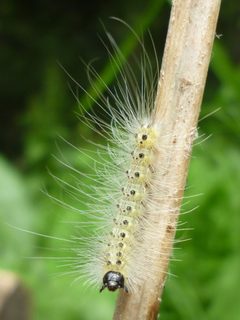
can be distinguished from similar white by their relatively plain wing pattern and association with larval web structures. Larvae are distinguished from eastern tent caterpillars (Malacosoma spp.) by their placement of webs on branch terminals rather than in branch crotches, and by their habit of feeding within the web rather than leaving to feed. The two color races of H. cunea (white moths with black-headed larvae vs. spotted moths with red-headed larvae) occur sympatrically but vary in frequency geographically.
Images
Appearance
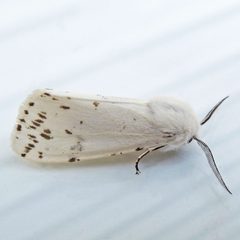
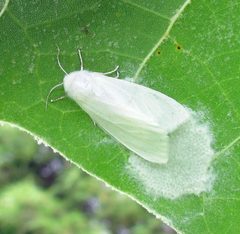
are typically white or pale in coloration. Hyphantria cunea exhibits two distinct color races: one with pure white wings and another with spotted or mottled wings. Larvae are hairy caterpillars with rows of dark or spots along the surface. coloration varies between races—black in the northern race and red or orange in the southern race. Body coloration ranges from pale yellow to greenish-gray, covered with long, silky setae.
Habitat
Native inhabit deciduous forests, orchards, and ornamental landscapes across North and Central America. Larvae feed on a broad range of hardwood trees and some conifers. In invaded regions (Europe and Asia), they occupy similar including urban parks, forest edges, and agricultural areas. The introduced in China has become particularly problematic in forest .
Distribution
Native range: North America (southern Canada through the United States to northern Mexico) and Central America. Introduced range: Europe (first recorded in Hungary in the 1940s, now present in Austria, Czech Republic, Romania, Yugoslavia, and other countries), and Asia (Japan, China, and surrounding regions). In China, the was first reported in Liaoning Province and has spread extensively southward.
Seasonality
In temperate North America, emerge in spring and early summer, with peak activity in June and August corresponding to two . A second generation occurs in July–September. In southern states (Georgia, Texas), up to four generations may occur annually. In invaded regions such as Turkey, adult show peaks in June and August. occurs as pupae in soil or leaf litter.
Diet
Larvae are highly , feeding on leaves of more than 200 plant including hardwood trees (cherry, crabapple, maple, sweet gum, sycamore, walnut, pecan, redbud) and some conifers. In Turkey, significant damage has been documented in hazelnut orchards. do not feed.
Host Associations
- Corylus - larval food planthazelnut; significant agricultural in Turkey
- Morus - larval food plantmulberry; in invaded range
- Juglans - larval food plantwalnut
- Cercis - larval food plantredbud
- Liquidambar - larval food plantsweet gum
- Platanus - larval food plantsycamore
- Carya - larval food plantpecan
Life Cycle
Females lay hundreds of on undersides of leaves. Larvae hatch and immediately construct small silk webs around their natal leaf, expanding the web to incorporate additional leaves and branches as they grow. Larvae feed gregariously within the protective web. Late instar larvae descend to the ground to pupate in leaf litter, soil cracks, or other protected locations. Pupae overwinter, with emerging the following spring. In temperate regions, two are typical; in southern areas, three to four generations occur.
Behavior
Larvae exhibit synchronized twitching movements when disturbed, possibly as a defensive display. They construct expansive communal silk webs that serve multiple functions: (internal temperatures can reach 50°C), protection from and , and creating a confined feeding area. Webs are typically constructed at branch terminals and expanded progressively. Larvae are freeze-avoiders, producing cryoprotectants including and antifreeze proteins to survive winter temperatures.
Ecological Role
Native are regulated by diverse natural enemy including over 50 of and 30 species of in North America. These include (Polistes, yellowjackets), assassin bugs (Reduviidae), spiders, and birds. Parasitoids include species in Ichneumonidae, Braconidae, Eulophidae, Tachinidae, and Trichogrammatidae. The species serves as a for (HycuNPV) and (HycuGV) used as agents. In invaded regions, the absence of co-evolved natural enemies contributes to populations.
Human Relevance
Native are generally benign, causing minor defoliation that healthy trees tolerate. In ornamental settings, webs are considered unsightly. In invaded regions (particularly China), H. cunea has become one of the most destructive forest pests, damaging thousands of acres annually. It is known as the "North American White " in China. Management approaches include physical removal of webs, pruning infested branches, and application of microbial (Bacillus thuringiensis, HycuNPV, HycuGV) or synthetic insecticides. The has been studied extensively for and development.
Similar Taxa
- Malacosoma americanumEastern tent caterpillar constructs webs in branch crotches rather than terminals, appears in early spring (March–April), and leaves webs to feed; fall webworm webs enclose foliage and larvae feed within
- Malacosoma disstriaForest lacks a complete tent structure, has distinctive pattern of keyhole-shaped spots, and occurs earlier in season
- Lymantria disparGypsy moth larvae are solitary rather than gregarious, do not construct communal webs, and have distinctive paired blue and red
Misconceptions
Frequently mistaken for "tent caterpillars," though the two groups differ in web placement, seasonality, and feeding . Often perceived as highly damaging to tree health, though native rarely cause significant harm to otherwise healthy trees; damage is primarily aesthetic. The name "fall webworm" refers to the late-season appearance of the more visible second , not a single autumn generation.
More Details
Color Races
Hyphantria cunea exhibits two genetically distinct color races that coexist throughout the range with geographic variation in frequency. The northern race (more common in northern latitudes) has pure white and black-headed larvae. The southern race (predominant in southern regions) has spotted or mottled wing patterns and red-headed larvae. Both races are fully interfertile.
Cold Hardiness
pupae employ freeze-avoidance strategies, eliminating ice-nucleating agents from their bodies and accumulating cryoprotectant compounds including and antifreeze proteins. This physiological allows survival of subfreezing temperatures in temperate and climates.
Hyperparasitism
In eastern Canada, approximately 50% of cocoons within fall webworm webs are attacked by hyperparasitoids, though this rate varies dramatically year-to-year in ways not correlated with or parasitoid .
Sources and further reading
- BugGuide
- Wikipedia
- GBIF taxonomy match
- iNaturalist taxon
- NCBI Taxonomy
- Catalogue of Life
- What do insects do in winter, Part 3? Avoiding the big chill: emerald ash borers, Agrilus plannipenis, ground beetles, Carabidae, fall webworms, Hyphantria cunea — Bug of the Week
- Worldwide webworm - Fall webworm, Hyphantria cunea — Bug of the Week
- Webworms of the fall - Fall webworm, Hyphantria cunea and mimosa webworm, Homadaula anisocentra — Bug of the Week
- World-wide webworm: Fall Webworm, Hyphantria cunea — Bug of the Week
- Tent caterpillars everywhere? Nah - Fall Webworm, Hyphantria cunea — Bug of the Week
- Unwanted Webs: Integrated Pest Management for Fall Webworms
- Hyphantria cunea . [Distribution map].
- HYPERPARASITISM IN POPULATIONS OF HYPHANTRIA CUNEA
- Düzce İlinde Hyphantria cunea (Drury)’nın Yayılış Alanı ile Bulaşma Oranının Belirlenmesi Determination of Distribution and Infestation Rate of Hyphantria cunea (Drury) in Duzce Province
- DISTRIBUTION OF HYPHANTRIA CUNEA DRURY IN THE TERNOPIL REGION
- Genomic analysis of two Chinese isolates of hyphantria cunea nucleopolyhedrovirus reveals a novel species of alphabaculovirus that infects hyphantria cunea drury (lepidoptera: arctiidae)
- A viral biopesticide from native Hyphantria cunea granulovirus (HycuGV) to control fall webworm ( Hyphantria cunea , Drury, Lepidoptera: Arctiidae) under field conditions
- The HcCarE6 conferring multi-host adaptation of the Hyphantria cunea: an important target for constructing nucleic acid pesticide
- Amerikan beyaz kelebeği, Hyphantria cunea (Drury) (Lepidoptera: Arctiidae)’nın ergin popülasyon takibi ile biyolojik mücadelesinde parazitoit ve predatörlerinin belirlenmesi Determination of adult population monitoring with parasitoids and predators in biological control of the Fall webworm, Hyphantria cunea (Drury) (Lepidoptera: Arctiidae)
- Life History and the Relation Between Population Dynamics and Meteorological Factors of Hyphantria cunea (Lepidoptera: Erebidae: Arctiidae) in Shanghai, China
- The involvement of human factors brings new findings for predicting global suitability habitat for Hyphantria cunea (Lepidoptera: Arctiidae)