
Arctiini
Leach, [1815]
Tiger Moths
Tribe Guides
7- Arctiina
- Callimorphina(woolly bear moths)
- Ctenuchina(Handmaidens)
- Euchromiina(Wasp Moths)
- Pericopina(pericopine tiger moths)
- Phaegopterina
- Spilosomina
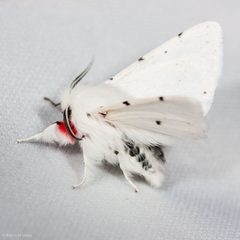
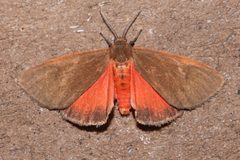
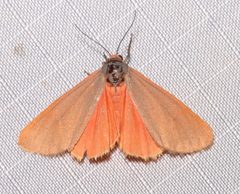
Arctiini is a tribe of tiger moths within the Arctiinae of the Erebidae. Formerly treated as the subfamily Arctiinae within the family , this group was reclassified in a major taxonomic revision that lowered its rank while retaining its constituent members. The tribe comprises numerous organized into nine recognized subtribes: Arctiina, Callimorphina, Ctenuchina, Euchromiina, Micrarctiina, Nyctemerina, Pericopina, Phaegopterina, and Spilosomina, with additional genera remaining incertae sedis. Arctiini exhibit striking aposematic coloration and many engage in acoustic or chemical defensive signaling.
Pronunciation
How to pronounce Arctiini: //ɑːrkˈtaɪ.ɪˌnaɪ//
These audio files are automatically generated. While they are not always 100% accurate, they are a good starting point.
Identification
Arctiini can be distinguished from other Arctiinae tribes by the combination of tymbal organs capable of producing ultrasonic clicks (in many ), forewing venation with M2 and M3 arising separately from the , and male genitalia typically featuring a well-developed uncus and gnathos. Members often display bold contrasting patterns of black, white, red, orange, or yellow. Many species possess dense hair-like on the body and wings. The subtribes within Arctiini are distinguished primarily by genitalic characters and wing pattern elements; for example, Ctenuchina typically exhibit metallic coloration and -mimicry, while Spilosomina often show spotted or striped patterns with prominent hindwing coloration.
Images
Habitat
Arctiini occupy diverse across their range, including tropical and subtropical rainforests, savannas, temperate woodlands, grasslands, and montane regions. In the Neotropics, they are particularly abundant in forested areas and savanna fragments. Some species have adapted to disturbed and anthropogenic environments.
Distribution
Global distribution with highest diversity in tropical and subtropical regions, particularly the Neotropics. Documented from North America (including the Great Basin), Central America, South America (extensively surveyed in Brazil including Amazon and Cerrado biomes, and the state of Maranhão), the Caribbean, and the Antilles. The Ptychotrichos is to the Neotropical region. such as Apantesis eureka are endemic to the Great Basin of western North America.
Diet
Larvae of Arctiini feed on a wide variety of plant materials. Specific documented associations include: Clematis stems (for clearwing moth relatives in related groups); oleander (Nerium oleander) for Empyreuma affinis; grape (Vitis spp.) and Virginia creeper (Parthenocissus quinquefolia) for related ; and various woody and herbaceous plants across different subtribes. Many species are feeders as larvae.
Host Associations
- Nerium oleander - larval food plantFor Empyreuma affinis; larvae sequester cardiac glycosides
- Vitis spp. - larval food plantDocumented for related clearwing and tiger moth
- Parthenocissus quinquefolia - larval food plantVirginia creeper, used by grape-feeding
Behavior
Many Arctiini produce ultrasonic clicking sounds using tymbal organs as a defense against bat ; these clicks may jam bat echolocation or serve as aposematic warnings. Some species engage in acoustic duets during courtship, such as reciprocal calling between males and females. Other species rely on chemical communication, with females releasing detected by males using feathery . of many species are or , particularly in the tropics, and visit flowers for nectar. Defensive include of frothy containing noxious compounds, and -mimicry patterns in day-flying species.
Ecological Role
Arctiini larvae function as herbivores in diverse plant , with some contributing to nutrient cycling in savanna and forest . Their of plant toxins makes them important mediators of chemical defense transfer through . serve as for and flowering plants. The tribe represents a significant food resource for bats, birds, and other , with their anti- adaptations influencing predator-prey dynamics in many ecosystems.
Human Relevance
Arctiini includes of economic importance as defoliators of ornamental plants, particularly oleander (Empyreuma affinis and Syntomeida epilais). Some species are valued in ecological research for their sophisticated anti-bat defenses and mimicry systems. The bright coloration of many species makes them popular subjects for nature photography and ecotourism. Larvae of some species are known as "woolly bears" and are familiar to the public, though often misidentified.
Similar Taxa
- Sesiidae (clearwing moths)Both groups include -mimicking with habits; distinguished by Sesiidae having clear wings with reduced scaling and different wing venation, plus larval boring habits in stems rather than external feeding
- Zygaenidae (leaf skeletonizer moths)Both contain aposematic, with chemical defenses; Zygaenidae lack tymbal organs, have different larval feeding habits (skeletonizing leaves), and possess cyanide-producing glands not found in Arctiini
- Other Arctiinae tribesDistinguished by genitalic , particularly structure of male uncus and valvae, and by differences in tymbal organ development and acoustic signaling capabilities
Misconceptions
The name "woolly bear" is commonly applied to Arctiini larvae, but this leads to confusion with other hairy caterpillars. Internet sources frequently misidentify Arctiini as pests of sheep or wool; these do not feed on animal materials. The spotted oleander caterpillar moth (Empyreuma affinis) is often confused with the polka-dot wasp moth (Syntomeida epilais), but differs in larval spotting pattern and geographic origin. Many sources incorrectly state that all tiger moths are , when numerous tropical species are strictly .
Sources and further reading
- BugGuide
- Wikipedia
- iNaturalist taxon
- NCBI Taxonomy
- Catalogue of Life
- Sheep Moths Draw Attention at Bohart Museum of Entomology Open House | Bug Squad
- Oh, What a (Moth) Night This Will Be! A Conversation With Bohart's Lepidoptera Curator Jeff Smith | Bug Squad
- Don't Miss Bohart Museum Open House on Nov. 2 | Bug Squad
- Take 2 on tropical tiger moths: Spotted oleander caterpillar moth, Empyreuma affinis — Bug of the Week
- Notodontidae | Beetles In The Bush
- Bug Eric: Wasp Wednesday: Not Wasp VIII
- Revision of the Neotropical moth genus Ptychotrichos Schaus (Lepidoptera, Erebidae, Arctiinae, Arctiini, Ctenuchina)
- Rediscovery of Apantesis eureka (Erebidae: Arctiinae: Arctiini): Contributions to the Distribution and Biology of a Great Basin Endemic
- An annotated catalogue of the Phaegopterina (Erebidae, Arctiinae, Arctiini) of state of Maranhão, Brazil
- Arctiini Leach, [1815] (Lepidoptera, Erebidae, Arctiinae) in a savanna areas of the Environmental Protection Area Alter do Chão, Santarém, Pará, Brazil
- Comparative morphology and taxonomy of the tiger moth genus Epanycles Butler (Lepidoptera, Erebidae, Arctiinae, Arctiini, Ctenuchina), with notes on related genera