
Pericopina
Walker, 1869
pericopine tiger moths, pericopines
Genus Guides
5Pericopina is a subtribe of tiger moths within the Erebidae, established by Francis Walker in 1869. Members are characterized by striking coloration patterns and participation in Müllerian mimicry rings, particularly involving black with white spots or transparent wing patches. The group exhibits notable and , with multiple distinct morphs occurring within single species. Larval associations include Malpighiaceae and Bromeliaceae, though these appear to be partitioned among different species groups.
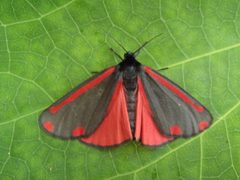
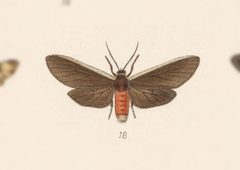
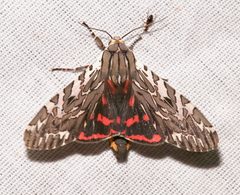
Pronunciation
How to pronounce Pericopina: /ˌpɛrɪkoʊˈpaɪnə/
These audio files are automatically generated. While they are not always 100% accurate, they are a good starting point.
Identification
Members of Pericopina can be distinguished from other tiger moth subtribes by their participation in specific mimetic rings involving black-and-white coloration. within the subtribe show pronounced and , with males and females often displaying dramatically different wing patterns. Some species possess transparent patches on the wings. The subtribe was historically classified as Pericopinae of , and its constituent have undergone substantial taxonomic revision.
Images
Distribution
Widespread in the Neotropical region, with documented occurrence in Trinidad, West Indies, and throughout South America. Some such as Calodesma militta are broadly distributed across South America, while others have more restricted ranges (e.g., Calodesma pseudocollaris known only from Trinidad).
Diet
Larvae feed on either Malpighiaceae or Bromeliaceae; plant associations appear to be split between these two plant across different groups.
Host Associations
- Malpighiaceae - larval plantdocumented for some in the group
- Bromeliaceae - larval plantdocumented for some in the group
Life Cycle
Larvae are known to feed on Malpighiaceae or Bromeliaceae, though more research is needed to define differences between . are frequently observed feeding on white Asteraceae flowers.
Behavior
of some are rather than . Members participate in Müllerian mimicry rings, particularly involving black species with white spots or transparent wing patches. Multiple male and female morphs occur within single species, with up to two male morphs and two or more female morphs documented in Calodesma militta.
Ecological Role
Participation in Müllerian mimicry rings, where unpalatable or defended converge on similar warning coloration. The loose mimicry ring of black species with white spots or transparent patches represents a significant component of Neotropical lepidopteran structure.
Similar Taxa
- Other Arctiini subtribesPericopina differs in its characteristic participation in black-and-white mimicry rings and pronounced with multiple morphs per
- Former Pericopinae classificationPreviously treated as a of ; now classified as subtribe within Arctiini of Erebidae based on phylogenetic revisions
More Details
Taxonomic history
Originally described as a Pericopinae of , the group was reclassified as subtribe Pericopina within Arctiini of Erebidae following major revisions of tiger moth . Recent work has involved substantial generic reorganization, including the synonymy of Thyrgis with Calodesma and reinstatement of Seileria.
Mimicry research significance
The Calodesma within Pericopina has become a model system for studying Müllerian mimicry and , with used to associate sexes and morphs that were previously described as separate .
Sources and further reading
- BugGuide
- Wikipedia
- iNaturalist taxon
- Illustrated catalogue of Pericopina (Lepidoptera, Erebidae, Arctiinae) in the Museum of Nature Hamburg – Zoology
- Using DNA barcodes to test the association of sexes and morphs in Calodesma spp. (Lepidoptera, Erebidae, Arctiinae, Arctiini, Pericopina) of Trinidad, West Indies, with an overview of the genus, taxonomic changes and a new species