
Apantesis
Walker, 1855
tiger moths
Species Guides
34- Apantesis allectans
- Apantesis anna(Anna tiger moth)
- Apantesis arge(Arge Moth)
- Apantesis behrii
- Apantesis blakei(Blake's Tiger Moth)
- Apantesis bolanderi
- Apantesis carlotta(Carlotta's tiger moth)
- Apantesis carlotta-nais-phalerata-vittata
- Apantesis doris(Doris tiger moth)
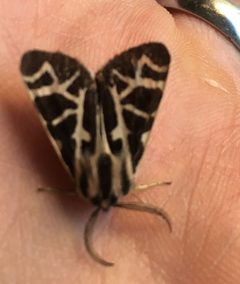
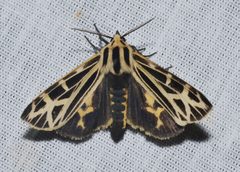
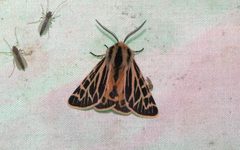
Apantesis is a of tiger moths in the Erebidae, first described by Francis Walker in 1855. Following phylogenetic research published in 2016, the genera Grammia, Holarctia, and Notarctia were merged into Apantesis, substantially expanding its . The genus is found in North and Central America, with some documented in other regions including Iraq. Members are characterized by bold color patterns typical of tiger moths, including striped forewings and often brightly colored that serve as aposematic signals.
Pronunciation
How to pronounce Apantesis: /əˈpantəsɪs/
These audio files are automatically generated. While they are not always 100% accurate, they are a good starting point.
Identification
within Apantesis can be challenging to distinguish due to the taxonomic reorganization that absorbed multiple formerly separate . The genus is characterized by tiger moth coloration: typically bold black-and-white or black-and-cream striped forewings, often with red, orange, or yellow abdominal markings. Following the 2016 revision, specimens previously identified as Grammia, Holarctia, or Notarctia should now be referred to Apantesis. Species-level identification requires examination of genitalia and detailed wing pattern analysis.
Images
Habitat
Specimens have been collected from diverse including mulberry trees, clover plants, and wooded areas with cliffs. The occurs in natural and semi-natural environments, with some associated with prairie and grassland .
Distribution
North and Central America. Documented in the United States (including Colorado, Kansas, Missouri, Florida, and Vermont), Mexico, and Central America. Also recorded in Baghdad, Iraq, though this may represent an introduced or misidentified . The was formerly restricted to certain regions before the 2016 taxonomic expansion incorporated from previously separate genera.
Seasonality
are active during warmer months. In the Front Range of Colorado, observations peak in mid- to late June and mid-September. National Week records from July indicate summer activity. In Florida, hybridization studies suggest year-round activity in subtropical regions.
Behavior
are attracted to ultraviolet and mercury vapor lights at night. Larvae of the are noted for their hairy appearance. Some exhibit defensive compound and aposematic coloration.
Ecological Role
As tiger moths, members contribute to pollination and serve as prey for bats, birds, and . Larvae function as herbivores in their respective . The has been described as having economic significance, though specific impacts for Apantesis are not well documented.
Human Relevance
Subject of entomological research, particularly regarding hybridization between . Featured in citizen science events such as National Week. The 2016 taxonomic revision has required updates to museum collections and field guides.
Similar Taxa
- GrammiaFormerly recognized as a separate of tiger moths, now synonymized with Apantesis following 2016 phylogenetic research. Specimens previously identified as Grammia should be reassigned to Apantesis.
- HolarctiaFormerly recognized as a separate , merged into Apantesis in 2016 based on molecular phylogenetic evidence.
- NotarctiaFormerly recognized as a separate containing such as N. proxima (Mexican Tiger Moth), now incorporated into Apantesis.
Sources and further reading
- BugGuide
- Wikipedia
- GBIF taxonomy match
- iNaturalist taxon
- NCBI Taxonomy
- Catalogue of Life
- Bug Eric: National Moth Week 2021 Review
- Bug Eric: Remembering National Moth Week 2018
- Sphingidae | Beetles In The Bush | Page 2
- Bug Eric: October 2018
- The Moth and Me | Beetles In The Bush
- Saturniidae | Beetles In The Bush | Page 2
- Biology and Hybridization of Apantesis phalerata and A. radians (Lepidoptera: Arctiidae)1
- External Morphological Study of Apantesis Carlotta Ferguson, 1985 Arctiidae-Lepidoptera-Insect in Baghdad, IRAQ
- Rediscovery of Apantesis eureka (Erebidae: Arctiinae: Arctiini): Contributions to the Distribution and Biology of a Great Basin Endemic
- Biology and hybridization of Apantesis phalerata (Harris) and A. radians Walker in Florida (Lepidoptera: Arctiidae) / by Jack Stangl Bacheler.