
Apantesis anna
(Grote, 1863)
Anna tiger moth
A tiger moth described by Augustus Radcliffe Grote in 1863. are active from May to July and are attracted to light. The species was transferred from the Grammia to Apantesis during a taxonomic reorganization of tiger moth genera.
Pronunciation
How to pronounce Apantesis anna: /æˈpæn.tə.sɪs ˈæn.ə/
These audio files are automatically generated. While they are not always 100% accurate, they are a good starting point.
Identification
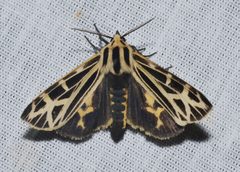
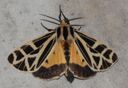
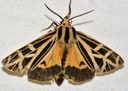
Distinguished from similar tiger moths by the combination of black forewings with yellowish to cream-colored lines and bright yellow hindwings with a broad black border. The two to three pale lines extending inward from the on the forewings are a key diagnostic feature.
Images
Appearance
Wingspan 40–53 mm. Forewings black with thick and thin yellowish to cream-colored lines, including two to three pale lines extending inward from the . Hindwings bright yellow with a broad black border and a black spot near the costa.
Distribution
Eastern and central North America: from Maine south to the mountains of North Carolina, west to Nebraska and Arkansas.
Seasonality
on wing from May to July.
Diet
Larvae feed on a wide variety of low-growing plants, including clover (Trifolium spp.) and plantain (Plantago spp.).
Similar Taxa
- Grammia speciesFormerly classified in the same ; Apantesis anna was moved from Grammia to Apantesis during taxonomic reorganization
- Other Apantesis speciesShare similar tiger moth and coloration patterns; identification requires examination of forewing line patterns and hindwing coloration
Sources and further reading
- BugGuide
- Wikipedia
- iNaturalist taxon
- NCBI Taxonomy
- Catalogue of Life
- A Dragonfly to Behold: Within an Arm's Reach | Bug Squad
- Meet Two Outstanding Entomology Graduating Seniors at UC Davis | Bug Squad
- Famous Female Entomologists Part 2: Anna Botsford Comstock
- Bug Eric: Remembering National Moth Week 2018
- Bug Eric: National Moth Week 2021 Review
- Notodontidae | Beetles In The Bush