
Apantesis doris
(Boisduval, 1869)
Doris tiger moth
Apantesis doris, commonly known as the Doris tiger moth, is a of tiger moth in the Erebidae. It was first described by Jean Baptiste Boisduval in 1869. The species exhibits a transcontinental distribution across North America, with in the western region (British Columbia, Alberta, northern Idaho, and western Montana) and eastern populations spanning from Atlantic Canada to Florida and west to central Texas. The species was transferred from the Grammia to Apantesis as part of a broader taxonomic reclassification involving multiple genera.
Pronunciation
How to pronounce Apantesis doris: /əˈpæntəsɪs ˈdɔːrɪs/
These audio files are automatically generated. While they are not always 100% accurate, they are a good starting point.
Identification
The can be distinguished from similar Apantesis and Grammia species by its specific geographic distribution and preferences. The forewing length of approximately 19 mm provides a measurable character for identification. Accurate identification to species level within this complex may require examination of genitalia or other microscopic features not detailed in available sources.
Images
Appearance
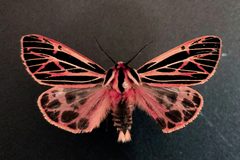
have forewings approximately 19 mm in length. As a tiger moth in the Arctiinae, the likely displays the characteristic bold coloration patterns typical of the group, though specific wing pattern details are not documented in available sources.
Habitat
Open willow/sedge fens and other open wetlands within the forest. The shows a strong association with wetland , particularly those dominated by willow and sedge vegetation.
Distribution
North America: western in British Columbia, northern Idaho, Alberta, and western Montana; eastern populations in Atlantic Coast provinces, Nova Scotia to northern Florida, and west to central Texas.
Seasonality
are active from June to August.
Diet
Larvae feed on various herbaceous plants, including Lactuca sativa (lettuce) and Taraxacum officinale (dandelion). feeding habits are not documented.
Host Associations
- Lactuca sativa - larval food plantcultivated lettuce
- Taraxacum officinale - larval food plantcommon dandelion
Life Cycle
Complete with , larval, pupal, and stages. Specific details of egg laying, larval instars, sites, and stage are not documented in available sources.
Ecological Role
Larvae function as herbivores in wetland , consuming herbaceous vegetation. The contributes to the as prey for various , though specific predator relationships are not documented.
Human Relevance
The has been documented feeding on cultivated lettuce (Lactuca sativa), indicating potential minor agricultural interaction. The species is named in honor of Doris Brown, wife of entomologist and collector Bill Patterson, who donated extensively to the Bohart Museum of Entomology at UC Davis.
Similar Taxa
- Apantesis phalerataSimilar tiger moth in the same with overlapping eastern distribution; distinguished by specific wing pattern and genitalia differences not detailed in available sources
- Grammia species (now Apantesis)Formerly classified in the same ; taxonomic revision moved multiple to Apantesis, requiring careful examination to distinguish among formerly Grammia species
More Details
Taxonomic history
Originally described as Chelonia doris by Boisduval in 1869, later transferred to Grammia, and subsequently moved to Apantesis along with from Grammia, Holarctia, and Notarctia as part of a taxonomic reclassification.
Subspecies
Two are recognized: Apantesis doris doris (nominate subspecies) and Apantesis doris minea (Slosson, 1892).