
Apantesis phalerata
Harris, 1841
Harnessed Tiger Moth
Apantesis phalerata, commonly known as the Harnessed Tiger Moth, is a of tiger moth in the Erebidae. are active in early spring, from late March to early May. The species is , with larvae feeding on various herbaceous plants including dandelion, plantain, and grasses. It is known to hybridize with the closely related A. radians under both natural and experimental conditions.
Pronunciation
How to pronounce Apantesis phalerata: /əˈpænˌθiːs fəˈlɛrətə/
These audio files are automatically generated. While they are not always 100% accurate, they are a good starting point.
Identification
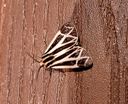
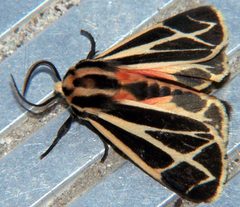
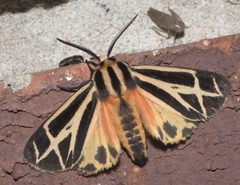
The Harnessed Tiger Moth can be distinguished from similar by its characteristic forewing pattern: white or cream-colored wings with bold black longitudinal stripes, giving a 'harnessed' appearance. The hindwings are typically pink or red with black spots. It closely resembles Apantesis radians, with which it hybridizes; precise identification may require examination of genitalia or molecular analysis in areas of sympatry.
Images
Habitat
Open fields, meadows, and grassy areas where larval plants grow. Found in a variety of open from lowland areas to upland meadows.
Distribution
Eastern North America, from Ontario, Quebec and Maine south to Florida, west to Texas, and north to South Dakota.
Seasonality
; active from late March to early May. period is relatively brief and early in the growing season.
Diet
Larvae feed on herbaceous plants including dandelion (Taraxacum), plantain (Plantago), and various grasses. do not feed.
Host Associations
- Taraxacum (dandelion) - larval plant
- Plantago (plantain) - larval plant
- various grasses - larval plant
Life Cycle
(one per year). are laid in spring. Larvae develop through summer, feeding on plants. occurs in fall, with emerging the following spring. Overwinters as pupa.
Behavior
are and attracted to light. The is known to hybridize with A. radians where ranges overlap.
Ecological Role
Herbivore as larva. do not feed and thus have limited direct ecological role, though they may serve as prey for various .
Human Relevance
Occasionally encountered by naturalists and enthusiasts during early spring surveys. Used in studies of hybridization and speciation due to its documented hybridization with A. radians.
Similar Taxa
- Apantesis radiansClosely related with which A. phalerata hybridizes; morphologically similar and sympatric in parts of range
- Other Apantesis speciesSimilar tiger moth patterning; may require genitalia examination for definitive identification
Sources and further reading
- BugGuide
- GBIF taxonomy match
- iNaturalist taxon
- NCBI Taxonomy
- Catalogue of Life
- Meloidae Holdings | Entomology Research Museum
- Bug Eric: National Moth Week 2021 Review
- Bug Eric: Remembering National Moth Week 2018
- Sphingidae | Beetles In The Bush | Page 2
- Bug Eric: October 2018
- The Moth and Me | Beetles In The Bush
- Biology and Hybridization of Apantesis phalerata and A. radians (Lepidoptera: Arctiidae)1
- Biology and hybridization of Apantesis phalerata (Harris) and A. radians Walker in Florida (Lepidoptera: Arctiidae) / by Jack Stangl Bacheler.